With the World Cup upon us this summer and the LA Olympics just two years away, the issue of housing and living accommodations has become a major topic of discussion.
With travelers flocking from around the world, we see people searching for hotels, apartments, and homes to rent in many of our major cities throughout Los Angeles and the South Bay. It was no coincidence that in June 2025, Airbnb and FIFA announced a multi-tournament partnership moving into the future. It is reported that over 380,000 guests are expected to use Airbnb for their housing needs during the World Cup 2026, generating an estimated impact of $3.6 billion for the local economies of host cities.
To examine how this will impact local housing, we will touch on what we are hearing and seeing in our own communities. To add some background, our own Peter Hazdovac has been named the committee chairman for Croatia House in San Pedro for LA28. This group, selected by LA City Councilmember Tim McOsker, is composed of individuals ranging from local government, the Port of LA, Chamber of Commerce, and other community advocates.
A country’s “House” is not a place where they actually sleep, but more a location for each country to share their culture, traditions, gastronomy, etc., with the Olympic spirit in mind. In our coastal town, this will feel more like a pavilion on our waterfront, with viewing screens and a place for the public to come together to celebrate athletes competing, while also hosting various community events.
San Pedro was the first city in LA to be named a “House” for a select country for LA28, and, with the large Croatian community, it is a perfect fit. As you can imagine, this will also attract people from around the world, boost our community’s economy, and offer a golden opportunity to share our fantastic town with many. But where will everyone sleep?
Eighteen months into our planning for LA28, we have come to realize that our options for short-term housing are extremely limited. We can also connect this on a broader economic scale, which exposes our lack of housing inventory and availability of new housing. This has been an ongoing theme in our past articles and is one of the primary reasons why our local housing prices remain stable.
To add to our need for local housing solutions, San Pedro’s outer harbor was named the sailing venue for LA28, which will attract another group of worldwide travelers coming to train, prepare, and eventually compete. These sailing teams do not just come for the actual Olympics; they begin traveling to the competition locations months and years in advance to acclimate to the conditions they will face in a real competition. With hotels in our area hovering at a 3-star level and prices rising due to high demand, travelers are looking for alternatives, especially those staying for longer periods.
So how can you possibly get involved, support, or even monetize these events coming to our area? Some home and condo owners are looking at this as an opportunity to jump into short-term rentals. Although you must meet certain criteria to rent a furnished property, the rents an owner can fetch for these events can sometimes be two to four times higher than the normal rents for long-term tenant rentals.
With ever-changing landlord-tenant laws in Los Angeles, we are hearing of more owners turning away from traditional rental models and considering the unique opportunities this presents. Have an Airbnb or furnished rental you would like to share with our local Olympic planning committee? Please email us at info@hhcoastal.com, and we can add it to our internal list of potential available housing. spt
I wrote at the end of December that San Pedrans should prepare for a rough 2026, and here we are, in March, and we’ve already lost four institutions.
The first was The Bike Palace, in the 1600 block of Pacific Avenue, consumed by fire on December 23. Opened in 1973 by San Pedro luminary Matty Domancich, The Bike Palace, along with the nearby King’s Bicycle Store, was the go-to place for all things bicycle-oriented.
The second institution was El Taco, the fast-food eatery that’s been on the corner of Ninth and Pacific since 1958, which closed its doors for good at the end of the year. I can’t personally vouch for the food (my high school hangout was the Taco Bell at Crestwood and Western). Still, El Taco was a mainstay for generations of San Pedrans craving something quick and spicy or just satisfying a case of the munchies.
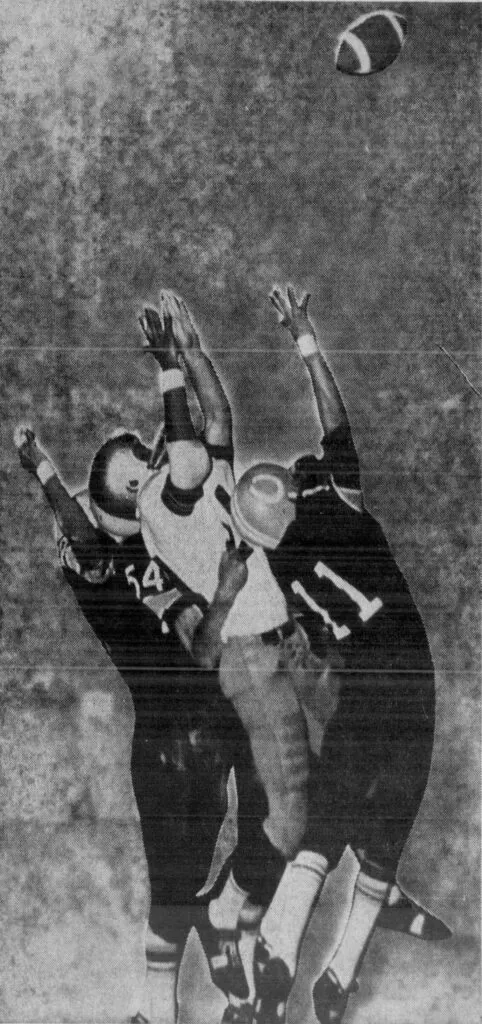
Danny Bondon (center) caught seven passes for 185 yards and two TDs in 1968 upset of Carson. (source: News Pilot – Oct. 19, 1968)
The third loss was Danny Bondon, an institution in San Pedro’s sports history. Bondon, a classmate of mine at Dodson and San Pedro High’s class of W‘69, died in December at the age of 75. Bondon was one of the Pirates’ all-time stars in football and baseball; the San Francisco Giants took him 17th in the first round of the 1969 draft. His catch of a pass from Dave Garasic to beat Carson in a 1968 game at El Camino Stadium is a part of San Pedro High gridiron lore.
And January ended with another devastating fire, this time consuming the long-abandoned Union Baptist Missionary Church building at First and Harbor Boulevard. One of San Pedro’s oldest structures, probably built more than a century ago, it was once the home of San Pedro pioneer William S. Savage (1840-1930). A Civil War veteran, the Irish-born Savage became an attorney and served in the California Assembly and Senate.
Enough with the bad news. There are still many good things to read about San Pedro as I continue my exhaustive list of literature about our town, its people, and its history.
SPORTS
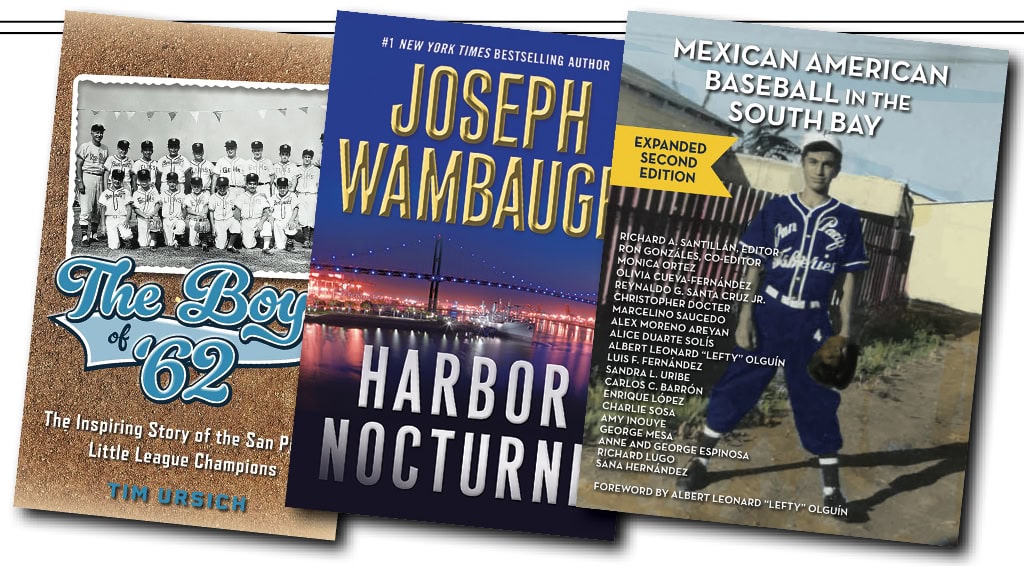
The Upset by Leonard “Pokey” Olguin. Story of San Pedro High’s 1962 football game against rival Banning.
Once a Pirate Always a Pirate: Legends of the San Pedro Rats by Lefty Olguin. A sports memoir by one of San Pedro’s best-known athletes (and Pokey’s cousin).
The Boys of `62: The Inspiring Story of the San Pedro Little League Champions by Tim Ursich.
Football in the South Bay by Don Lechman. Every school, every team.
Hit the Line: 100 Years of San Pedro High Football by Sam Domancich. Matty’s younger brother, an educator and columnist, published this in 2006.
A Diamond Dynasty: Four Decades of History of the 17-Time CIF-Los Angeles City Section Champion San Pedro High School Softball Program by Jamaal K. Street.
Mexican American Baseball in the South Bay, edited by Fermin Lasuen grad Ron Gonzales and Richard A. Santillan.
Baseball’s Unlikely: A Constant, Game 1 by Scott Parker. A second volume, Game 2, is now available on Amazon.
Thin Ice on the Gridiron by Nick Trani. Famed coach writes about the “miraculous” 1960 Mary Star High football team.
Thru the Tunnel by former USC quarterback Paul McDonald and San Pedro filmmaker Jack Baric.
Turning of the Tide: How One Game Changed the South by Don Yaeger, with Sam Cunningham and John Papadakis. The epic story of USC’s 1970 victory over Alabama.
NOVELS
A New Day Yesterday by Peter Adum. San Pedro High graduate’s “American Graffiti” story set during the last week of old Beacon Street in 1973.
All Involved by Ryan Gattis. San Pedrans live and die during 1992’s Los Angeles riots.
Theresa’s Blessings by David G. Freligh. Historical drama based on family stories of the San Pedro High graduate.
Harbor Nocturne by Joseph Wambaugh. Best-selling author sets crime story in the underbelly of San Pedro.
They Call It the City of Angels by Joshua A. Triliegi. First novel by San Pedro resident, founder of Bureau of Arts and Culture Magazine.
The Breaking: Book One of the Abram Trilogy by Peter Churness. San Pedro-born minister envisions life before biblical patriarch became Abraham.
A Poppy in Remembrance by Michelle Ule. WWI-era romance by prolific San Pedro High grad.
The Property by Cynthia Engh McCoy. Rancho Palos Verdes resident’s first novel is a mystery-romance set in the 1940s.
Terminal Island: A Jack Liffey Mystery by John Shannon. Famous fictional private eye reaches the Harbor Area.
Still to come: History, Biography, and Anthology. spt
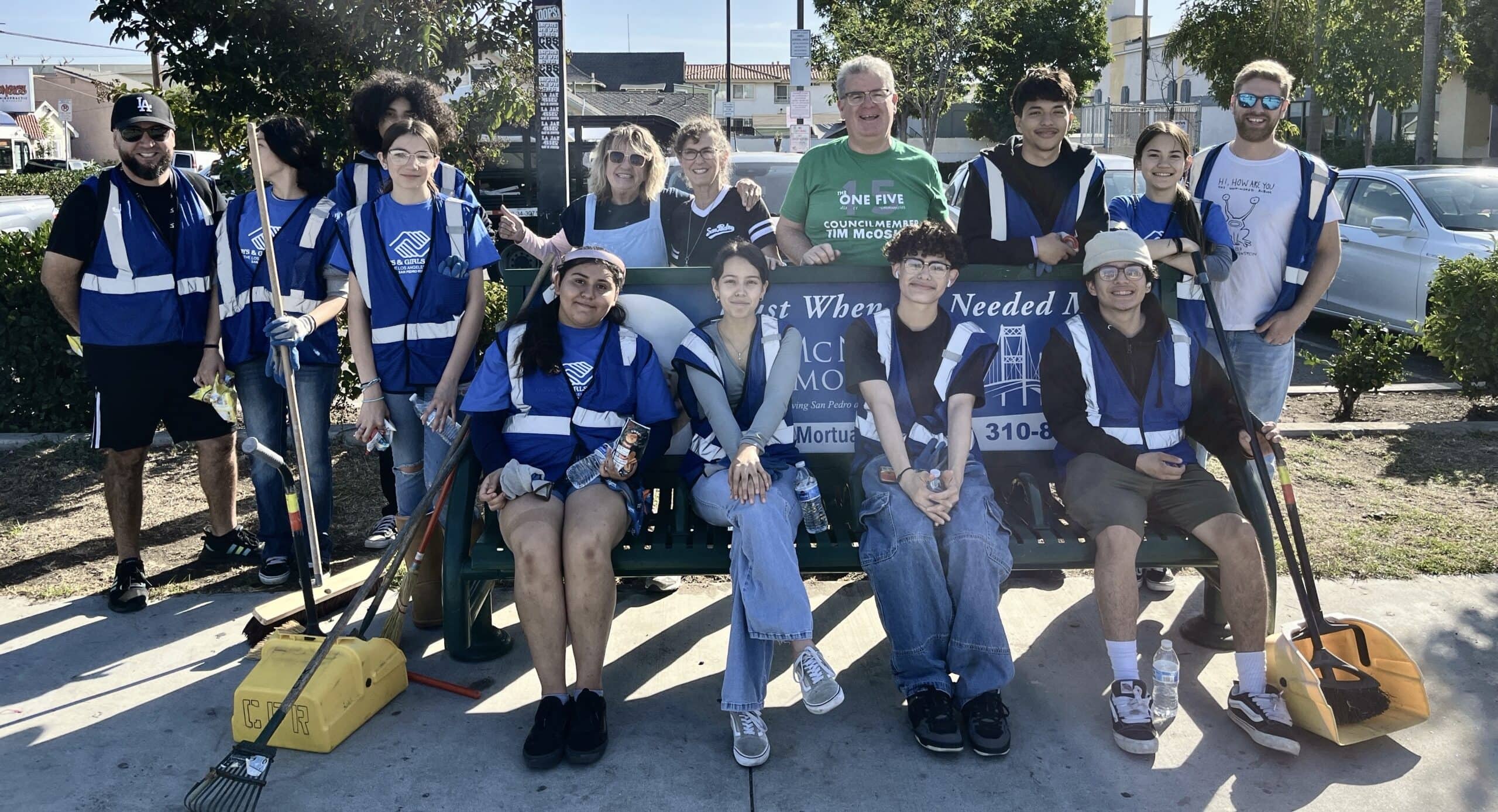
Barbara St. John, Central San Pedro Neighborhood Council’s outreach chair, has been organizing alley cleanups and beautification efforts in Central San Pedro since January 2023.
She began her first volunteer project, One Alley at a Time, within a four-block radius of the Anderson Memorial Senior Citizen Center, where council meetings are held. She recruited volunteers, secured donations of supplies, and created a positive activity for community members.
In the last three years, St. John’s alley events have collected and disposed of over 100,000 pounds of trash, filling 12 dumpsters. Volunteers pick up trash and paint over tagging. Most recently, they began planting native and succulent plants at the bases of trees in parkways, which have historically been common places for litter and dog waste to accumulate. While the focus is on alleys, volunteers also beautify other areas within the project radius.
“It’s all about community, neighbors helping neighbors,” says St. John.
St. John canvasses each selected area, which usually includes a few blocks and four to eight alleys. She contacts 311 in advance to arrange for bulky items to be removed and graffiti to be cleaned. She also submits requests for pothole repairs in the alleys. On one occasion, this resulted in the complete repaving of an alley. Today, the City is not filling potholes with asphalt due to budget cuts. Even with the help of 311, there is still plenty of work for volunteers. St. John encourages residents to use 311 to help keep the community clean.
Flyers are distributed to neighbors in each selected cleanup area, explaining the project and inviting them to participate. One neighbor joined a cleanup and later provided 80 tacos and bottles of water for volunteers. Through Mayor Bass’s office, the group connected with the Department of Sanitation and the Office of Community Beautification. This led to the donation of supplies such as masks and trash bags. Sanitation loans rakes and other equipment, while Athens Services has donated dumpsters, demonstrating the collaboration that makes these events successful.
One Alley at a Time volunteers clean up around the San Pedro Regional Branch Library. (photo: courtesy One Alley at a Time)
Beacon House has provided volunteers from its programs at every event. People of all ages and backgrounds have participated, including Scouts, San Pedro Boys and Girls Club members, GAP, LAPD cadets, families, seniors, couples, and groups such as San Pedro CPR, another local organization focused on beautification. Other areas that have been cleaned include neighborhoods around Daniels Field and Dana Middle School, and outside the San Pedro Regional Branch Library.
As a member of the Friends of the Library, St. John worked with library staff who purchased locally sourced succulents from White Point Nature Center. More than 60 succulants were planted around the library to support bees, birds, and other pollinators.
St. John hopes her efforts in Central San Pedro will inspire other neighborhood councils to create similar programs in other areas of San Pedro, and she is willing to help them get started. Looking ahead, the group hopes to expand neighbor-to-neighbor support by identifying seniors and residents who may be struggling to maintain their yards and organizing volunteer cleanups and revitalization efforts. She also encourages community members to adopt storm drains to keep them clear and functioning.
One Alley at a Time is a volunteer effort started by one person that shows anyone can make a positive difference in San Pedro. Many people are looking for ways to be part of the community. In addition to beautifying neighborhoods, efforts like this bring people out of their homes, introduce neighbors to one another, and strengthen community ties.
To learn more, visit centralsanpedro.org or contact barbarastjo@gmail.com. spt
During COVID, the stars aligned, and two spirited Sagittarian small business owners crossed paths.
Alexis Sadler & Melissa Hay
Like many people during that time, we were craving connection. In a moment that would have confused anyone who knew us pre-COVID, we both joined the same gardening group on Facebook. It wasn’t about gardening. It was about human connection, however we could get it.
From there, the universe kept nudging us together. Over the next year or so, we kept running into each other at random birthday parties, community events, and even dinners out. It felt intentional, like we were meant to stay connected. And we did—not just as business collaborators, but as friends.
We are Melissa Hay and Alexis Sadler. Melissa runs a candle business, Homemade by the Hays at CRAFTED, and Alexis runs a bookkeeping firm called Accounting Therapy. On paper, our businesses couldn’t be more different. But beneath the surface, we quickly realized we shared the same struggles, questions, and experiences that come with running a small business.
What started as casual conversations over coffee or evenings with friends slowly turned into something more meaningful. We found ourselves talking about hiring challenges, pricing decisions, marketing frustrations, customer boundaries, and the emotional weight of being responsible for everything. Those conversations became something we both relied on.
One night, while talking through yet another set of business challenges, we realized: We can’t be the only ones dealing with this. We knew there had to be other small business owners who wanted a space to talk openly about their struggles, without feeling judged, sold to, or talked down to. Not everyone has someone they can bounce ideas off of, and we had found real value in doing that together.
That night, sitting in Melissa’s living room over dinner, Small Business Shop Talk (SBST) was born.
We launched our first meeting in January 2024 with a simple goal: Create a supportive, honest space where small business owners could learn from each other. Each meeting has a planned topic, but the conversation always goes where it needs to go. That flexibility is part of what makes SBST work.
Since then, we’ve covered everything from hiring and partnerships to marketing strategies, social media (a frequent topic because, yes, the struggle is real), technology decisions, customer boundaries, and getting new businesses off the ground. No topic is off-limits, and no one is expected to have all the answers.
What makes SBST unique is that the attendees run it. There are no “talking heads.” No one positions themselves as the smartest person in the room or tries to sell something. The collective experience in the room is the value. Everyone contributes, and everyone benefits.
Patrick, owner of Through the Porthole, says, “What I love most about SBST meetings is the opportunity to connect with like-minded business owners and openly talk through challenges.
Brittany, owner of Prop House Plants, also loves connecting with other local small businesses to share ideas and learn from them. She has found it valuable for talking through mental roadblocks, where all she needed was the perspective of someone who had been there before.
SBST exists to remind business owners that this work is hard and that they don’t have to do it alone. Running a business can feel isolating, and it’s easy to believe you should already have the answers. We’re here to challenge that idea and to create a space where people feel seen, heard, and supported.
Small Business Shop Talk meets on the last Tuesday of each month at 10 a.m. at The Corner Store, 1118 W. 37th Street. You can find us on Facebook and Instagram at @SmallBusinessShopTalk. If there’s a topic you’d like to discuss, send us a DM, and we will add it to our topic list. spt
It’s estimated that every cruise ship visit to the Port of Los Angeles drops an average of $1.3 million into the local economy within a five-mile radius.
In 2025, POLA saw 241 cruise calls with a record 1.6 million passengers injecting over $303 million into the local economy. San Pedro is working hard to capture an even greater share.
America’s Port has always been a critical connection between the US and the rest of the world. A working waterfront that supports families, builds industries, and firmly powers Southern California’s economy. We’re used to containers stacked like Lego bricks and massive container ships moving in and out of San Pedro Bay, carrying 40 percent of the goods that keep our country running.
But now, new attention and focus are being directed to the end of the port’s 7,500 acres along our shoreline.
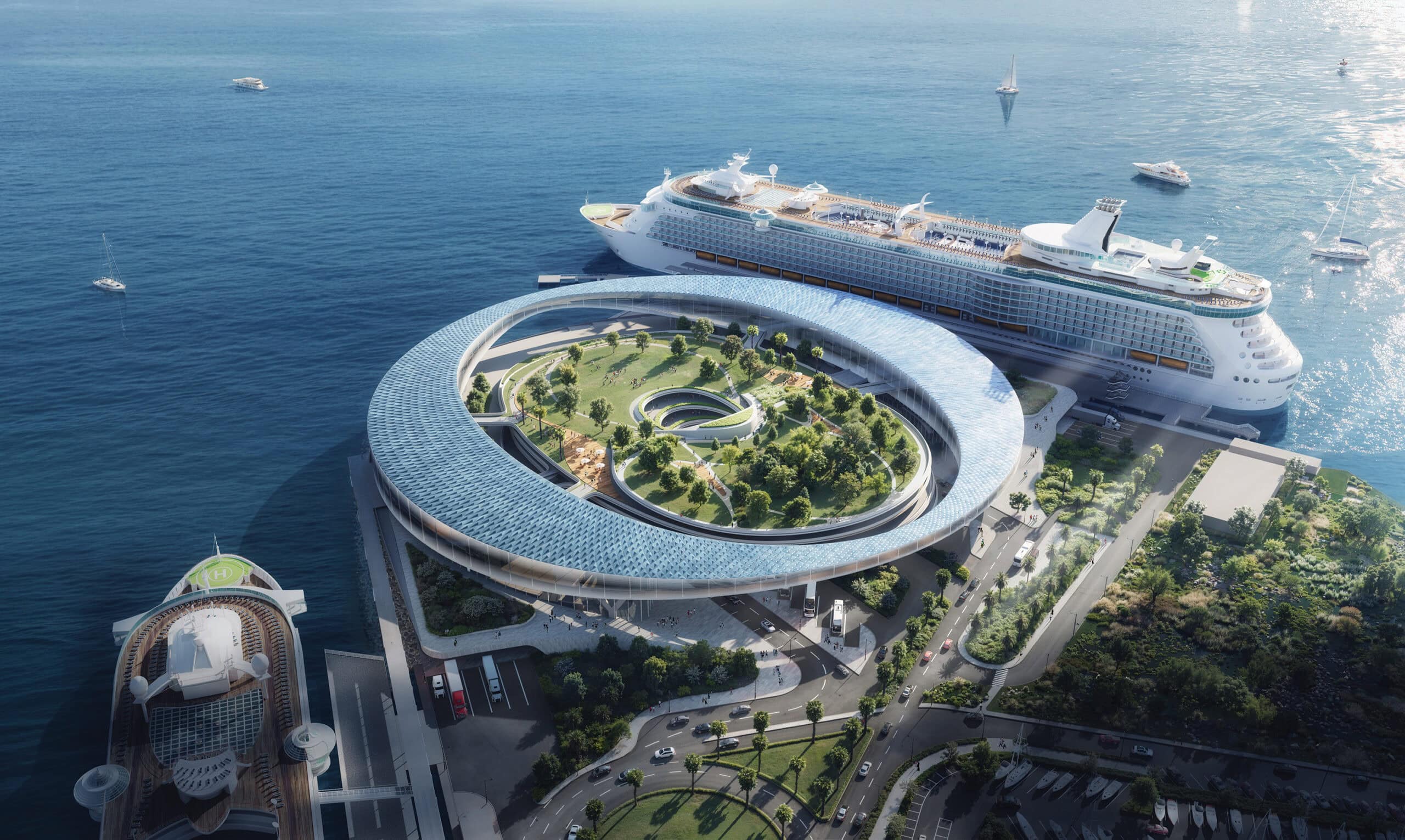
The Port of LA has selected Pacific Cruise Terminals to renovate our existing cruise terminal at Berths 92 and 93 and build an additional facility at Berth 46, aka, the Outer Harbor. PCT is a partnership between Carrix, North America’s leading cruise terminal operator, and JLC, which is led by LA’s own Magic Johnson. Together, they are moving forward with plans for a new, modernized cruise ship terminal designed to elevate the passenger experience while reinforcing our identity as a global gateway. And whether you’re a born-and-raised San Pedran or a transplant who just bought their first home here, this moment matters.
The Los Angeles World Cruise Center has long been one of the West Coast’s primary cruise hubs for Princess, Norwegian, Royal Caribbean, and Celebrity Cruises. But the cruise industry has evolved. Ships are larger. Travelers expect more. Ports compete for routes and itineraries. If San Pedro wants to stay in that conversation as an industry leader, we have to grow with it.
The proposed upgrades include modernized terminals, improved traffic flow, expanded passenger amenities, and infrastructure designed to handle next-generation cruise vessels. In practical terms, that means smoother embarkation days, less congestion, and a far more welcoming first impression for the millions of visitors who pass through our harbor each year.
And make no mistake, first impressions matter.
Cruise passengers don’t just board ships. They eat in our restaurants. They book hotel rooms. They shop in our stores. They will soon wander through West Harbor. They visit the Battleship USS Iowa Museum. They post photos of our coastline and tell friends about the place they discovered at the edge of Los Angeles.
A modern cruise terminal strengthens that ecosystem.
More sailings mean more foot traffic. More foot traffic means more opportunity for small businesses. More opportunity translates into jobs in hospitality, transportation, maintenance, and event programming.
For a community that has long balanced heavy industry with neighborhood charm, this is the kind of growth that promotes our “live, work, play” mission.
San Pedro is in the middle of one of the most significant waterfront transformations in its history. From new dining concepts to expanded public spaces, the harbor is slowly becoming more accessible, more experiential, and more connected to the community.
The cruise terminal project fits squarely into that broader picture. It’s not just about moving passengers. It’s about positioning San Pedro as a destination.
Growth can make people nervous, and that’s understandable. San Pedro isn’t trying to become something it’s not. We are not a polished resort town. We are a working harbor with grit, history, and soul.
The challenge and the opportunity require thoughtful development and infrastructure that serves both visitors and residents. Projects that enhance quality of life rather than overwhelm it. That’s why considerations for the final design include waterside observation decks that can be used for watching sailing competitions, as well as exploring flexible spaces that may allow for gatherings and convention-type activities when ships aren’t currently at berth. This announcement may encourage additional investment in hotels, both downtown and along the waterfront.
The cruise terminal expansion, if executed well, can strike that balance. Cleaner technology, smarter traffic design, and community engagement will be critical pieces of the puzzle.
Our parents and grandparents worked these docks. Generations have watched ships come and go from these bluffs. The harbor is part of our identity, not just our skyline.
The new cruise ship terminal isn’t just about tourism. It’s about momentum. It’s about San Pedro stepping confidently into its next era while honoring the one that built it.
Ships will continue to sail in and out of this port. The difference is that now, more of the world will step off those gangways and see what we’ve always known: San Pedro isn’t just a place you pass through. It’s a place worth spending time. spt
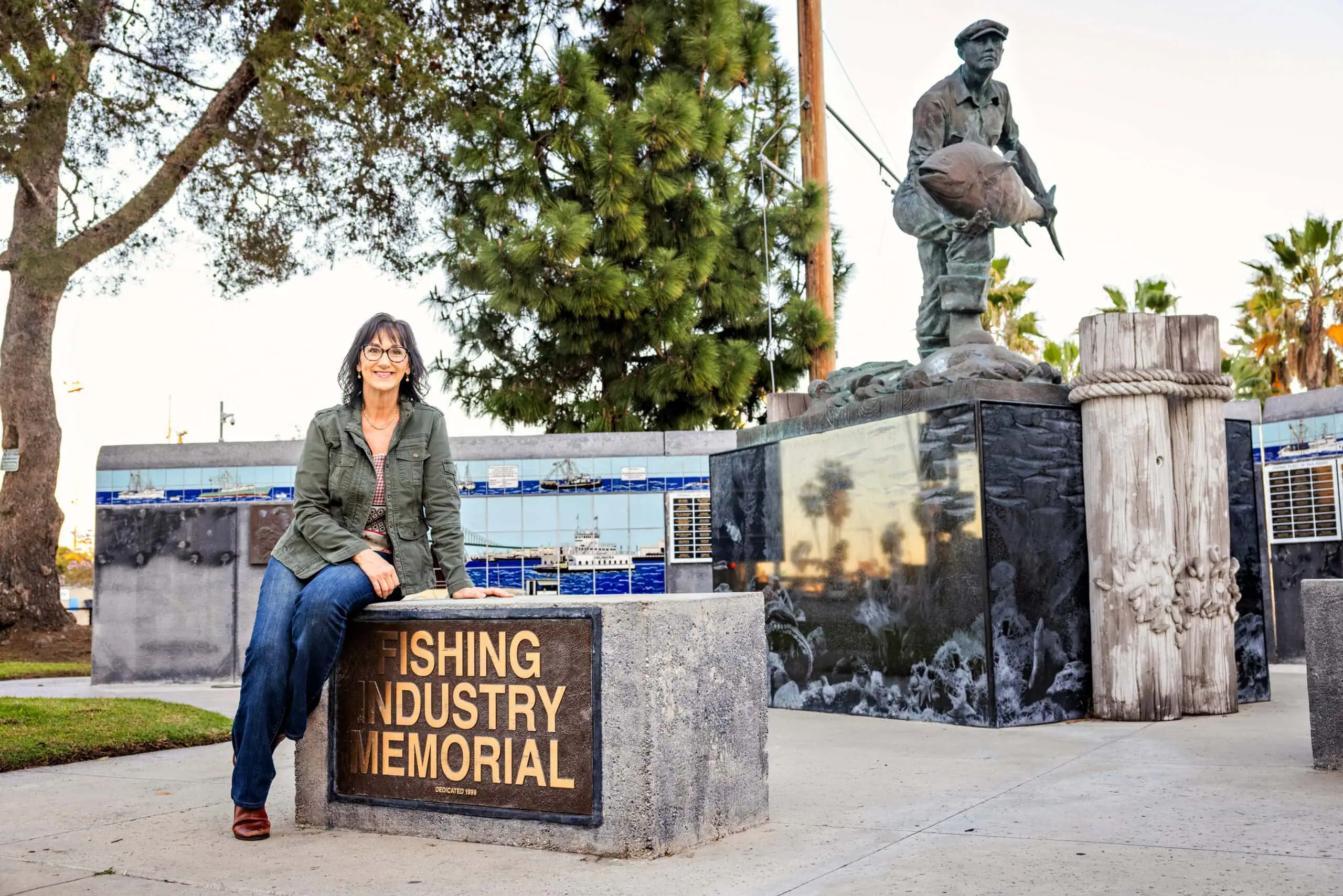
Kris Ursich-Pielago keeps photographs of the plaques on her phone.
Not the new granite ones going up now at the Fishing Industry Memorial on the San Pedro waterfront at Fifth and Harbor, but the old bronze ones—the ones stolen in late 2023, pried off in the dark, sold for scrap. When someone emails asking if their grandfather’s name was there, she zooms in on those photos, squinting at names engraved 27 years ago, and tells them yes or no. Sometimes she recognizes a name before she finds it. “Oh yeah, I know that name,” she says. In San Pedro, everybody knows the names.
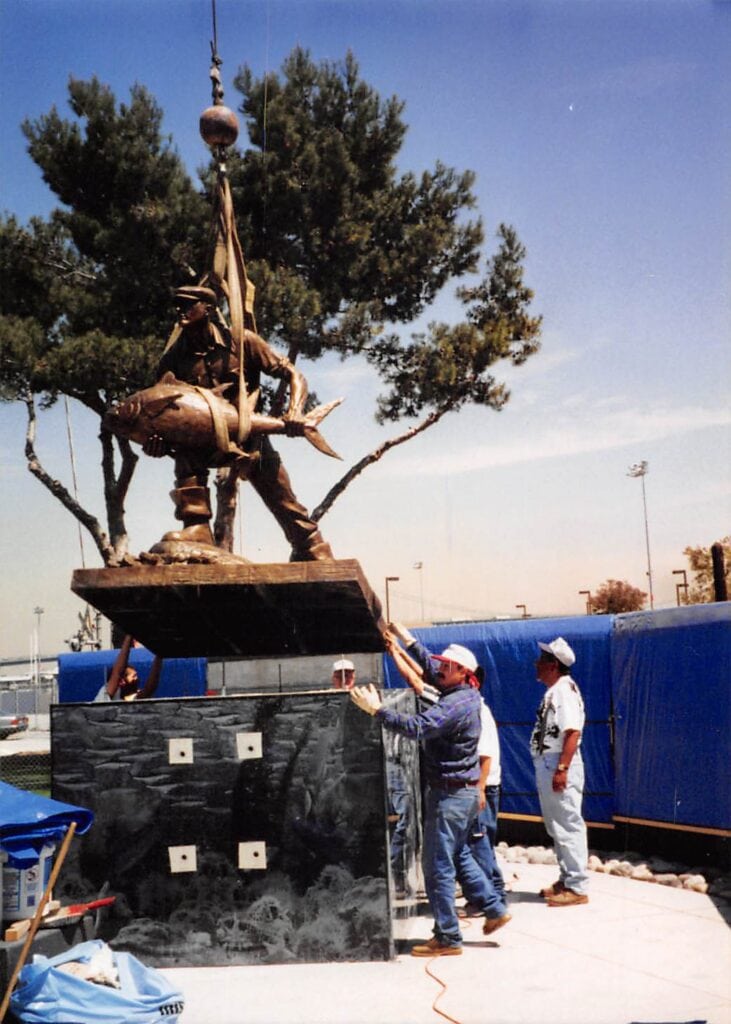
Photo from early 1999 during the installation of the Fishing Industry Memorial. The memorial, with a statue designed by artist Robert Pena with lead sculptor Henry Alvarez, features a bronze fisherman holding a tuna and a hand-painted tiled wall where plaques bore the names of the immigrants who made San Pedro the largest fishing port in the country. (photo: courtesy Kris Pielago)
The memorial, begun in 1992 by the Fisherman’s Fiesta committee, was completed in 1999 by a new committee that included Pielago’s mother, father, uncle, and two aunts, all now deceased. Designed by artist Robert Pena with lead sculptor Henry Alvarez, it featured a bronze fisherman holding a tuna and a hand-painted tiled wall where plaques bore the names of the immigrants who made San Pedro the largest fishing port in the country.
At its height, the industry supported tens of thousands of jobs, from cannery lines and fishing boats to shipyards, ice plants, and other businesses that kept the harbor working. Eighteen canneries lined Terminal Island. StarKist and Chicken of the Sea started here. If you lived in San Pedro mid-century, you either fished or worked the docks or packed tuna. When the Fisherman’s Fiesta rolled around, the Catholic Archbishop of Los Angeles would bless the fleet before it went out.
The last cannery closed in 2001. The fleet dwindled to a handful. By the time the memorial went up, it was already an elegy.
Pielago didn’t ask for the job of maintaining it. Her mother handed her boxes of documents and asked if she’d take care of things. “Sure,” Pielago said. She thought it meant keeping the site tidy.
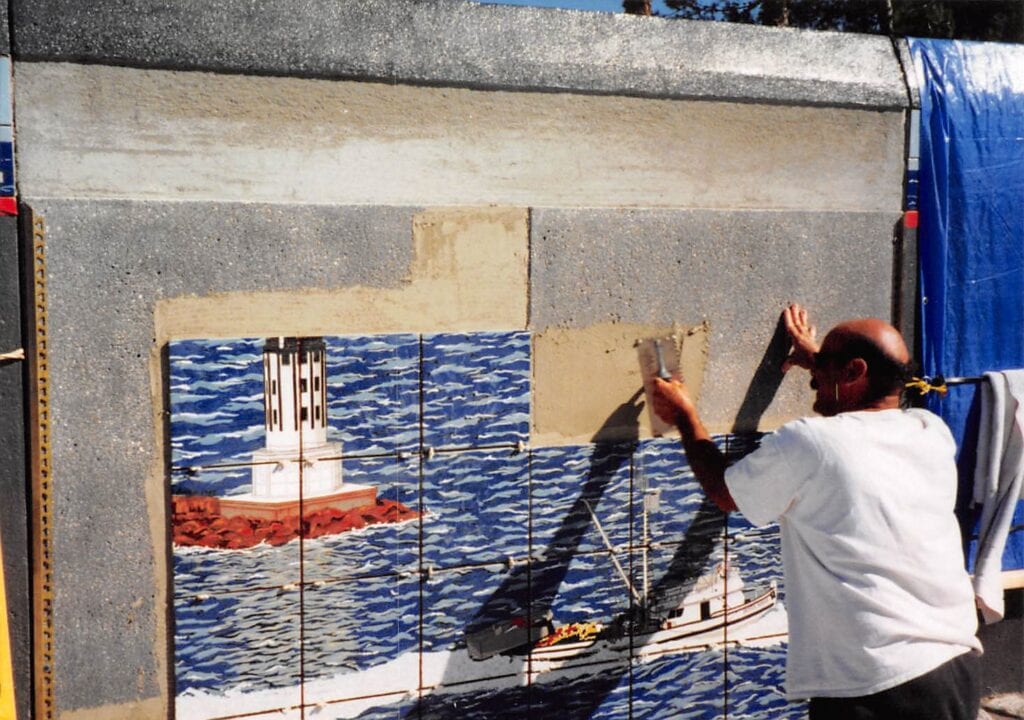
In early 2023, the Port of Los Angeles called: The lighting was broken. Over 20 fixtures had to be replaced, concrete torn up and redone. A worker noticed the mural—originally a creation of artist Petra Lefeber—separating from the wall. Pielago brought in a craftsman, Frank Scotti, who took it down tile by tile, cleaned each one, and remounted it. By the time the work finished, the memorial looked better than it had in years.
Then, driving past a month later, she saw four plaques missing. She pulled over and photographed everything still there. Within two months, 23 of the 27 plaques were gone.
Installation of the original bronze plaques, early 1999. (photo: courtesy Kris Pielago)
“I kick myself,” Pielago says. “Did I just draw attention to it [with the improvements]?” But the theft wasn’t personal. Coming out of COVID, metal prices had spiked. Cemeteries across Southern California were being hit.
The Merchant Marine memorial down Harbor Boulevard lost plaques too, though no one noticed until Pielago pointed it out. Arrests were made eventually. The thieves probably got a few dollars per pound. The plaques reading “Fishermen Lost at Sea” ended up in a smelter somewhere.
Pielago never considered not rebuilding. The question was how. Bronze was out—too expensive, too stealable. She studied memorials: the 9/11 site, the National Mall. Everything was engraved stone. Granite couldn’t be pried off and sold. It cost an eighth of what bronze would. When the first six went up, “they just popped,” she says. “This is what’s meant to be.”
The Port granted funds to replace 19 plaques, the number stolen when Pielago applied in early 2024. By the time the grant came through a year later, four more had been taken. She started fundraising through the Dalmatian-American Club, the Croatian Hall, the Sons of Ischia, among others—groups whose members were descendants of fishermen. She created a patron plaque for donors giving between $2,500 and $10,000. Eleven families have signed on to date, many dedicating their lines “in honor of” family members who fished.
Pielago stands with a few of the new granite plaques, which will be officially unveiled on April 25. (photo: John Mattera Photography)
The work is unending. There’s a 501(c)(3) to maintain, tax returns to file, grant applications to complete. Her husband’s a CPA; he helps. Eight plaques are in production now, though five came back wrong and had to be redone. Pielago, who has a day job in her husband’s accounting office, checks every letter against her photographs. The original memorial records are a fragmented puzzle, forcing Pielago to squint at her phone’s digital archive, cross-referencing 27 plaques of names, one by one, to ensure a relative’s legacy isn’t lost to a typo.
The original committee was led by Dr. Lou Mascola, Wayne Bettis, and Gary Bettis. The new committee (pictured above) included (from l to r): Libby DiBernardo, Irene Mendoza, Jim Frlekin, Eva Frlekin, Cyril Welle, Jean Welle, Eleanor Rodriguez, Marie Ursich, (unidentified), Francis Gargas, Kruno Ursich, Steve Frlekin, and (unidentified). Board Members not in photo: Barbara Mancusi, Mike Mavar, and Karen Horner Anderson. (photo and info: courtesy Kris Pielago)
She gets emotional talking about it. Her mother Marie, her aunts Eva and Jean, her grandfather who started fishing out of Bellingham before coming to San Pedro in the 1920s—their names were on those walls. Her brother fished commercially; he’s on the memorial. Her brother-in-law, many of her father’s uncles and cousins—all there. “Those people worked countless hours,” she says. “Their sacrifice produced our town.”
She remembers driving out with her sister to a point at the end of the docks where you could see boats coming through the breakwater. The wives and families would wait. The men had been gone for weeks, sometimes months, down beyond Mexico with no way to call home. They didn’t come back until the hold was full.
Babies were born while fathers were at sea. Graduations were missed, First Communions. The boats would radio each other— “I got a full load, I’m coming in,” and somehow, word would reach shore. Families would drive down and wait. When the boat docked, they’d hold their men and hear the stories.
Some boats never came back.
The rededication ceremony is scheduled for April 25, 2026—27 years to the day after the original dedication. Pielago expects 250 people, though her gut says more. Families are coming from out of state. She’s starting at 9:30 a.m. so there’s time to gather, to reminisce, before the program begins at 11 a.m. Time for coffee and a light breakfast. A priest will bless the memorial. Surviving members of the original committee will sit in the front row. She’s working on photo boards showing the memorial’s construction in the 1990s, the empty wall after the theft, the new granite going up.
“It’s going to be a ‘family’ reunion,” she says. After the ceremony, she wants people to walk up the street to the restaurants in a downtown that exists, in large part, because of the fishing industry.
By then, 19 plaques should be up. The goal is to have all the stolen ones replaced by the end of 2026. People are still adding names—commercial fishermen who weren’t on the original memorial, and cannery workers. Two full plaques were dedicated to cannery workers. That’s been the biggest category of additions.
When it’s done, she plans to document everything: cross-references of every name, every plaque, every line. She’s thinking of giving it all to a local museum so there’s a permanent record. Her kids know the history, but institutions last longer than people.
Does she ever think about walking away? “Every day I feel like it’s overwhelming,” she says. “And then I’m reminded that how I feel doesn’t matter, that quitting’s not an option.”
The original installation of the tile mural by artist Petra Lefeber, early 1999. (photo: courtesy Kris Pielago)
Why doesn’t it matter?
“It’s my mom, my aunts, my town, my family. Everybody’s family. When you go out in San Pedro, you carry your family name with you. This town is based on families. That memorial is based on our families. You go by your name, and your pride comes by your name. That’s what’s on that memorial—our family names. That’s what has to be rebuilt.”
When she hits a roadblock, she looks up. “I need help,” she says out loud, and something shifts. Finding the original graphic artist from 1997 happened through Councilman Tim McOsker’s office—someone at a meeting mentioned the memorial, and Heather Lawson of Blue Engravers, who’d created the original plaques, walked up and offered to help with the granite versions. An attorney helped Pielago set up the new nonprofit. Every time she throws her hands up, something comes together. “Divine intervention,” she says. “I know my family’s watching me. I know they’re proud.”
The most rewarding part is the emails. Someone writes: Is my grandfather up there? And she can write back: That plaque just got replaced. Your family’s name is coming back.
A name on granite doesn’t seem like much. But Pielago has taken her kids down there and pointed to her grandfather’s name and shown them pictures of the fishing boat. “That was his boat,” she tells them. “He built that boat.” When the plaques were stolen, people wrote to Pielago: We took our grandson there to show him his great-grandfather’s name, and it was ripped off the wall. It was their pride being ripped off.
On Saturday, April 25, the names go back up. Not all of them—some will take longer—but enough. Enough for the families to gather, enough to bless, enough to start again. The granite won’t weather the way bronze did. It won’t get stolen. It will outlast everyone at the ceremony, outlast Pielago, outlast her kids. The fishermen it honors are nearly all gone now, and the industry with them, but the names remain. And in San Pedro, names matter. spt
The rededication ceremony for the Fishing Industry Memorial is Saturday, April 25, starting at 9:30 a.m. (program at 11 a.m.) at the memorial site on Harbor Blvd. (at 5th Street). For more info or to donate, contact Kris Pielago at kpielago@cox.net.
Once the dried Christmas trees are hauled to the curb and the last of the holiday lights blink out, a familiar malaise sets in.
By February, most of us have already broken at least one New Year’s resolution, the calendar stretches ahead in shades of gray, and the rain arrives with no particular promise other than more of the same.
There is little left to celebrate in this post-holiday lull, save for one relentlessly cheerful exception: Valentine’s Day. With its cupids and crimson cards, the holiday arrives less as an invitation and more as a reminder—of who has been struck by the arrow of reciprocal love, and who is standing just outside its range, aware that this most coveted of resources is not evenly distributed.
For single people, Valentine’s Day rarely comes as a shock. Many approach it with humor, indifference, or deliberate avoidance. Couples, too, can choose to dismiss it or play along. The deeper discomfort often belongs elsewhere—in relationships that lack definition, in bonds that offer intimacy without assurance, and in what has become one of the most pervasive relational arrangements in contemporary culture: the situationship.
These connections function as liminal spaces—neither fully absent nor fully committed—where ambiguity is framed as flexibility, and looseness is mistaken for freedom. On paper, this can sound liberating. In practice, such relationships often fracture under the weight of symbolic moments, when the question, “Where do I stand?” can no longer be deferred.
Valentine’s Day functions less like a celebration and more like an MRI for modern relationships.
Valentine’s Day functions less like a celebration and more like an MRI for modern relationships. It does not create problems so much as reveals what already exists beneath the surface.
For people in situationships, this scan can be particularly uncomfortable. Emotional involvement may be real, but recognition remains optional. The gray zone is often defended as autonomy, yet, psychologically, it usually relies on subtle forms of self-avoidance and, over time, self-erasure. Needs are edited. Expectations go unspoken. Desire is reframed as something one should outgrow rather than honor.
In recent years, a powerful cultural narrative has emerged around not needing another—that independence is proof of emotional maturity, and that wanting to be cherished, chosen, or claimed signals insecurity. Many people learn to speak fluently about self-sufficiency while quietly negotiating a private grief: the conflict between a deep longing for mutual recognition and an equally strong wish for infinite personal space. Situationships thrive in this tension. They allow closeness without containment, intimacy without obligation, and the illusion of connection without the vulnerability of being fully known.
After the holiday lights go out and the days begin to blur into weeks, this period of seasonal hibernation can be reframed as something essential rather than empty. Winter is not a time of visible growth but of quiet consolidation, when roots deepen in subterranean spaces, out of sight. It is perhaps no coincidence that this most liminal month is dedicated to celebrating love. When the noise fades, the gifts have been exchanged, and the performances complete, what remains is what is true. Often, that truth is not romantic spectacle but self-confrontation. February asks us not for declarations of love, but for a clearer analysis of where love actually lives: around us, between us, and within us.
What Valentine’s Day ultimately exposes in this in-between space is not a failure of love, but a failure of structure. Human beings can tolerate uncertainty, but we struggle when it requires us to minimize ourselves to stay connected.
The quiet harm of the situationship is not the absence of guarantees, but the slow internal negotiation that asks one person to want less, expect less, and need less so that the relationship can continue at all. These dynamics become inevitably laborious and draining. Situationships are framed as low-commitment relationships, often at the expense of one person carrying the burden of maintaining the connection.
The way forward is not cynicism, nor is it blind hope. It is discernment. Clarity does not mean forcing outcomes or issuing ultimatums; it means telling the truth about what is being offered and what is being asked in return. A relationship does not need perfect symmetry to be viable, but it does require shared reality. When one person is living inside a bond while the other remains adjacent to it, no amount of patience or self-work can compensate for that misalignment.
Perhaps Valentine’s Day, stripped of its sentimentality, offers a quieter invitation. Not to declare love, but to locate it honestly. To notice where we feel held and where we do not. And to remember that wanting to be chosen is not a regression—it is a deeply human desire, and one that deserves a place to land.
“Tell me what you love, and I will tell you who you are.” — Arsene Houssayespt
Three years after its groundbreaking, San Pedro celebrated the long-awaited opening of Piazza Miramare on Saturday, January 18, with a ribbon-cutting ceremony and festive gathering in the heart of Downtown San Pedro’s Little Italy district.
Considered the state’s first Italian piazza, the European-style public space at 629 S. Harbor Blvd. offers a welcoming place to gather, enjoy coffee, and take in views of the working LA Harbor. The 10,000-square-foot plaza serves as the hub of San Pedro’s Little Italy and will host future cultural and entertainment programming led by the Little Italy of Los Angeles Association.
Designed by award-winning firm Gensler, the piazza officially opened with remarks and a ribbon-cutting hosted by LA City Councilmember Tim McOsker, joined by Italian Consul General Rafaella Valentini, former LA City Councilmember Joe Buscaino, Christian Di Sanzo, a member of the Italian Parliament, and other local community leaders.
San Pedro Today congratulates the Little Italy of Los Angeles Association and all involved on a wonderful addition to our downtown. Grazie! spt (photos: John Mattera Photography)
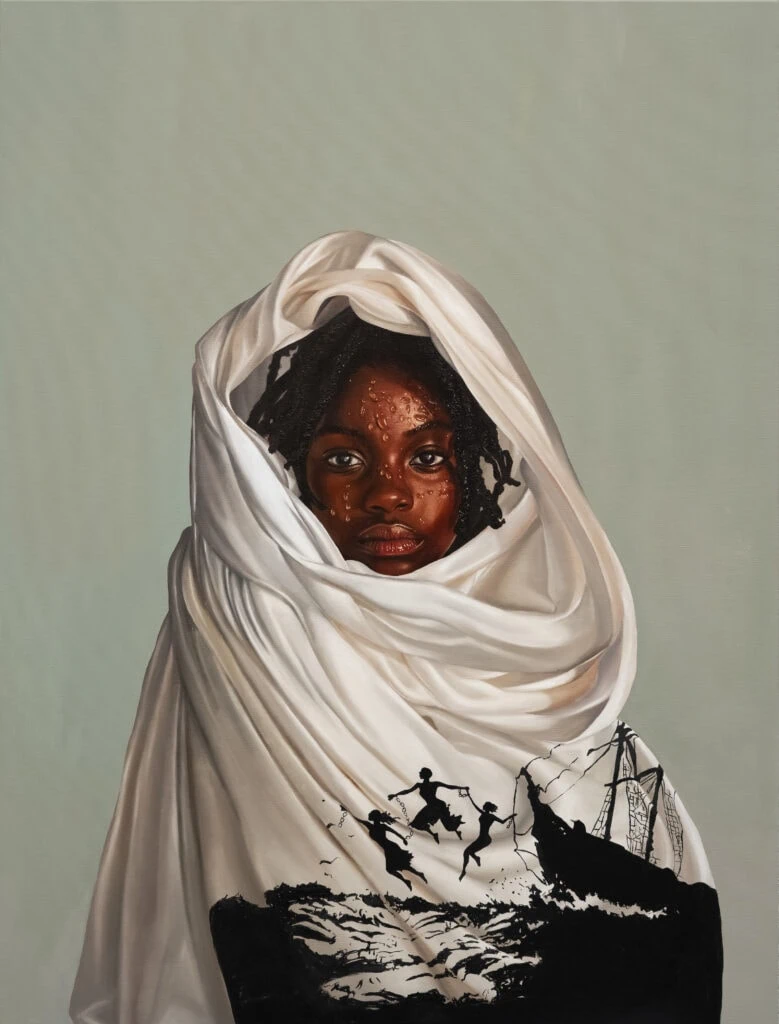
During the pandemic, the San Pedro Waterfront Arts District produced several online interviews with local artists as part of the Armchair ArtWalk Tour. During production, a friend introduced me to Floyd Strickland, an extraordinary artist worthy of your attention.
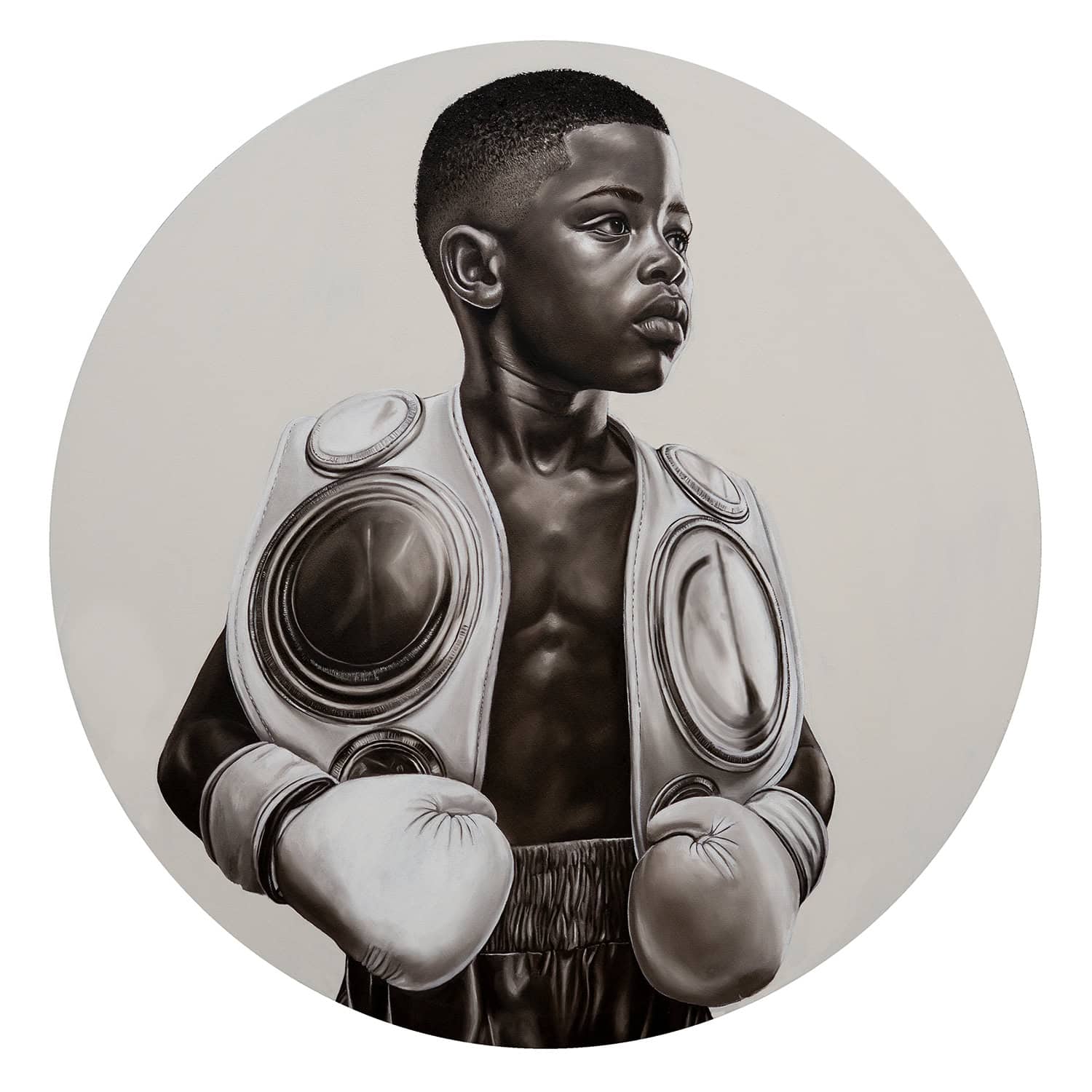
Floyd is a Los Angeles-based artist whose work offers an introspective and critical exploration of American culture, viewed through the eyes of Black and Brown children. Drawing on his own childhood experiences, Strickland creates ethereal, figurative oil paintings, merging realistic figures with cultural imagery, while evoking both tenderness and strength.
His journey began while he was working to build and renovate elementary schools across the country, where he observed a troubling lack of confidence among many children of color and an insecurity he deeply understood from his own upbringing. This realization led him to dedicate his practice to portraying these children as larger-than-life figures, celebrating their beauty, resilience, and boundless potential.
His own children often serve as central figures in his work, embodying the profound love and hope driving his artistic vision. His recent exhibitions have further cemented his place as a distinct and influential voice in contemporary figurative painting.
“In Memory of Those Who Chose the Sea” (2025) by Floyd Strickland.
Floyd graciously answered my questions:
What prompted you to become an artist?
Floyd Strickland: I’ve always drawn and paid attention to images, but becoming an artist wasn’t a straight path. I grew up in Watts, and creativity was a way to make sense of my environment. Art became the place where I could process memory, identity, and history when words felt limited.
What are some significant influences on your work?
Strickland: My influences range from classical painters like Caravaggio and Velázquez to artists such as Aaron Douglas, Kerry James Marshall, and Barkley Hendricks.* Just as important are lived influences, Black youth culture, family history, religion, sports, and the visual language of Americana and propaganda.
*For context, edited from Wikipedia:
Aaron Douglas (May 26, 1899 – February 2, 1979) was an American painter, illustrator, and visual arts educator. He was a significant figure in the Harlem Renaissance. He developed his art career by painting murals and creating illustrations that address social issues related to race and segregation in the United States.
Floyd Strickland. (photo: Instagram)
Kerry James Marshall (born October 17, 1955) is an American artist and professor known for his paintings of Black figures. He previously taught painting at the School of Art and Design at the University of Illinois at Chicago. Marshall’s childhood in the Watts neighborhood of LA, where the Black Power and Civil Rights movements took place, had a significant impact on his paintings.
Barkley L. Hendricks (April 16, 1945 – April 18, 2017) was a contemporary American painter who made pioneering contributions to Black portraiture and conceptualism. While he worked in a variety of media and genres throughout his career (from photography to landscape painting), Hendricks’ best-known work was a series of life-sized painted oil portraits of Black Americans.
Floyd’s work also brings to mind Kehinde Wiley (born February 28, 1977), an American portrait painter based in New York City. In 2017, Wiley was commissioned to paint former U.S. President Barack Obama’s portrait for the National Portrait Gallery of the Smithsonian Institution.
Have you been to San Pedro? If so, can you elaborate about when and where?
Strickland: Yes. I’ve spent time in San Pedro over the years, mostly around the waterfront and arts district. The harbor, light, and industrial landscape have always stood out to me; it feels honest and unpolished, which I’m drawn to.
Where do you take first-time visitors to LA or San Pedro?
“Middle Passage” (2018) by Floyd Strickland.
Strickland: I usually take first-time visitors to the beaches or to local restaurants I enjoy. It’s an easy way to experience the city, with good food, ocean air, and a pace that lets people really take in their surroundings.
Do you have any upcoming shows? When and where?
Strickland: I have several projects in development, including gallery exhibitions and public art commissions. Dates and locations will be announced soon.
What would the 10-year-old Floyd tell you now?
Strickland: Don’t doubt it. Keep going. Everything you’re experiencing now will eventually make sense. spt
The San Pedro Youth Coalition’s Future Leaders of San Pedro Award was established in 1989 to recognize local students who demonstrate exceptional leadership potential while attending elementary, middle, or senior high school.
Over the years, hundreds of young people have been honored for their promise, character, and ability to inspire others. Occasionally, long after a student has received this recognition, their later accomplishments come to the attention of the Coalition’s Board—serving as a powerful reminder that early leadership often blossoms into extraordinary achievement. One such individual is Zeuz Islas.
In 2010, when the San Pedro Youth Coalition distributed its annual Future Leader nomination form to local schools, few could have anticipated how far one fifth-grade student’s journey would extend. At Point Fermin Elementary School, Mr. Lloyd recognized something special in a student who consistently demonstrated maturity, responsibility, and leadership beyond his years. That student was Zeuz Islas, whose early recognition would mark the beginning of a remarkable and steady ascent.
After matriculating from fifth grade at Point Fermin Elementary School, Zeuz enrolled at Dana Middle School, where his commitment to excellence continued. Throughout all three years at Dana, Zeuz maintained perfect attendance—a testament to his discipline, perseverance, and respect for education. His dedication earned him the Kiwanis Club Award for attendance, an honor reflecting both consistency and personal responsibility.
A young Islas at the 2010 SPYC Future Leaders of San Pedro Awards Banquet. (photo: Ray Vaudo)
Zeuz went on to attend Harbor Teacher Preparation Academy High School, where his academic and leadership abilities continued to flourish. Graduating in 2017, he distinguished himself not only within his high school but also at the collegiate level. While still a high school student, Zeuz concurrently enrolled at Los Angeles Harbor College, demonstrating remarkable initiative and academic confidence. By the time he completed high school, he had earned two associate of arts degrees—one in arts and humanities and another in social and behavioral sciences.
His achievements at Harbor College were widely recognized. Zeuz received the Distinguished Graduate Award, highlighting his academic excellence and leadership. In addition, he was awarded several competitive scholarships, including the Ruben Salazar Memorial Scholarship Award, the AALA Scholarship, and the META Foundation Scholarship. These honors reflected both his scholastic achievements and his dedication to serving and representing his community with integrity.
Building upon this strong foundation, Zeuz was accepted to Columbia University, one of the nation’s most prestigious academic institutions. There, he earned a Bachelor of Arts degree in biological sciences and in ethnicity and race studies—fields that reflect his passion for medicine alongside a deep commitment to understanding social equity and cultural identity. While at Columbia, Zeuz was recognized for his leadership in multiculturalism, diversity, and social justice, further affirming his role as a thoughtful and engaged leader.
Zeuz’s academic success and leadership journey culminated in his acceptance to the Kaiser Permanente Bernard J. Tyson School of Medicine. In 2022, he was selected as one of only 0.4 percent of applicants admitted from a pool of approximately 11,000 candidates nationwide. This milestone represented years of perseverance, discipline, and purpose.
Now on track to graduate with his Doctor of Medicine degree this spring, Zeuz Islas stands as a compelling example of the lasting impact of early leadership recognition. From a fifth-grade Future Leader in San Pedro to a medical professional in training, his story embodies the San Pedro Youth Coalition’s mission and serves as an inspiration to future generations. spt
For more information about the San Pedro Youth Coalition’s Future Leaders Awards Banquet, visit sanpedroyouthcoalition.org.
February is synonymous with love and dating. However, I believe that any day is a good day to visit a couple of bistros in town.
When Seaside Bistro (1420 W. 25th St.) opened a handful of years ago, many people I know gave rave reviews of their breakfast menu. And they were not wrong. Truth be told, I have eaten here more often for breakfast than for any other meal. But don’t get me wrong—the other meals here are really good, too.
Seaside Bistro’s prime rib and mashed potatoes. (photo: Sanam Lamborn)
Their breakfast menu offers plenty of options. If you have read my column long enough, you know that I have a soft spot for any type of omelette that includes bacon, mushrooms, avocado, and cheese. As such, I have had both variations on the menu and give them both a thumbs up. I particularly like the generous amount of cascading avocado slices on top of the omelette. My request for the side home potatoes to be extra crispy is always served exactly as I request it. When I am really hungry and it’s late morning, their country fried steak and eggs are my go-to. The lunch menu includes a good selection of sandwiches (hot and cold), burgers, soups, and salads.
The dinner menu, though, is a whole other story. One can assume that a restaurant that is open all day may keep the same vibe during every service. But here, they step it up at night.
Don’t be fooled by Seaside Bistro’s simplistic, albeit clean, comfortable, and modern ambiance. Dinner service is like stepping into a high-end restaurant. The dinner courses are served with intentional plating. For example, being served mashed potatoes piped onto a plate to look like duchess potatoes makes such a visual difference. Call me crazy, but it made my prime rib dish feel even more tasty.
Not only is the composition appealing to the eye, but these dishes are served with the restaurant’s name, Seaside, handwritten in glaze on the side of the plate. There are plenty of chicken, steak, and seafood options; you won’t be disappointed.
Savoria Mélange Bistro (1902 S. Pacific Ave.) opened its doors last year. Currently, they only offer dinner service. It is impossible for me to fully write about the food experience here before setting the scene. Having dined at the restaurants that preceded Savoria Mélange, I was completely taken aback when I first walked in.
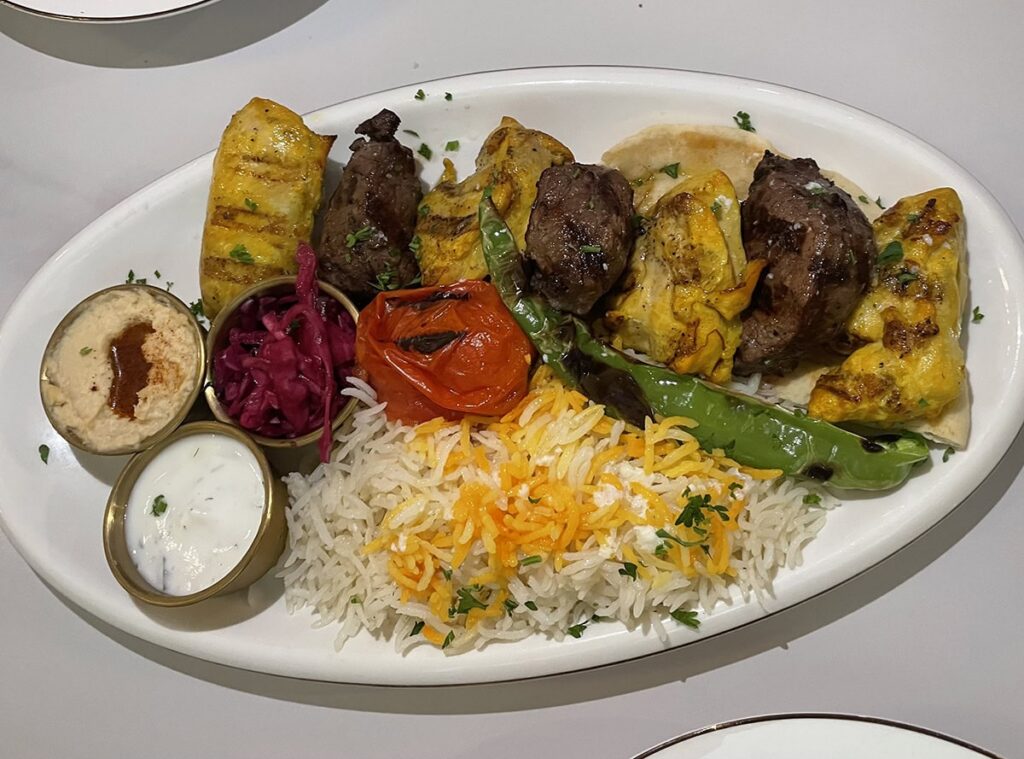
The Bakhtiari Kebob at Savoria Mélange. (photo: Sanam Lamborn)
The space has had a much-needed overhaul, making it look brighter and feel more spacious. The elegant décor—which combines royal blue with gold accents and the magenta bougainvillea flowers in pots hanging from the back wall—creates an overall ambiance reminiscent of a Mediterranean bistro.
The menu takes you on a culinary journey from Mediterranean to Persian and Armenian dishes that reflect the owners’ background. The loaded hummus, olive tapenade, and the Mediterranean board are my favorite appetizers. The main menu includes French favorites beef bourguignon and ratatouille, along with chicken, seafood, steak, and pasta options. I equate their Bakhtiari Kebob to a feast on a plate. At Savoria Mélange, it’s served with skewers of tender, marinated beef and chicken, basmati rice, tzatziki, and pickled red cabbage, along with a grilled hot pepper and a whole tomato. I gravitate toward the kebob plates not only because of my Persian heritage but also because they are well-made.
But before you have a chance to indulge in your chosen dinner, you will be presented with what I consider a very eye-catching and delightful bread service: a lit butter candle surrounded by pieces of house-made rosemary focaccia. The heat slowly softens the butter for the bread to be dipped in. Enjoyed with a glass of wine, cocktail, or mocktail from their drink menu, it makes for a perfect start to a great meal. spt
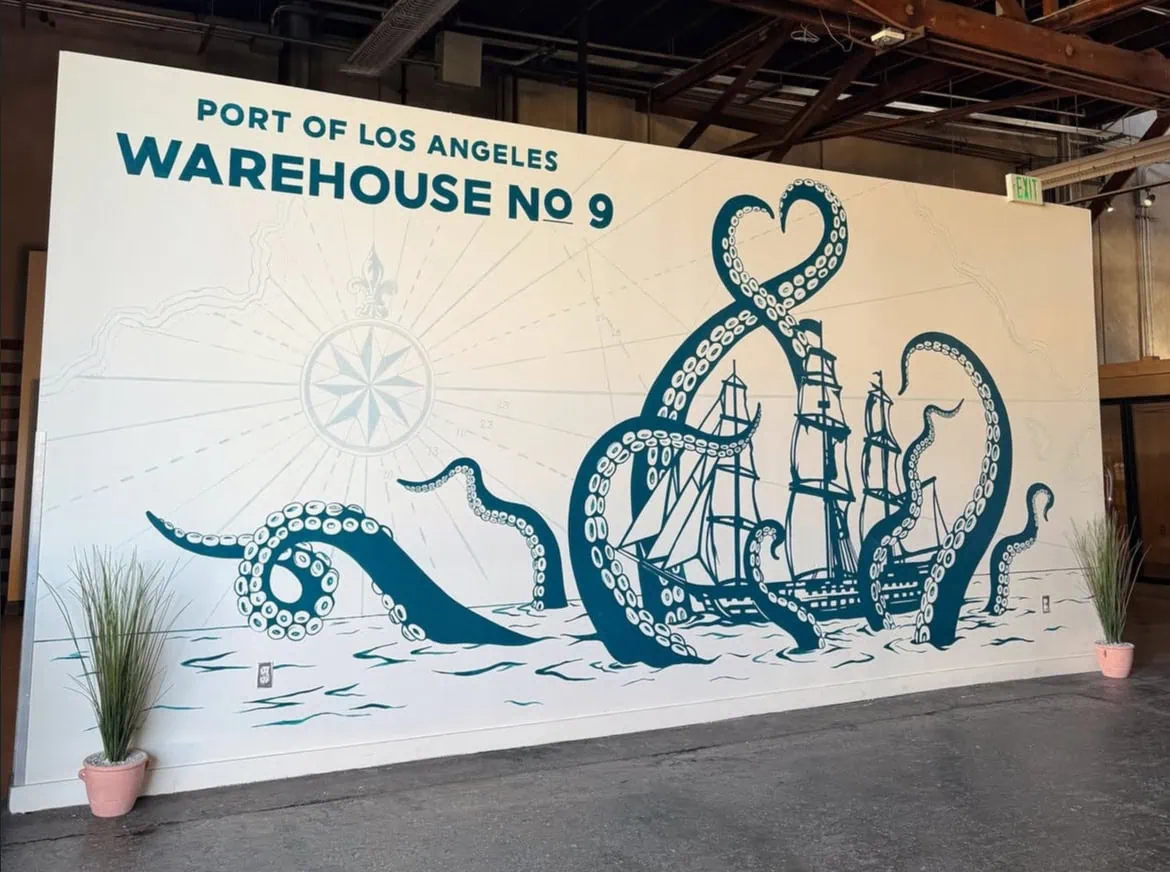
After a period of transition, the new gathering spot Warehouse 9 has emerged with a clearer vision, a broader license, and a renewed commitment to being more than just a bar.
The goal now is simple. Create a flexible, family-friendly community hub that listens first, adapts often, and puts San Pedro at the center of everything it does.
At the heart of the reboot is a major licensing shift. Unlike the previous tenant, Brouwerij West, which was limited to beverages they produced, Warehouse 9 can now offer multiple beer brands based on demand. That change opens the door to greater variety and, more importantly, to community choice.
Hard seltzers, slushies, hard kombucha, and cider are already part of the mix, expanding appeal while keeping the space all-ages. Wine is being considered, but only if it can be done without sacrificing that family- and dog-friendly environment. Hard liquor, for now, is intentionally off the table.
Equally important is how the venue fits into the larger CRAFTED at the Port of Los Angeles ecosystem. You will soon see CRAFTED tenants selling wares in the courtyard and guiding folks to the main sales floor across the way. Even social media has been unified, managed by a single voice to ensure consistent messaging and cross-promotion between Warehouse 9 and the artisan marketplace that surrounds it.
That collaboration shows up daily in the lineup of food and activity. Food trucks are on site every operating day, Wednesday through Sunday, with rotating vendors and pop-ups that keep things fresh. Barbecue, specialty concepts, and new culinary ideas cycle through regularly, turning the courtyard into a casual open-air dining destination.
Current hours run from late afternoons during the week to full days on weekends, making it easy to drop in, whether you’re meeting friends after work or bringing the family out on a Saturday.
Programming is where Warehouse 9 truly leans into its new identity. Not every event is designed to be revenue-driven; some are simply about bringing people together. A Lunar New Year celebration is planned for the Phase Three area and courtyard, opening a whole new section of the property that few San Pedrans even know is there. A Chamber of Commerce ribbon cutting and Business Expo is set for Thursday, January 29, at 4 p.m., signaling the venue’s official reintroduction to the community. This indoor warehouse space is desperately needed in San Pedro for big events, weddings, birthday celebrations, and more.
Live music is returning on weekends, with plans for a Sunday series running from Mother’s Day through late summer. “Brunch and Bands” will debut on Mother’s Day as well, with breakfast offerings before transitioning to the regular menu. Seasonal and themed events are also on tap, including a “Hoppy Valentine’s Day” dinner in partnership with Primal Alchemy, plus heart-shaped pizzas.
Weekly favorites like Trivia Wednesdays and DJ Thursdays are making a comeback, while sports fans can expect more big screen TVs and, possibly coming soon, an outdoor screen or projectors for playoff viewing. The biggest event you will not want to miss is the free-for-all-ages San Pedro Music Festival featuring San Pedro’s own Windy Barnes on Saturday, May 16.
Behind the scenes, there’s been a strong effort to support staff through the transition. Several employees from the prior operation have returned, and team members have stepped into new roles to keep things moving during months without revenue. Yes, CRAFTED kept some of the management staff on payroll while Warehouse 9 was languishing through the month-long ABC approval process. It’s a reminder that community isn’t just who shows up. It’s also the people who keep the doors open.
Warehouse 9’s future ties into a broader vision for San Pedro’s economic growth, from upcoming hotels and cruise terminal upgrades to conversations about attracting major employers and conventions downtown. But for now, the focus is local, and intentionally community, family, and pet friendly.
In its new chapter, Warehouse 9 isn’t trying to be the biggest venue in town. It’s aiming to be the most welcoming—an open, adaptable space where beer, music, food, and creativity intersect, and where the courtyard truly belongs to everyone. spt
For more information on Warehouse 9, visit wh9bar.com.
Several months ago, as conversations about potential cuts to SNAP (Supplemental Nutrition Assistance Program) benefits, rising food prices, and an uncertain economy were unfolding, a group of San Pedro residents came together with a question: How can we help each other with daily needs? From that concern, the San Pedro Community Collective was formed.
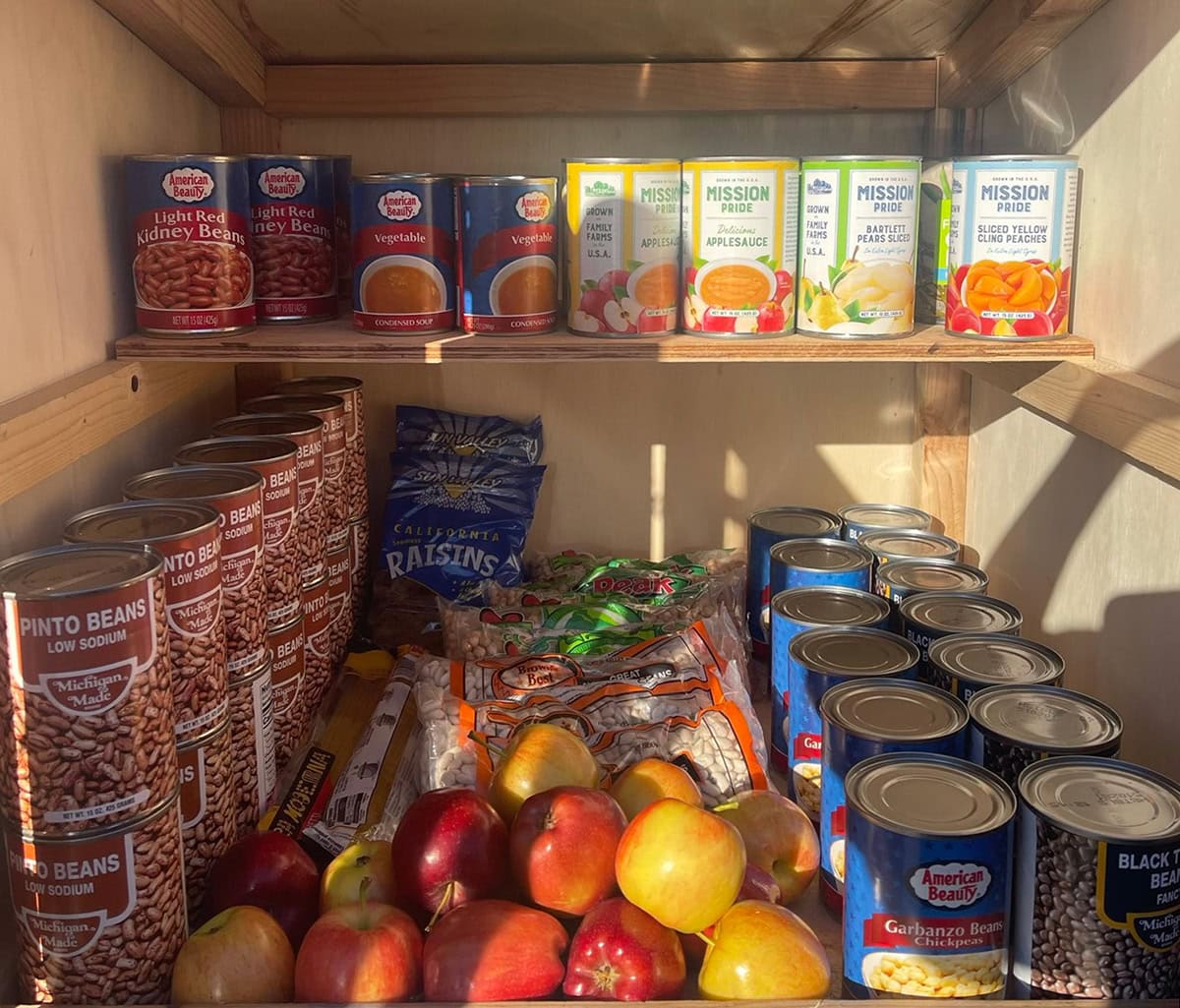
Volunteers began creating small food pantries throughout San Pedro, built by neighbors for neighbors. Similar to the Buy Nothing movement (neighbors giving and receiving things freely at no cost), the pantries are rooted in sharing without money and in building connections between people who may live just a few doors apart but have never met before.
The Collective is made up of everyday community members. As local volunteer Steve Casares explains, “Take what you need, give what you can. Community activism improves neighborhoods because it creates a feeling that people care when they help each other.”
The goal is mutual aid, neighbors helping neighbors, similar to a time when asking your next-door neighbor for a cup of sugar was normal, and sharing happened because there was enough to share. The support is inclusive and not aimed at specific populations. The intention is for people to be able to walk from their homes and access what they need without shame or barriers.
What started with just two food pantries, some resembling the little free libraries found around town, has grown across San Pedro. Anyone can place a pantry on their property, whether at a home or a business.
The pantries typically contain shelf-stable foods such as canned goods, beans, rice, snacks, and sometimes fresh produce. Donations are open to everyone, and each pantry is cared for by the person who installed it. Some pantries are repurposed pieces of furniture, while others are handmade or a shelf in a tree—the Collective plans to host a future workshop to teach residents how to build their own pantries.
Volunteers also recognize the large amount of waste generated in Los Angeles, including food and clothing that end up in landfills. By encouraging the sharing of items people no longer need, the Collective supports efforts to reduce waste while also meeting real community needs.
Just as important is shifting the narrative around asking for help, making it more normalized and not a failure, as society has been socialized to believe. With estimates suggesting that nearly 10,000 people in San Pedro experience food insecurity, the Collective believes no one in our town should go hungry.
Traditional food donation distribution systems often serve people piecemeal, typically through nonprofit organizations focused on specific groups. While those efforts are important, they do not reach everyone. The San Pedro Community Collective is trying something different. It is volunteer-run, not a nonprofit, not a business, and not driven by funding. It is neighbors organizing from the ground up.
“Nonprofits cannot solve what for-profits cause,” says Casares.
As people began leaving clothing at food pantries, which proved ineffective, the Collective identified another need. This led to the creation of community clothing swaps. Two successful events have already taken place in local parks. The first was held before Halloween, giving neighbors a chance to find costumes for themselves and their families. The swaps are not trades. No one needs to bring anything in order to take something, and everyone is welcome.
Today, the San Pedro Community Collective has nearly 400 members on social media and hosts in-person and Zoom meetings that are open to all.
To learn more, visit sanpedrocommunitycollective.org or find them on Facebook or Instagram at @sanpedrocommunitycollective. spt
I love books. I love them so much that when I was a kid in elementary school, I’d spend most of my Saturdays in the old San Pedro Library while many of my peers were out playing ball on the sandlots (which is why they became athletes and I became a sports writer).
I was into history and science fiction, but my favorite books were by humorist and poet Richard Armour, who wrote satires such as American Lit Relit, The Classics Reclassified, and It All Started with Columbus.
What I didn’t know at the time was that Armour was born and raised in San Pedro, his father having moved here in 1904 and opened a pharmacy. I discovered this when I got a copy of Armour’s Drug Store Days: My Youth Among the Pills and Potions, published in 1959 and still available on Amazon.
With that in mind, and knowing how much San Pedrans love their town, I’m going to list here and over the next couple of months all the books I know of that were either written by San Pedrans, written about San Pedro, or include San Pedrans.
It’s a long list that I’ve broken down by topic and present in no particular order. Many of the books are no longer available (although some may be at the library), many are self-published and hard to find, but most can be found on Amazon. I’ve reviewed many of them in this column over the years, and there are a lot of good reads; if I’ve missed one, let me know. So put down your smartphone, turn off the big-screen TV, and grab a book.
MEMOIR Levitation’s View: Lessons Voiced From an Extraordinary Journey, Vol. 1 The Wonder Years and Vol. 2 The Wooden Years by Willie Naulls. If you have to ask who’s Willie Naulls, you’re not a real San Pedran.
Autobiography of Michael George Markulis: A Professional Police Officer, Educator, Family Man by Michael George Markulis.
Missing: The Search for My Son—A True Story by Vivian Churness.
The Uninvited Guest: From the Docks to the Doorsteps by Ed Storti.
Mooney: A Story About a Girl and Her Horse by Betsy Gude Borda. When residents of Paseo Del Mar had stables.
Tales From the Ammo Dump: A Vietnam Vet Recalls His Time in the United States Army by Van Barbre.
From East Garrison to the Ranch House by Peter J. Gravett. The Black experience growing up in San Pedro, as told by the retired Army general.
Escaping the Kill Zone: My Journey From LAPD’s Zebra Unit to Undercover Federal Operative in the Las Vegas Mafia by Mike J. Powell.
Second to the Last to Leave USS Arizona by Lauren F. Bruner and Edward J. McGrath. Seven San Pedrans died on the Arizona.
The Many Adventures of a Flying Fish Sailor by John Lewis Barbre. Van’s father.
The John Barbre Life Story by John Lewis Barbre.
Apricots & Figs: An Immigrant Father-Son Story by Anthony Pirozzi, Jr.
When the Devil Smiles the Angels Frown: My Life and Times in Rock ‘n’ Roll by Leo Rossi.
View From the Top of the Mast by Bungy Hedley. Hedley’s family lived at Royal Palms.
Eli Hedley Beachcomber Original 1943 Catalog by Bungy Hedley.
How Daddy Became a Beachcomber by Marilyn Hedley.
An Ocean of Inspiration: The John Olguin Story by Stefan Harzen, Barbara J. Brunnick, and Mike Schaadt.
A Gaetano in America: My Unexpected Journey from Gaeta, Italy to the United States by Ray Vaudo.
RELIGION A Guide to Building Character in Blocks of Poetic Rhyme by Willie Naulls.
The Book of Daniel: A Well-Kept Secret Beyond and More by Charles Eisenberg. The minister and evangelist was the son of the owner of San Pedro’s legendary Shanghai Red bar.
40 Questions About Heaven and Hell by Alan Gomes. The latest of several books from the professor of theology at Biola, a San Pedro High graduate.
The Christian Family by Larry Christenson. A longtime Trinity Lutheran Church pastor and founder of the Lutheran renewal movement, wrote this best-seller.
Partnering with the King: Study the Gospel of Matthew and Become a Disciple of Jesus by John Hiigel. A Bible professor at the University of Sioux Falls and San Pedro High student body president.
Leadership in 1 Corinthians: A Case Study in Paul’s Ecclesiology by John Hiigel.
The Lutheran Theology of the Holy Spirit by Fred Perry Hall. Longtime Eastview resident sat under Christenson at Trinity Lutheran.
Cold-Case Christianity: A Homicide Detective Investigates the Claims of the Gospels by J. Warner Wallace. Raised in San Pedro, the retired Torrance police detective has written several books on apologetics.
Topics to come: history, sports, biography, novel, anthology, and others. spt
The marble tables arrived in San Pedro long before Dustin Trani did.
They came from the steam room downstairs, slabs of Carrara that had been part of this building since 1926, when it opened as the Army and Navy YMCA. Soldiers and sailors came here after their shifts to lift weights, to box and wrestle in the gymnasium, and to run laps on the sloped track that still hangs, shelf-like, above the basketball court.
Dustin’s great-grandfather Filippo knew this building. So did his grandfather Jim Sr. They worked out here, used the steam room, and walked these halls when the paint was fresh, San Pedro was younger, and the Vincent Thomas Bridge didn’t exist yet. Now Dustin stands in the same building, surrounded by those same marble slabs, fabricated into tables for a restaurant that carries a name his family hasn’t used in nearly 40 years: The Majestic.
It’s early afternoon, a few hours before dinner service, and the dining room is empty except for the light coming through the tall windows that face the harbor. Dustin walks between tables, checking details—a table setting, the angle of a chair. He’s 41, fourth generation in a restaurant family that started in San Pedro in 1925, when Filippo Trani opened a pool hall a few blocks from here and served chili beans, beef stew, and wet beef sandwiches to men who’d just cashed their checks.
“The original Majestic was on Seventh Street,” Dustin says. “A dumpy little pool hall next to the check-cashing place. That’s what they started with.”
He pauses at one of the marble tables and runs his hand across the surface.
“These were in the steam room here. When they were renovating, the owner said, ‘What do we do with these?’ I said, ‘We’ll make them into tables.’”
A scene from the original Majestic Cafe, December 1963. (photo: courtesy Trani family)
A TOWN THAT’S ALWAYS WAITING The history of The Majestic is also the history of waiting.
In 1925, Filippo Trani—an immigrant from Ischia who arrived via Ellis Island—opened his restaurant in Downtown San Pedro after a brief stint in Pennsylvania’s coal mines. He was part of a wave of Italians who settled here because the cliffs and the fishing reminded them of home. The pool hall wasn’t much, but it was his.
The name might have been painted on the door when he took over the place. Dustin isn’t sure. “Someone told me he called it The Majestic because it was ironic, like calling a dump a ‘palace.’ But I don’t know if that’s true.”
What’s true is that it worked. The restaurant grew. In 1964, they expanded. In 1974, the city approached Filippo with a proposal: move closer to the waterfront. The whole area was about to be redeveloped, they said. The new San Pedro waterfront was coming.
Fifty years later, it’s still coming.
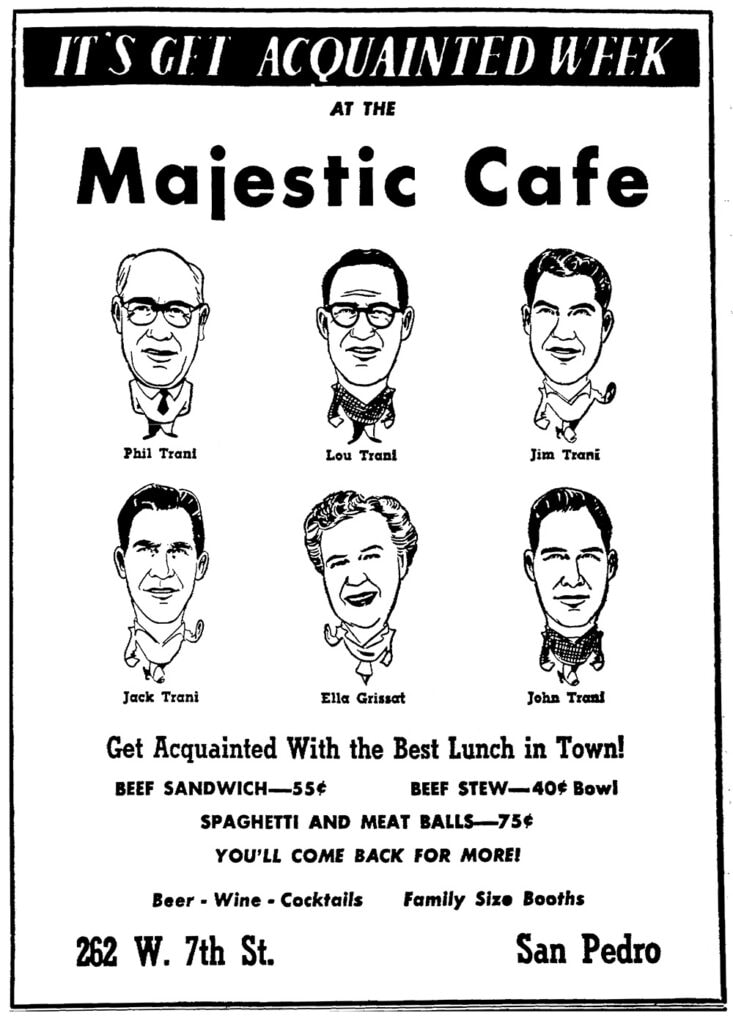
A newspaper ad for the Majestic Cafe, featuring members of the Trani family, circa 1960s. (photo: San Pedro Heritage Museum)
“My dad remembers being told, ‘This is it, the waterfront is happening,’” Dustin says. “I remember being 21 in the early 2000s, looking at renderings of the [San Pedro] Public Market, thinking, ‘I’ll be 25 when this opens.’ I’m 41 now.”
All those years, while the town was busy waiting for its future, the building—known locally as the Harbor View House—was accumulating a history of its own. It was a Jay, Rogers, and Stevenson-designed Mediterranean Revival landmark that spent five decades as a state-run mental health facility, a long, quiet stretch of time before the Hillcrest Company arrived in 2018 to peel back the layers and find the 1926 bones underneath.
Dustin is sitting at a table near the stage (yes, there’s a stage; more on that in a moment), talking about how San Pedro isn’t a pass-through town, about how every decade, someone promises the waterfront is about to change, and every decade it doesn’t, until maybe now it finally is. West Harbor is taking shape.
The Majestic opened just before Christmas in a building overlooking West Harbor that required millions in restoration, with a vision that’s both reverent of the past and completely uninterested in being trapped by it.
INHERITANCE AND INDEPENDENCE Dustin Trani became executive chef at J. Trani’s Ristorante when he was 18 years old.
It wasn’t nepotism; he earned the job. His grandfather Jim Sr. had been running the family kitchens since returning from World War II. His father, Jim Jr., loved the business—the architecture, the design, the building—but not the daily grind of the kitchen. When the opportunity came, Dustin took it.
“I’d been working there since I was 12,” he says. “Dishwasher, then pantry, then pizzas. At 18, I was already running the kitchen a few nights a week. When they said, ‘You want it?’ there was no doubt in my mind.”
He learned the basics from his grandfather and father: work ethic, attention to detail, and the difference between good enough and good. He learned that you don’t outsource, you make it yourself—the sausage, the bolognese, the breads. He learned that restaurants are built on consistency, and consistency is built on repetition, and repetition is only sustainable if you love it.
But there was something they couldn’t teach him.
“The biggest thing I had to learn on my own was that you don’t always have to do it yourself,” he says. “They gave me this incredible foundation—work hard, pay attention, do it right. But to be successful without killing yourself, you have to trust people. You have to teach them to do it as well as you, if not better.”
At 28, he got the chance to test that theory. An opportunity came to open a restaurant in Beverly Hills (Doma, in the Golden Triangle), and Dustin took it. Esquire took notice. Bravo came calling.
It also didn’t feel right.
“It didn’t feel like home,” he says. “I was going to move to LA, and I just couldn’t do it. I couldn’t leave San Pedro.”
He came back in 2016 and opened Trani’s Dockside Station in 2023, in the old immigration building (and former home to Canetti’s Seafood Grotto) at the corner of 22nd and Signal streets. And now this: The Majestic, in a building his ancestors knew, under a name that hasn’t existed in decades.
“When I saw this space,” he says, “I knew. This is The Majestic.”
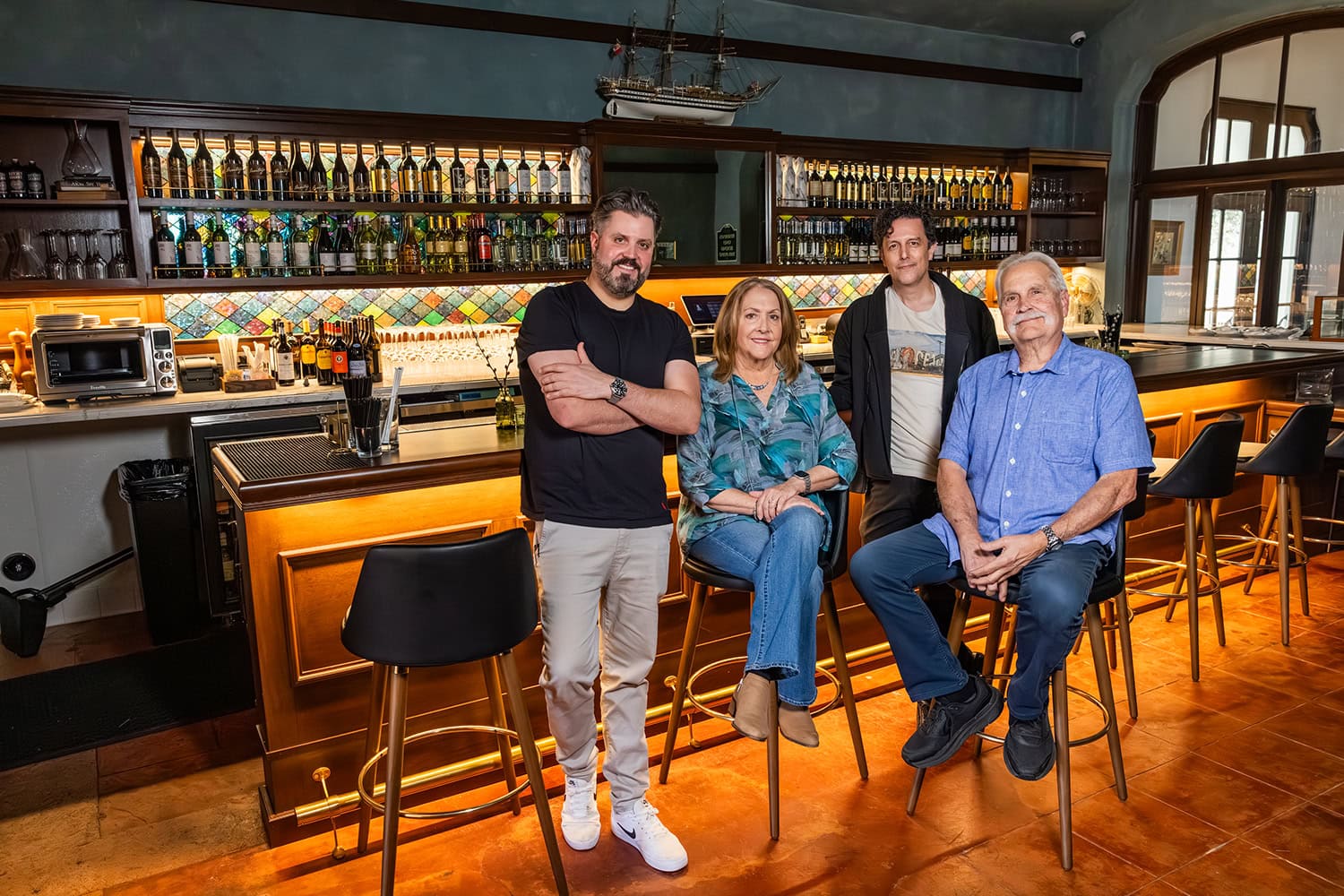
The bar, offering coffee during the day and libations at night, stretches beneath stained glass and shelves of wine bottles, transforming a historic space into an elegant gathering place once again. (photo: John Mattera Photography)
TRADITION WITHOUT THE TRAP The menu at The Majestic is an argument about memory, where dishes like linguini and clams nod to old-world originals, while the sea urchin with black ink pasta reflects Dustin’s time in Thailand and Michelin-starred kitchens.
“It’s about finding the balance,” he says. “Paying tribute to the past but not being trapped by it. You can still get the lasagna, the bolognese. But we’re also doing things nobody in my family would have done.”
His grandfather and father let him do this. After he came back from Thailand in 2007, inspired and restless, they gave him permission to change everything at J. Trani’s. New menu. New techniques. Asian influences. Square plates.
“If they’d said no,” Dustin says, “I probably wouldn’t be here. I’d have gone to work somewhere else.”
But they didn’t say no. They said: go.
His father, Jim Jr., remembers that decision. “All the old restaurants in this town–Olson’s, Papadakis, Louie’s—they all did the same thing every night, and they’re all gone,” he says. “The changes created a whole new clientele.”
It’s a small thing, that permission. But it’s also everything. Four generations in the restaurant business is rare. Four generations where each one is allowed to reinvent the work is rarer still.
“My grandfather was at the restaurant every morning until he was 85,” Dustin says. “Cleaning stoves, making soups. My dad’s 73, still making the bolognese, still making the sausage. That’s the work ethic. That’s what they taught me.”
He pauses.
“But they also taught me that it has to be mine.”
Dustin’s grandfather Jim Sr. died in 2013. Dustin never knew Filippo, who died five years before Dustin was born.
“I know my grandfather was proud of all his grandkids,” Dustin says, “but he wasn’t a big ‘attaboy’ guy. It was more like ‘You do the work, you prove yourself, you earn respect.’”
Dustin’s mother, Viki, agrees. “Knowing Jim Sr., he would just nod his head,” she says. “He would have tears in his eyes, and I think he would have been extremely happy.”
MORE THAN A DINING ROOM The Majestic isn’t just a restaurant. It’s also a venue.
The dining room has a stage and a state-of-the-art sound system designed for live performance. The vision is unannounced acts—a comedian one night, a guitarist the next, another day a string quartet. Dustin and his business partner, KamranV, want The Majestic to become the kind of place where you never quite know what you’re going to get, where the surprise is part of the draw.
The curation philosophy draws from the building’s history. “When Bob Hope and Lucille Ball were entertaining the troops here, it may have been a comedian and a juggler or a musician,” KamranV says. “That variety spirit is how we decide what happens here.”
The Majestic’s dining room, with its main stage, blends warm design with deep San Pedro history. (photo: John Mattera Photography)
The bet is that food and performance together create something neither could alone: a reason to drive to the edge of Los Angeles, to a harbor town that’s always been a little out of the way, a little overlooked. The bet is that San Pedro is ready.
“San Pedro isn’t a pass-through town,” Dustin says. “It’s a destination. That’s been the problem, but it’s also the opportunity. If we give people a reason to come, they’ll come.”
NOT A REVIVAL—A REWRITING It’s a winter afternoon in The Majestic, and the light changes quickly. Dustin walks through the empty dining room, pointing out the building’s many original features. Those marble tables catch the late afternoon light. The harbor—the cranes, the ships, and the bridge that’s under construction, now always under construction—is visible through the windows.
The original Majestic served its last dinner in the late 1980s. When the relocated restaurant on Sixth Street closed (the space later housed the Green Onion), the name disappeared. The family moved on. Filippo was gone. Jim Jr. was running J. Trani’s. The pool hall became memory, then mythology, then a name that younger generations didn’t recognize.
And now it’s back, in a building Filippo and Jim Sr. knew, in a town that’s been waiting 50 years for its waterfront to arrive.
Across the courtyard, the restored gymnasium gleams with its polished floors and that original sloped running track around the upper perimeter. Downstairs, in the old boiler room, they’re building a speakeasy with a 30-foot library bar, vinyl records, and a password you’ll need to know.
But The Majestic is not a museum to a lost San Pedro. It’s a revision. A rewrite. The same name painted on a new door, the same family in a new kitchen, the same harbor outside, completely changed—all of it part of a new story taking shape.
The past, Dustin knows, isn’t something to be preserved under glass. It’s raw material. Steam-room marble you can eat off, and recipes you can argue with. In a town that’s been told for generations that its future is “coming soon,” The Majestic makes a quieter, more confident claim: The future is already here, built out of what survived. spt
The Majestic is located at 921 S. Beacon St. For more info, visit themajestic.la.