
The feeling hits you before you find your seat.
The ballroom of the Dalmatian-American Club fills from the edges inward: conversation first, then laughter, then the warm friction of a room that has decided, collectively, to have a good time.
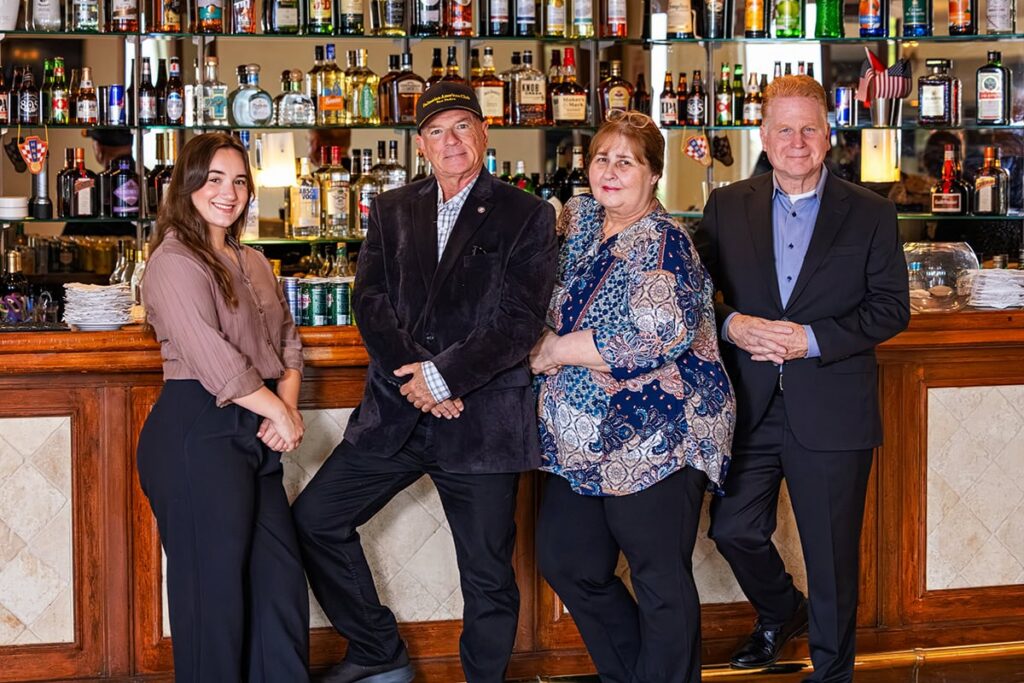
Rudy Svorinich, Jr. has stood in this room for nearly half a century, and he still notices it. “When people arrive for an event,” he says, “they really want to be there. There’s this overwhelming joy and happiness and festive mood.” He pauses, searching for the right word. “Electric,” he settles on. “The feeling is electric.”
That electricity has been running through this building for a hundred years. On May 6, 1926, 25 Croatian immigrants—fishermen, cannery workers, dockworkers, men whose hands knew saltwater before they knew English—gathered at a lawyer’s office on West 7th Street in San Pedro and founded the Jugoslav Club. They had no building. They had no money to speak of. What they had was a conviction that belonging was worth a fight, and the port town of San Pedro, with its fishing boats and its fog and its immigrants from the coasts of Southern Europe, would be the place to create that sense of belonging.
They were right. The Dalmatian-American Club of San Pedro, the institution that grew from that first meeting, turns 100 this May. It has outlasted the country it was named after. It has survived a world war, a terrorist attack, a name change, three financial crises, and a pandemic that left it with only $2,000 in the bank. It has hosted a Croatian president, a Croatian prime minister, Tommy Lasorda, and actor Karl Malden. It has witnessed thousands of San Pedro weddings, funerals, quinceañeras, and fish luncheons. And on the last Friday of every odd-numbered month, it still serves swordfish, family-style, to anyone who shows up feeling hungry and sociable.
A HOME AWAY FROM HOME
San Pedro made sense to Dalmatian migrants because it looked and felt like home. Fishermen from the islands of Vis, Brač, and Korčula arrived to find waterfront jobs, fishing boats, and a port culture built on physical labor and tight-knit community, the same rhythms they had known back on the Adriatic. By the mid-20th century, San Pedro had become one of the largest Croatian settlements on the Pacific Coast. The club became what Svorinich calls “the landmark,” a monument not only to Croatian identity but also to the broader immigrant project of building a life in a new country by creating something that would outlast you.
That project had a price tag. In 1934, in the depths of the Depression, the club’s building committee needed to close a funding gap to break ground on a permanent clubhouse. A member named Paul Marinkovich came home from a committee meeting and told his wife he wanted to donate $10,000 (roughly $240,000 in today’s dollars) to fill it. She reminded him they had saved that money to buy their own house. He told her he would make more money, that he could build their house later, but that the $10,000 was needed now. “For our people,” he said. She agreed.
Svorinich heard this story from Paul’s son, who was in his 80s at the time, and it has stayed with him. “For someone to take what in the present day would be hundreds of thousands of dollars and give it to their social club,” he says, “knowing that it was not only for their people but for their community—that’s phenomenal. To squander that love and dedication would be a terrible injustice. That’s why we continue to carry on.”
BUILDING BEGINNINGS
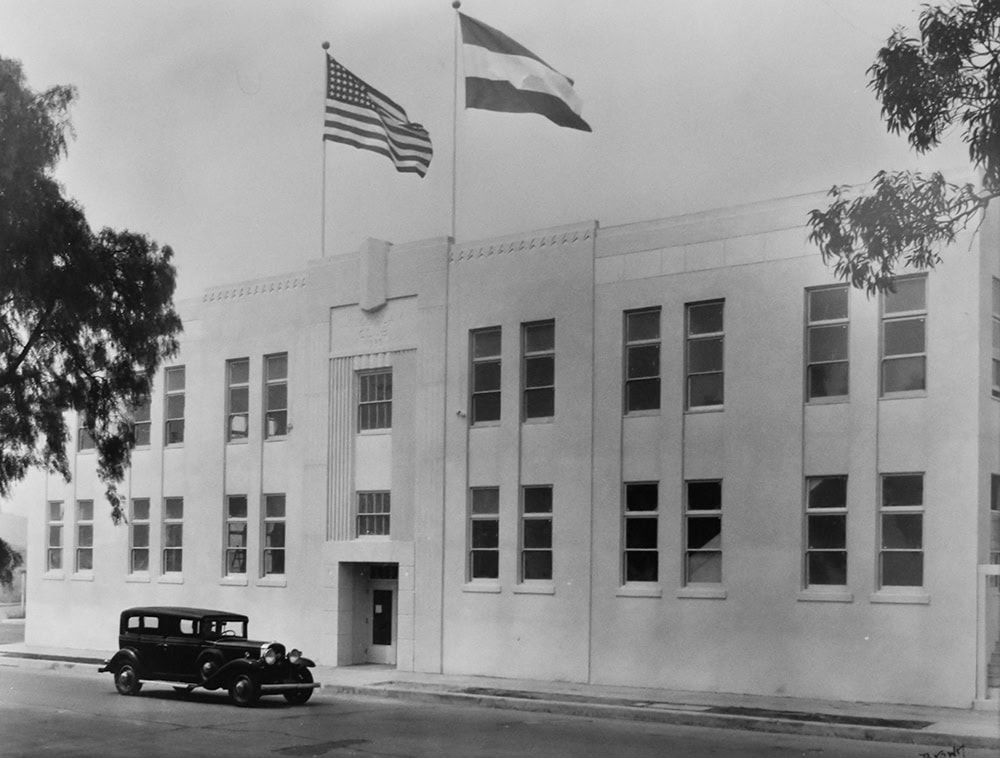
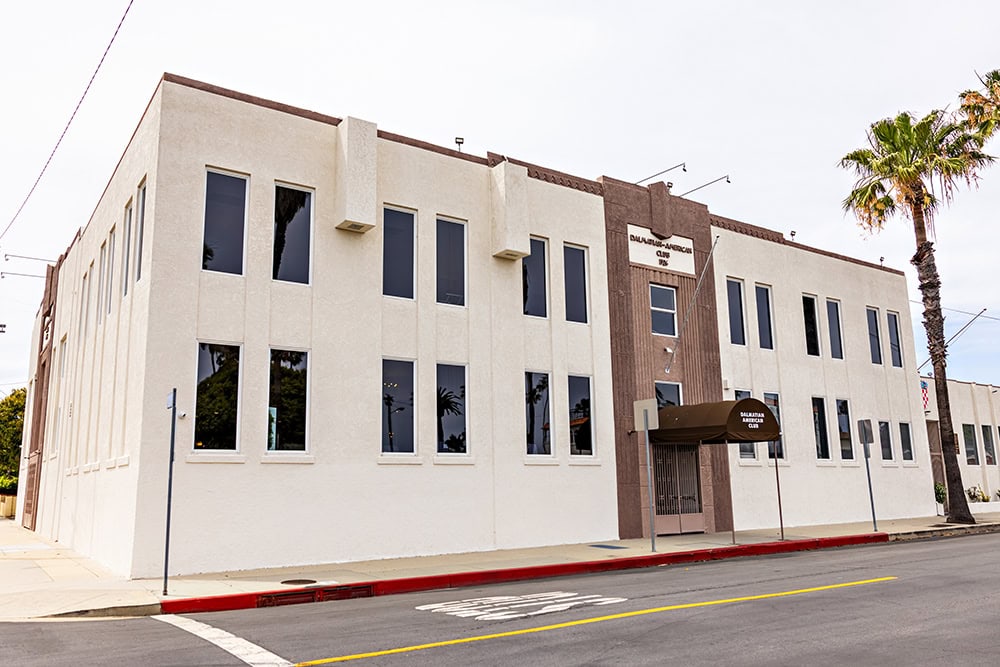
The new clubhouse opened on August 31, 1935, as a two-story Art Deco building at the corner of 17th and Palos Verdes streets, featuring a grand ballroom, a balcony stage, and theater-style seating along the perimeter. More than a thousand people attended the three-day opening celebration. The club’s president, Martin J. Bogdanovich—a sardine fisherman turned tuna canner who founded StarKist Tuna—led the festivities. Nine years later, in 1944, during a war bond rally on that same stage, Bogdanovich suffered a heart attack and was carried off in front of a distraught crowd. He was 61. His portrait still hangs in the upstairs dining room. His bronze bust still watches over the lobby.

(photo: courtesy Dalmatian-American Club)
Institutions that survive a century do so because they absorb history rather than resist it, and the Dalmatian-American Club has absorbed plenty. In 1973, foreign agitators—believed to have been sent from Yugoslavia to stir up tensions in Croatian-American communities—injected an incendiary liquid through the club’s front-door mailbox and set the entryway on fire. The building was saved by its own architecture: a second set of glass doors at the top of the stairway starved the fire of oxygen. The attackers—the history records with a certain grim satisfaction—later perished in San Pedro while attempting another arson.
Through the Cold War years, the club navigated the fault lines of Yugoslav identity politics, yet its relationship to the homeland was never merely symbolic. During World War II, it hosted war bond rallies and collected humanitarian aid for refugees in Yugoslavia. In the early 1990s, as Croatia fought for independence, the club became a conduit for something more tangible: shipping containers of food, medicine, and clothing sent to the homeland, along with four surplus Los Angeles rescue ambulances and three fully equipped city fire trucks. “They wanted to build a new life in America,” Svorinich says of the founding generation and those who followed, “but they never forgot where they came from, and when the time arose where assistance was needed in the homeland, our members always rose to the occasion.”
THE FAMOUS FISH LUNCHEON
The club’s name changed three times over the century: Jugoslav Club, then Yugoslav-American Club, and in 1992, after Croatia declared independence, the Dalmatian-American Club of San Pedro. “The club might have been born as the Yugoslav club,” Svorinich says, “but it most certainly exists and lives today as an American Croatian club.” The building stayed the same. The exterior flag changed.
Through it all, one thing didn’t change: the fish luncheon. Since January 1961, on the last Friday of every odd-numbered month, the club has served swordfish, mostaccioli, green beans, and potatoes to whoever shows up. Eighteen people attended the first luncheon. By the late 1980s, more than 400 were coming.
For more than 50 of those years, a man named Gojko Spralja ended each luncheon by leading the room in “God Bless America.” Spralja, who arrived with nothing and built a life in San Pedro, died in December 2024. Last September, the intersection near the club was renamed Gojko Spralja Square in his honor. The singing continues. “It isn’t the same,” Svorinich says quietly, “because he was our song leader.” A pause. “Gojko’s story is the story of our club. And our story is his story.”
The next fish luncheon is on May 29. If you don’t walk out feeling better than when you walked in, Svorinich says, that’s your own fault.
SURVIVING THE PANDEMIC
n March 2020, the state of California ordered all public gathering places to close. The Dalmatian-American Club had deposits on the books, staff on payroll, and no playbook for what came next. Over the following weeks, the club refunded deposits, reduced operations, and watched its finances drain. By May 2020, there was $2,000 left.
Svorinich made a decision not to furlough anyone. “They had families to feed,” he says. “We went to three-quarter time. We never fired anyone.” Then came the improvisation: weekly to-go dinners, packaged and handed out to customers idling in the parking lot. A Wall of Honor in the lobby, where members could buy commemorative plaques for $250 to $1,500. Bake sales and outdoor fundraisers organized by the club’s youth group, led by Svorinich’s daughter Danielle, who was 20 at the time. Over 18 months, the club sold between 15,000 and 16,000 meals and raised—through the dinners, the Wall of Honor, county grants, and a federal loan it invested rather than spent—enough to not only survive but also pay off its existing bank loan early.
The symmetry is not lost on Svorinich. In 1934, the founding generation raised $100,000—nearly $2 million in today’s dollars—to build the clubhouse. In 2020, the Wall of Honor alone raised $100,000, and the full COVID recovery effort raised far more. “In 1935, the members and their families donated $100,000 to build it,” he says. “Then, 85 years later, the members, their families, and our community friends donated more than that to save it.” He pauses. “Pretty amazing.”
What the crisis revealed, Svorinich says, was something the club had perhaps always suspected but couldn’t fully see: that it belonged to San Pedro more than San Pedro knew. “We always knew how important we were to our members,” he says. “COVID and post-COVID showed us how important we were to the greater community. People came back in droves.”
A ROOM DESIGNED TO EMBRACE
Rudy Svorinich, Jr., first walked through the club’s doors as a member in June 1978, sponsored by his father, Rudy, Sr., who had joined in 1958. His grandfathers joined in the early 1940s. His maternal grandparents met at a club dance in 1929 or 1930, before the building even existed. His parents met at a dance at the club in 1951. He met his wife, Deann, at a dance at the club in 1988. It is not, says Svorinich, a stretch to say that he and his children owe their very existence to the place.
He joined the board of directors in 1983, a nine-month favor to his father that has now stretched past four decades. He has served as club president for 21 years, across two separate tenures. When you ask him what the club needs to stop doing to survive the next hundred years, he surprises you. Stop worrying about social media, he says. Stop treating it as a threat. “As long as we keep the doors open and remain a welcoming place for folks to enjoy one another’s company,” he says, “we need not worry about social media as much as we thought we had to.” COVID, paradoxically, proved his point: When isolation ended, people didn’t stay home with their phones. They came to the club.
The Grand Ballroom’s balcony extends in two curved wings above the dance floor, like two arms reaching out. Svorinich has noticed this for years. It has always struck him as intentional, a room designed to embrace whoever walks in. The founding members raised the money, built the walls, hung the chandeliers, and set the stage. What they were really building, he thinks, was the embrace.
“We became,” he says, “a monument to the American dream, not only for the Croatian immigrant people of our community but for many other immigrant people as well. That’s what we became.” He thinks about Gojko Spralja, about the Marinkovich family, about his grandmother meeting his grandfather at a dance before the building existed. “We are forever grateful,” he says finally, “to everyone who wouldn’t let us die.” spt
The Dalmatian-American Club is located at 1639 S. Palos Verdes Street. For more info, call (310) 831-2629 or visit dalmatianamericanclub.com.

Aaron McKenzie is a director, photographer, and producer who has called San Pedro home since 2014. Whether he's exploring the town’s local history, its arts scene, economics, or maritime industries, Aaron’s writings for San Pedro Today are just his selfish excuse to learn about his fellow San Pedrans and this cool place we call home. Follow his adventures on Instagram at @aaronwmckenzie.

Share Your Comments