
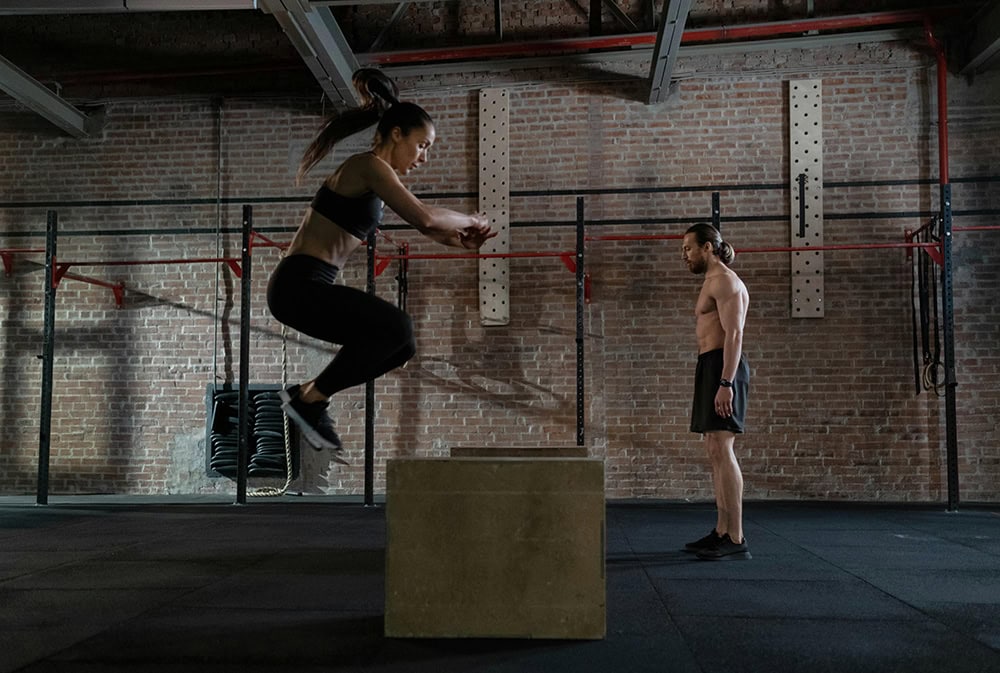
A few weeks ago, one of our members looked at the workout board and froze.
The movement was a simple box jump. Nothing crazy. Nothing dangerous. Just a controlled jump onto a box. She looked at me and asked, “Coach, aren’t plyometrics bad for your knees?” It’s one of the most common fears I hear. For many people—especially adults over 40—the word plyometrics conjures images of elite athletes flying through the air, pounding their joints into the ground, and blowing out their knees. But that image couldn’t be further from the truth.
When programmed correctly, plyometrics are among the most powerful tools we have for improving health, resilience, and longevity. Not just for athletes—for everyone. Plyometrics train your body’s ability to produce force quickly. In other words, they train power, which declines faster with age than almost any other physical quality. Research shows that after about age 30, adults begin to lose explosive strength at a steady rate. That loss of power is one of the biggest contributors to falls, slower reaction times, and decreased mobility later in life.
Think about something as simple as catching yourself when you trip, jumping over a puddle, or reacting quickly when you lose your balance. All of those actions require power. Plyometric training helps preserve that ability. A key point many people misunderstand is that plyometrics don’t have to mean high-impact jumping. For older adults or beginners, plyometric training can be as simple as small pogo hops, gentle jump rope work, step-off landings, medicine ball throws, or low-box step-and-stick drills. The goal isn’t to jump as high as possible. The goal is to teach the body to absorb and produce force safely and efficiently.
When taught correctly, plyometrics often improve joint health rather than damage it. The tendons, ligaments, and muscles around your joints adapt to the loading and become stronger and more elastic. Your body essentially becomes a better shock absorber. Studies have shown that plyometric training can improve bone density, tendon stiffness and elasticity, balance, coordination, reaction time, and even walking speed in older adults. In other words, it improves the exact qualities that help people stay mobile and independent as they age.
Perhaps one of the most overlooked benefits is confidence. There is something powerful about realizing you can still jump, react, and move quickly. It reminds people that aging does not automatically mean slowing down. Of course, plyometrics need to be introduced thoughtfully. You start by teaching proper landing mechanics, controlling jump volume, and gradually increasing intensity. A 25-year-old athlete may be doing hurdle bounds or depth jumps, while a 60-year-old client might begin with gentle rebounding hops or stepping off a small platform and learning to land softly. Both are still training power, and both are building resilience.
The truth is that the real risk isn’t plyometrics. The real risk is never training power at all. If we stop asking our bodies to move and react quickly and produce force, those abilities slowly disappear. The good news is that the body can adapt at any age. You just have to give it a reason to. Sometimes that reason starts with something as simple as a small leap of faith. spt

Eddie McKenna is co-owner of Heyday Elite Fitness. For more info, visit heydaytraining.com.









Share Your Comments