
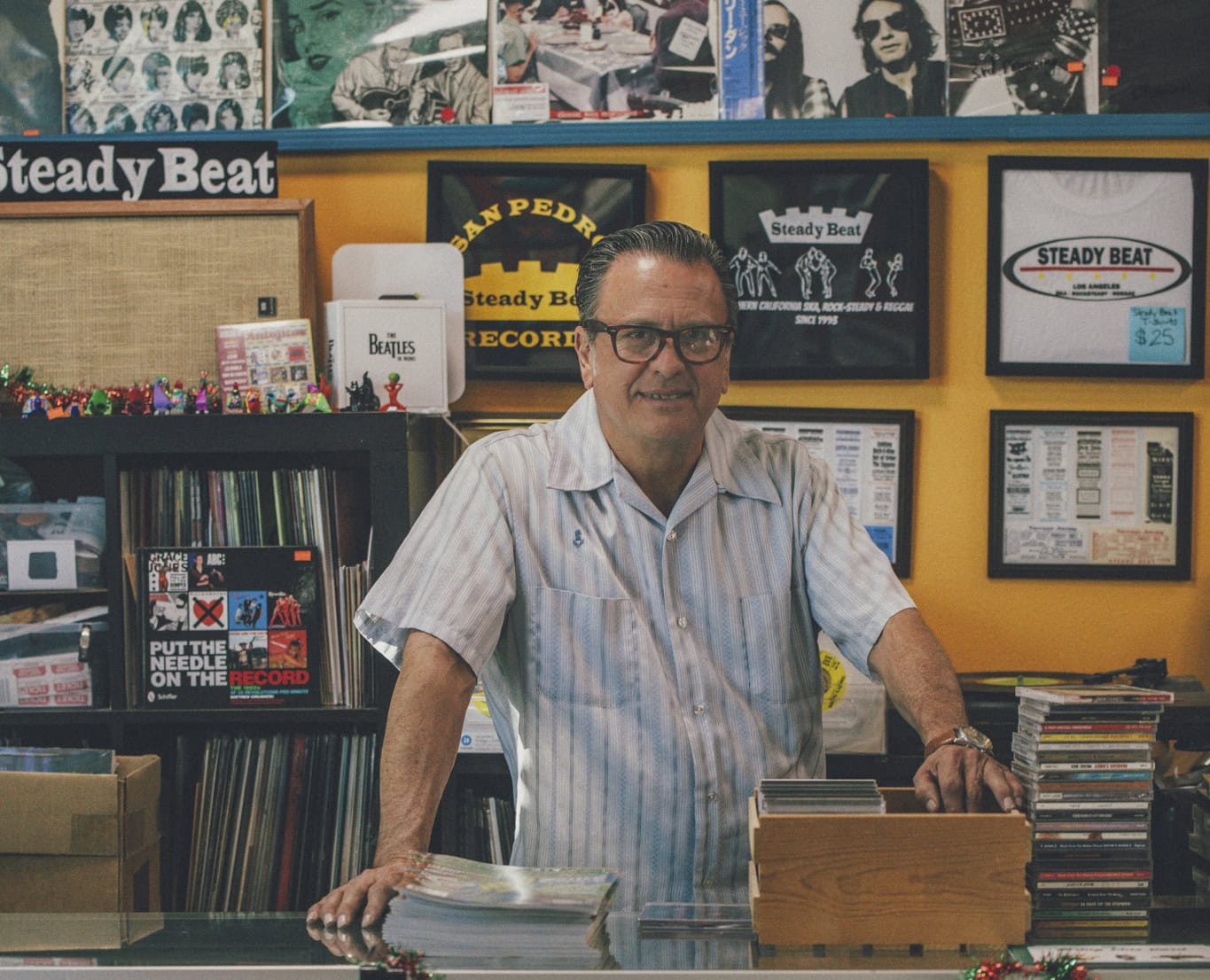
Luis Correa vividly recalls the exact price he paid for his first two records: 25 cents each at the Vermont Avenue swap meet in 1978, when he was nine–“I Want You Back” by the Jackson 5 and El Chicano’s “In a Silent Way.” Then he bought the Madness greatest hits album, and that’s how all this madness began.
Five decades later, the madness continues. Correa owns Steady Beat Records on Seventh Street in Downtown San Pedro, where roughly 80,000 vinyl records (along with CDs, cassettes, t-shirts, posters, and other miscellany) demonstrate what’s possible when music fans reclaim control from the algorithms.
Twenty-five years ago, around the turn of the millennium, none of this seemed possible. In 1998, Correa was running Steady Beat Recordings, his own label focused on the local ska and reggae scene. His releases were sold in Tower Records. Distributors were moving product. Then Napster arrived, and within a year, everything imploded.
“Distributors started shutting down,” he recalls. “They started calling me saying, ‘Hey, listen, we’re not accepting any more vinyl. We’re sending back your stuff… and you owe us money.’”
Everybody in the vinyl business was out of a job. For years after, records became the domain of DJs and collectors who knew which shops still existed. Correa continued DJing, promoting shows, and staying involved in the music scene however he could. Then, around 2008, things started to change. Some music fans grew frustrated with iTunes’ licensing restrictions, realizing they didn’t actually own any of the music they had “bought,” so they started buying vinyl again. By the time Correa opened Steady Beat Records at its original Gaffey Street location in September 2021, the revival was complete.
Walk into Steady Beat, and the shop reveals Correa’s 50-year education. The Latin section—one of the best of its kind in Los Angeles—is renowned for its cumbia, salsa, boogaloo, Latin funk, and rare Colombian Fuentes pressings. The store also features plenty of jazz, soul, classic rock, punk, and even some niche subsections like drum and bass, jungle, 1990s house, trance, and freestyle, all meticulously organized for easy browsing.
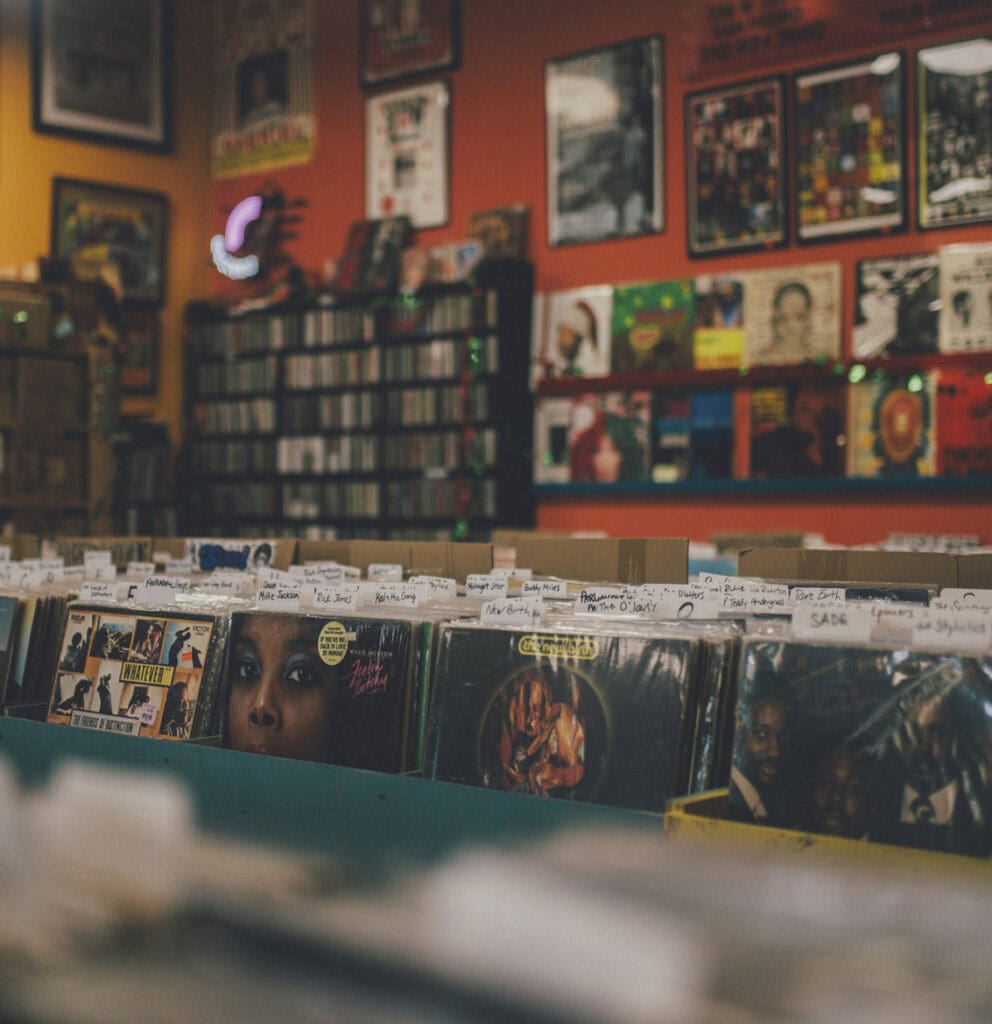
“I was a DJ, so I couldn’t have all my stuff mixed up,” Correa explains. “When people come in, they don’t waste time. They’re like, ‘Where’s Run-D.M.C.?’ It’s right there, easy to find, so now they have time to keep looking for other stuff.”
This is Correa’s invisible labor: knowing what to stock in the main bins and what to exile to the $5 bargain boxes. After four years, Correa has learned that Fleetwood Mac flies out the door, as do The Police and The Cars. Neil Diamond, despite writing some of the greatest pop songs of the late 1960s, doesn’t move. “People don’t know he was a great songwriter. They just look at him as that 1980s Jazz Singer guy.”
Recordhounds are known for amassing huge collections. Asked about the difference between a collector and an enthusiast, Correa replies, “A collector will try to show somebody that he has, say, a sealed copy of some album,” but for Correa, the enthusiast; it’s about the music. “The music is there to be listened to. If I buy a record, I’m going to play the hell out of that record.”
The question, though, is: Why vinyl? In this age of streaming music—when the cost of listening to countless albums is near zero—why navigate what seems like a bulky inconvenience?
Correa admits that vinyl isn’t for everyone. “People who didn’t grow up with records are going to think, ‘Why do I have to do this? Why do I have to get up and change the record?’ But they also might discover that it brings them closer to what they’re hearing. Instead of just being some kind of background music, they’re actually looking at the liner notes and reading everything and actually choosing the next thing they’re going to listen to.”
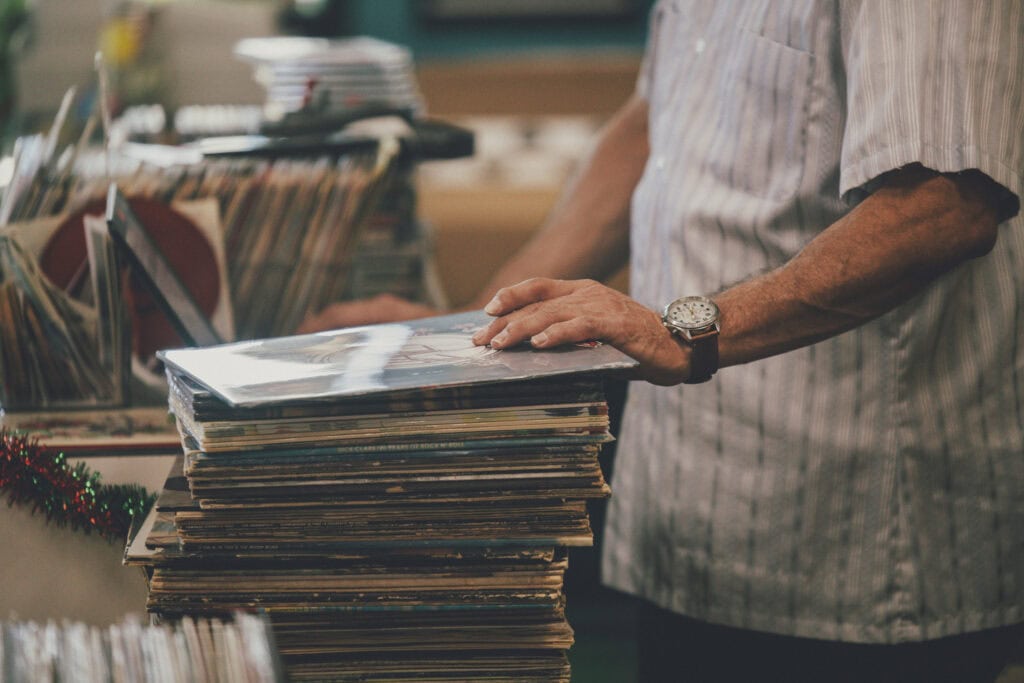
Spotify is frictionless. Vinyl demands participation. One is convenient. The other is intentional.
A good day at Steady Beat means dollars through the till. An excellent day means someone walks in with a collection to sell. Correa celebrates not the immediate cash, but the long-game value.
“I don’t look at how much money came in,” Correa explains. “I look at how much value I’ve added to the store. With that collection, all of a sudden I’m adding value.”
The store survives because Correa knows what Steady Beat is and what it isn’t: In order to know what you are, you’ve got to know what you’re not. If you try to be for everyone, you end up being for no one. When someone asks for specialized soul outside his lane, Correa sends them across the bridges to shops in Long Beach. When someone walks in looking to sell 78s or Edison cylinders, he directs them across the street to the Grand Emporium.
The Downtown San Pedro record stores—Steady Beat, JDC, the Grand Emporium, PM Sounds—each operate in their own niche and constantly refer customers to one another. “The more the merrier,” Correa says.
When the lease ended and rent spiked at Correa’s original Gaffey Street location, a friend convinced him to move downtown. The decision was partly economic, partly personal. That was his chance to move the shop to another part of Los Angeles. But Correa grew up in San Pedro, knows the place, and loves it.
“This is my hometown. I know everything about this place,” he says. “I’d feel like a little outsider if my shop was somewhere else. But here? After I close, I’ll have a drink at Godmother’s and hang out. It’s my town.”
Every Wednesday, all the $5 records become $1. Every First Thursday, live bands and DJs take over the sidewalk outside. On any given Saturday, DJs drop by looking for rare Colombian cumbia. Newbies wander in asking for “psychedelic” without knowing if they mean Jimi Hendrix or Funkadelic. Collectors spend two hours digging, then buy one carefully selected record.
“The most rewarding thing is introducing music to people,” Correa says. “When someone comes in and I play them something and then they come back later saying, ‘Bro, I’ve been playing that nonstop’—that makes me happy. The reward is seeing people smile. It doesn’t cost me a thing to make people smile.”
One customer came through recently on a record store crawl from Santa Cruz to San Diego. Steady Beat was stop number 83 on his tour. Other customers stop in before catching a cruise to Mexico. Correa meets DWP meter readers, ship crew members, DJs, fanatics, and collectors hunting specific pressings.
“I meet people from all walks of life, but we have something in common: the music,” Correa says.
A friend told him before he opened his store: “You’ve been a DJ, a promoter, a band manager, a tour manager. You’ve done everything. This is the only thing you haven’t done.”
It took nearly 50 years to build the expertise that makes Steady Beat work. Every previous incarnation was preparation: knowing the music, understanding the scene, building relationships, developing taste.
After the Napster apocalypse, after watching the industry he’d built evaporate in 12 months, Correa opened a record store in his hometown and filled it with 80,000 records. Every one of them is there to be played. Every one is an argument for intentionality over ease, ownership over access, ritual over algorithm.
In an age when every song ever recorded lives in your pocket, Steady Beat Records shouldn’t exist. That it does—and that it thrives—suggests that there’s more to music than convenience. spt
Steady Beat Records is located at 336 W. 7th St. #101 in Downtown San Pedro. For more info, visit steadybeatrecords.com.

Aaron McKenzie is a director, photographer, and producer who has called San Pedro home since 2014. Whether he's exploring the town’s local history, its arts scene, economics, or maritime industries, Aaron’s writings for San Pedro Today are just his selfish excuse to learn about his fellow San Pedrans and this cool place we call home. Follow his adventures on Instagram at @aaronwmckenzie.






Share Your Comments