
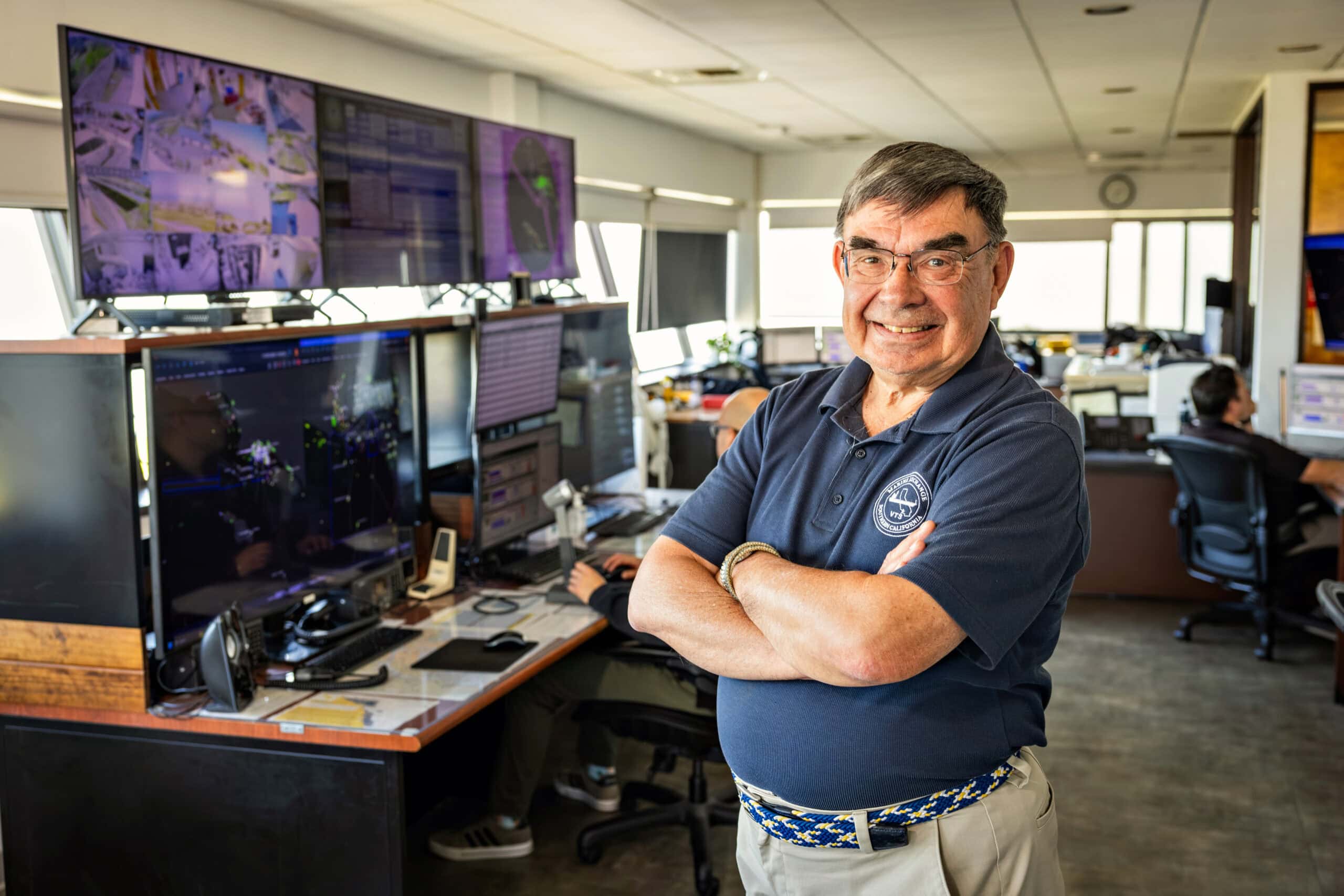
The screen glows with rows of color-coded ships.
Orange for car carriers. Blue for tankers. Green means it’s actually going to happen. Captain Kip Louttit points to the top line: Valiant Ace, arriving tomorrow at 4 a.m. from Yokohama, carrying a couple thousand cars, 199.95 meters long, flying the Marshall Islands flag, heading to Berth 198 in the Port of Los Angeles with two tugboats assigned. He knows all this because it’s his job to know.
For thirty years, he served in the United States Coast Guard aboard cutters out of Alaska, Hawaii, San Diego, Virginia, and Boston. He captained three of them. Now he sits in a building on a hill above Los Angeles Harbor, watching computer screens track ships he’ll never board.
“The now 103-year-old mission of the Marine Exchange,” Louttit says, “is assembling the schedule for the Ports of Los Angeles and Long Beach.”
He runs through the thirty columns of data they track on every vessel: who, what, when, where, how. The pilots need to know. The tugboat operators need to know. The longshoremen need to know when to show up to unload the ship. The terminals need to position their cranes. Even the guy delivering groceries to a ship needs to know where that ship actually is, not where it’s supposed to be. “Lots of people can tell you what’s supposed to happen,” Louttit says. “We tell you what’s actually happening.”
The Marine Exchange of Southern California sits atop the hill above the Korean Bell of Friendship. Maybe people notice the building while flying kites or picnicking with family, but most likely never think about what happens inside.
In 1923, it started with men using binoculars on the hills around here to spot approaching ships, then racing down to Wilmington to chalk ship arrivals on a sidewalk blackboard. The ships were color-coded then, just as they are now on Louttit’s screens. What’s changed is the scale. Back then, maybe five or ten ships a day. Now, 4,500 arrivals annually, carrying approximately $1.7 billion in cargo every twenty-four hours through the nation’s busiest port complex.
The system is peculiar. No single person is actually in charge of LA Harbor. The Port of Los Angeles owns the land but doesn’t control vessel movements. The Coast Guard has regulatory authority and could shut it all down in case of a security threat or emergency, but isn’t a traffic controller for commercial ships. The pilots guide ships in and out but don’t decide when or where.
The Marine Exchange has two parts: the Maritime Information Service (MIS) provides the information, and the Vessel Traffic Service (VTS), housed here in the same building, guides ship traffic but doesn’t tell the ships to turn right, turn left, or stop. Somehow this decentralized arrangement works. It works because everybody trusts the data.
Trust, however, is fragile. Louttit’s nightmare isn’t ships colliding; it’s someone hacking the systems. If a bad actor gets in and starts changing data, berth assignments could flip from Pier J to Pier A. Tugboats would head to the wrong location. Cranes would be positioned for the wrong ship. Pilots would expect the wrong arrival time. The harbor could grind to a halt in hours, not from physical damage but from corrupted information.
Upstairs, in the operations room, a VTS Specialist sits before a wall of screens showing the real-time movement of every vessel in the precautionary area. When the Valiant Ace appears on radar tomorrow morning, the Specialist will confirm it’s headed to the right port or anchorage. If several ships are arriving at the same time, the Specialist will work with the pilots to arrange them in the safest and most efficient order. If there’s an emergency, the Specialist will divert traffic.
When the Specialist speaks on the radio, the ships listen. The whole system runs on a mutual desire for safe, secure, efficient, reliable, and environmentally sound marine transportation, all based on a mix of trust, federal and state and local laws and regulations, and agreed-upon “standards of care” that govern everything from anchor protocols to vessel spacing.
Louttit has been leading the Marine Exchange since 2013. He holds master’s degrees from MIT and Golden Gate University. Away from this job, he’s a member of the Coast Guard Auxiliary and serves as assistant Scoutmaster for Scouting America. He’s also an accomplished sailor, the kind of navigator who understands both celestial navigation and modern vessel traffic management, who’s crossed oceans and now orchestrates the movement of thousands of ships through one of the world’s busiest ports.
What he values most is the people. “A workforce who is never late,” he says, “because they really value, as I do, what we give to the port complex.”
There are twenty members of the Marine Exchange and six Coast Guard members who work together as a single blended workforce. He gets emails and phone calls: You guys are great. You’re saving my company money. The terminal operator knows when the ship will actually arrive. The line handlers show up at the right time. The customs agents clear the ship so the longshoremen can start unloading. Everything is synchronized.
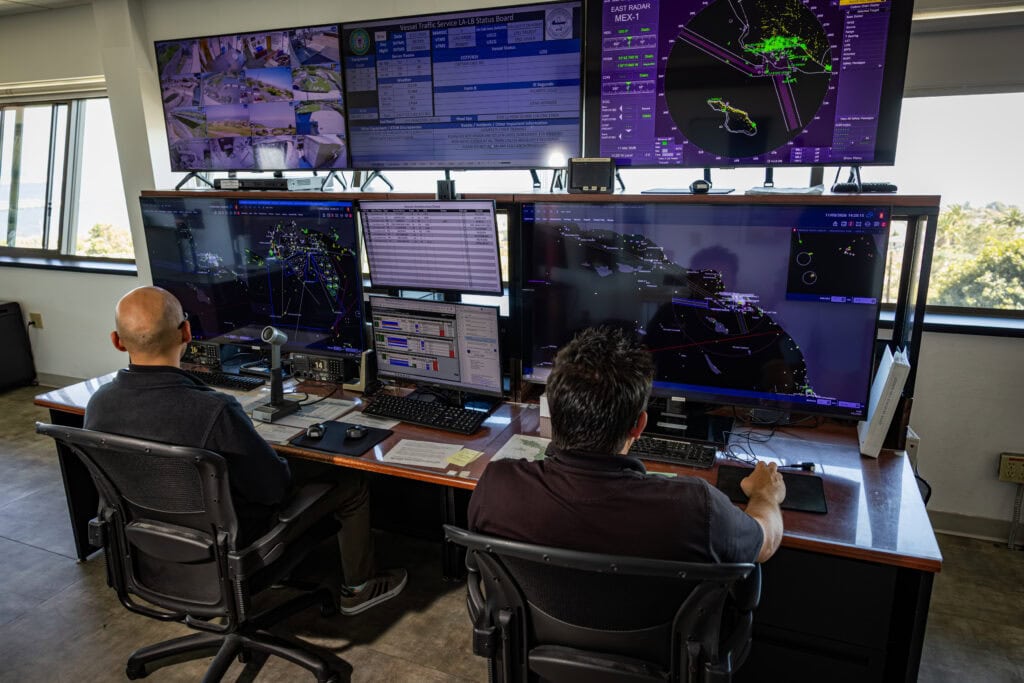
He mentions something called the Pacific Maritime Management Services (PacMMS), created during the 2020 COVID supply chain backup when more than a hundred ships drifted off the coast. People were complaining about particulate matter on their patio furniture from those idle ships. Louttit and his partners pointed out they could track ships across the ocean using modern technology and calculate arrival times using the simple speed-time-distance formula.
They worked with the Marine Exchange of Alaska, which analyzed more than two million rows of data over a weekend and discovered that container ships cross the Pacific in two weeks at an average of eighteen knots. The solution: instead of racing across in two weeks and waiting offshore, ships could slow to nine knots, cross in four weeks, and arrive exactly when their berth was ready.
“And then three months later, when we had this new system in place,” Louttit recalls, “they weren’t getting particulate matter on their patio furniture anymore.” The backup ended in November 2022, but PacMMS remains, still counting container ships crossing the Pacific, still feeding data to the ports, still keeping ships from piling up offshore.
The ships keep moving through the harbor’s channels. Massive container vessels stacked seven stories high, tankers bringing oil, car carriers like the Valiant Ace arriving at 4 a.m. tomorrow. Louttit knows where each one is headed. He knows that tugboats are assigned, that pilots will be boarding, that longshoremen will be waiting. The entire system is synchronized by the data his twenty civilians and six Coast Guard specialists provide.
It’s been happening for 103 years now, and still the people flying kites down at the Korean Bell have no idea what’s going on in the building at the top of the hill. Which means it’s working. spt
For more information on the Marine Exchange of Southern California, visit mxsocal.org.

Aaron McKenzie is a director, photographer, and producer who has called San Pedro home since 2014. Whether he's exploring the town’s local history, its arts scene, economics, or maritime industries, Aaron’s writings for San Pedro Today are just his selfish excuse to learn about his fellow San Pedrans and this cool place we call home. Follow his adventures on Instagram at @aaronwmckenzie.






Share Your Comments