
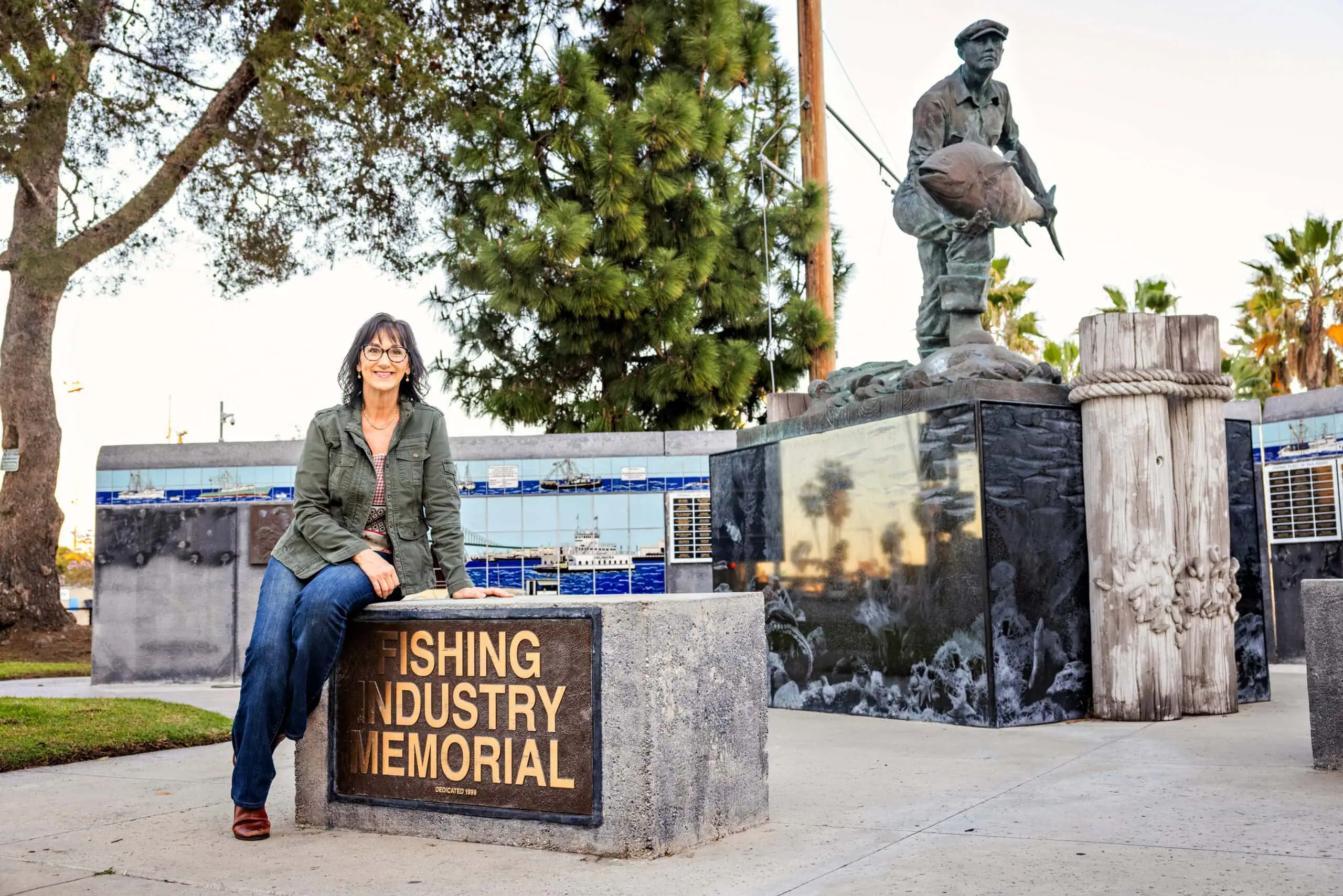
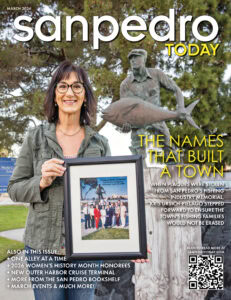
Kris Ursich-Pielago keeps photographs of the plaques on her phone.
Not the new granite ones going up now at the Fishing Industry Memorial on the San Pedro waterfront at Fifth and Harbor, but the old bronze ones—the ones stolen in late 2023, pried off in the dark, sold for scrap. When someone emails asking if their grandfather’s name was there, she zooms in on those photos, squinting at names engraved 27 years ago, and tells them yes or no. Sometimes she recognizes a name before she finds it. “Oh yeah, I know that name,” she says. In San Pedro, everybody knows the names.
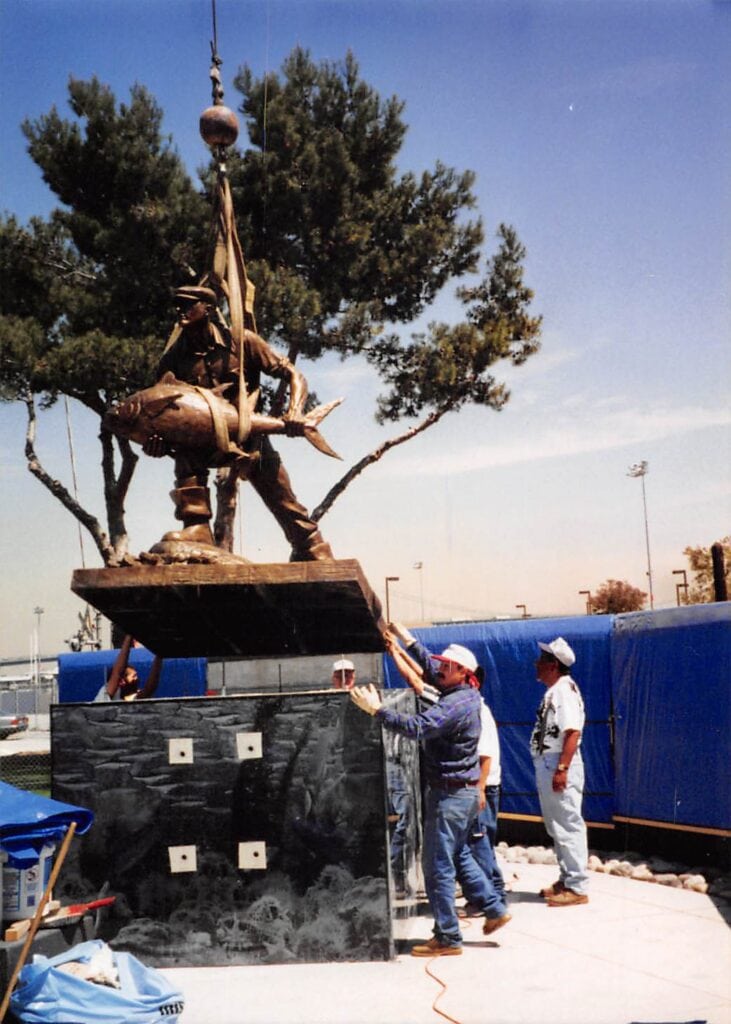
The memorial, begun in 1992 by the Fisherman’s Fiesta committee, was completed in 1999 by a new committee that included Pielago’s mother, father, uncle, and two aunts, all now deceased. Designed by artist Robert Pena with lead sculptor Henry Alvarez, it featured a bronze fisherman holding a tuna and a hand-painted tiled wall where plaques bore the names of the immigrants who made San Pedro the largest fishing port in the country.
At its height, the industry supported tens of thousands of jobs, from cannery lines and fishing boats to shipyards, ice plants, and other businesses that kept the harbor working. Eighteen canneries lined Terminal Island. StarKist and Chicken of the Sea started here. If you lived in San Pedro mid-century, you either fished or worked the docks or packed tuna. When the Fisherman’s Fiesta rolled around, the Catholic Archbishop of Los Angeles would bless the fleet before it went out.
The last cannery closed in 2001. The fleet dwindled to a handful. By the time the memorial went up, it was already an elegy.
Pielago didn’t ask for the job of maintaining it. Her mother handed her boxes of documents and asked if she’d take care of things. “Sure,” Pielago said. She thought it meant keeping the site tidy.
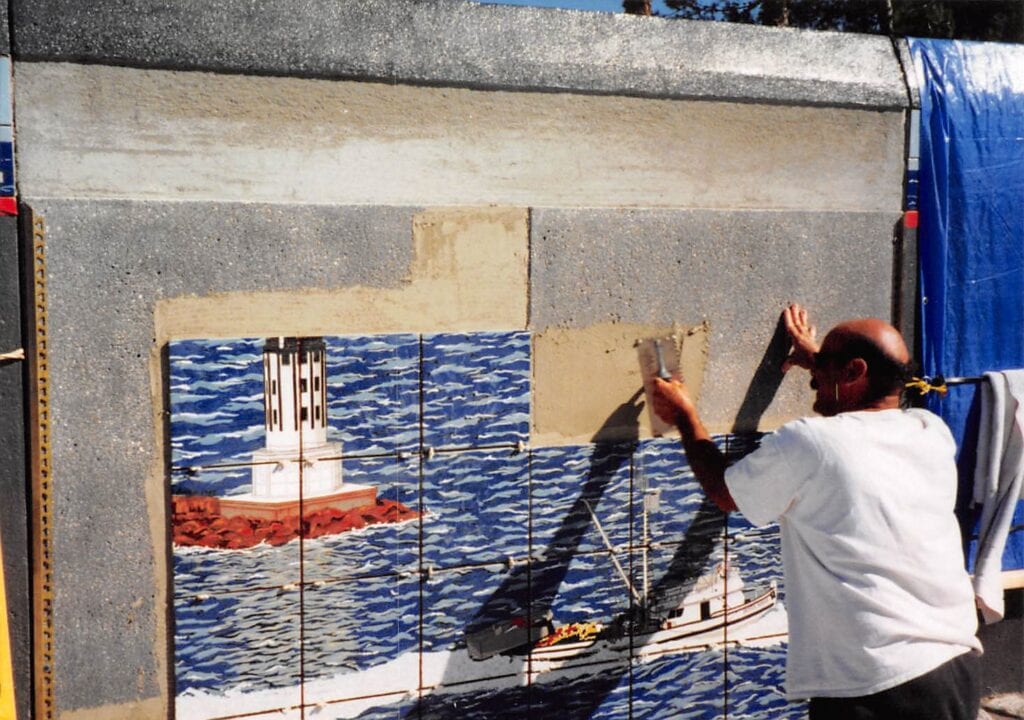
In early 2023, the Port of Los Angeles called: The lighting was broken. Over 20 fixtures had to be replaced, concrete torn up and redone. A worker noticed the mural—originally a creation of artist Petra Lefeber—separating from the wall. Pielago brought in a craftsman, Frank Scotti, who took it down tile by tile, cleaned each one, and remounted it. By the time the work finished, the memorial looked better than it had in years.
Then, driving past a month later, she saw four plaques missing. She pulled over and photographed everything still there. Within two months, 23 of the 27 plaques were gone.

“I kick myself,” Pielago says. “Did I just draw attention to it [with the improvements]?” But the theft wasn’t personal. Coming out of COVID, metal prices had spiked. Cemeteries across Southern California were being hit.
The Merchant Marine memorial down Harbor Boulevard lost plaques too, though no one noticed until Pielago pointed it out. Arrests were made eventually. The thieves probably got a few dollars per pound. The plaques reading “Fishermen Lost at Sea” ended up in a smelter somewhere.
Pielago never considered not rebuilding. The question was how. Bronze was out—too expensive, too stealable. She studied memorials: the 9/11 site, the National Mall. Everything was engraved stone. Granite couldn’t be pried off and sold. It cost an eighth of what bronze would. When the first six went up, “they just popped,” she says. “This is what’s meant to be.”
The Port granted funds to replace 19 plaques, the number stolen when Pielago applied in early 2024. By the time the grant came through a year later, four more had been taken. She started fundraising through the Dalmatian-American Club, the Croatian Hall, the Sons of Ischia, among others—groups whose members were descendants of fishermen. She created a patron plaque for donors giving between $2,500 and $10,000. Eleven families have signed on to date, many dedicating their lines “in honor of” family members who fished.

The work is unending. There’s a 501(c)(3) to maintain, tax returns to file, grant applications to complete. Her husband’s a CPA; he helps. Eight plaques are in production now, though five came back wrong and had to be redone. Pielago, who has a day job in her husband’s accounting office, checks every letter against her photographs. The original memorial records are a fragmented puzzle, forcing Pielago to squint at her phone’s digital archive, cross-referencing 27 plaques of names, one by one, to ensure a relative’s legacy isn’t lost to a typo.

She gets emotional talking about it. Her mother Marie, her aunts Eva and Jean, her grandfather who started fishing out of Bellingham before coming to San Pedro in the 1920s—their names were on those walls. Her brother fished commercially; he’s on the memorial. Her brother-in-law, many of her father’s uncles and cousins—all there. “Those people worked countless hours,” she says. “Their sacrifice produced our town.”
She remembers driving out with her sister to a point at the end of the docks where you could see boats coming through the breakwater. The wives and families would wait. The men had been gone for weeks, sometimes months, down beyond Mexico with no way to call home. They didn’t come back until the hold was full.
Babies were born while fathers were at sea. Graduations were missed, First Communions. The boats would radio each other— “I got a full load, I’m coming in,” and somehow, word would reach shore. Families would drive down and wait. When the boat docked, they’d hold their men and hear the stories.
Some boats never came back.
The rededication ceremony is scheduled for April 25, 2026—27 years to the day after the original dedication. Pielago expects 250 people, though her gut says more. Families are coming from out of state. She’s starting at 9:30 a.m. so there’s time to gather, to reminisce, before the program begins at 11 a.m. Time for coffee and a light breakfast. A priest will bless the memorial. Surviving members of the original committee will sit in the front row. She’s working on photo boards showing the memorial’s construction in the 1990s, the empty wall after the theft, the new granite going up.
“It’s going to be a ‘family’ reunion,” she says. After the ceremony, she wants people to walk up the street to the restaurants in a downtown that exists, in large part, because of the fishing industry.
By then, 19 plaques should be up. The goal is to have all the stolen ones replaced by the end of 2026. People are still adding names—commercial fishermen who weren’t on the original memorial, and cannery workers. Two full plaques were dedicated to cannery workers. That’s been the biggest category of additions.
When it’s done, she plans to document everything: cross-references of every name, every plaque, every line. She’s thinking of giving it all to a local museum so there’s a permanent record. Her kids know the history, but institutions last longer than people.
Does she ever think about walking away? “Every day I feel like it’s overwhelming,” she says. “And then I’m reminded that how I feel doesn’t matter, that quitting’s not an option.”
Why doesn’t it matter?
“It’s my mom, my aunts, my town, my family. Everybody’s family. When you go out in San Pedro, you carry your family name with you. This town is based on families. That memorial is based on our families. You go by your name, and your pride comes by your name. That’s what’s on that memorial—our family names. That’s what has to be rebuilt.”
When she hits a roadblock, she looks up. “I need help,” she says out loud, and something shifts. Finding the original graphic artist from 1997 happened through Councilman Tim McOsker’s office—someone at a meeting mentioned the memorial, and Heather Lawson of Blue Engravers, who’d created the original plaques, walked up and offered to help with the granite versions. An attorney helped Pielago set up the new nonprofit. Every time she throws her hands up, something comes together. “Divine intervention,” she says. “I know my family’s watching me. I know they’re proud.”
The most rewarding part is the emails. Someone writes: Is my grandfather up there? And she can write back: That plaque just got replaced. Your family’s name is coming back.
A name on granite doesn’t seem like much. But Pielago has taken her kids down there and pointed to her grandfather’s name and shown them pictures of the fishing boat. “That was his boat,” she tells them. “He built that boat.” When the plaques were stolen, people wrote to Pielago: We took our grandson there to show him his great-grandfather’s name, and it was ripped off the wall. It was their pride being ripped off.
On Saturday, April 25, the names go back up. Not all of them—some will take longer—but enough. Enough for the families to gather, enough to bless, enough to start again. The granite won’t weather the way bronze did. It won’t get stolen. It will outlast everyone at the ceremony, outlast Pielago, outlast her kids. The fishermen it honors are nearly all gone now, and the industry with them, but the names remain. And in San Pedro, names matter. spt
The rededication ceremony for the Fishing Industry Memorial is Saturday, April 25, starting at 9:30 a.m. (program at 11 a.m.) at the memorial site on Harbor Blvd. (at 5th Street). For more info or to donate, contact Kris Pielago at kpielago@cox.net.

Aaron McKenzie is a director, photographer, and producer who has called San Pedro home since 2014. Whether he's exploring the town’s local history, its arts scene, economics, or maritime industries, Aaron’s writings for San Pedro Today are just his selfish excuse to learn about his fellow San Pedrans and this cool place we call home. Follow his adventures on Instagram at @aaronwmckenzie.




Share Your Comments