
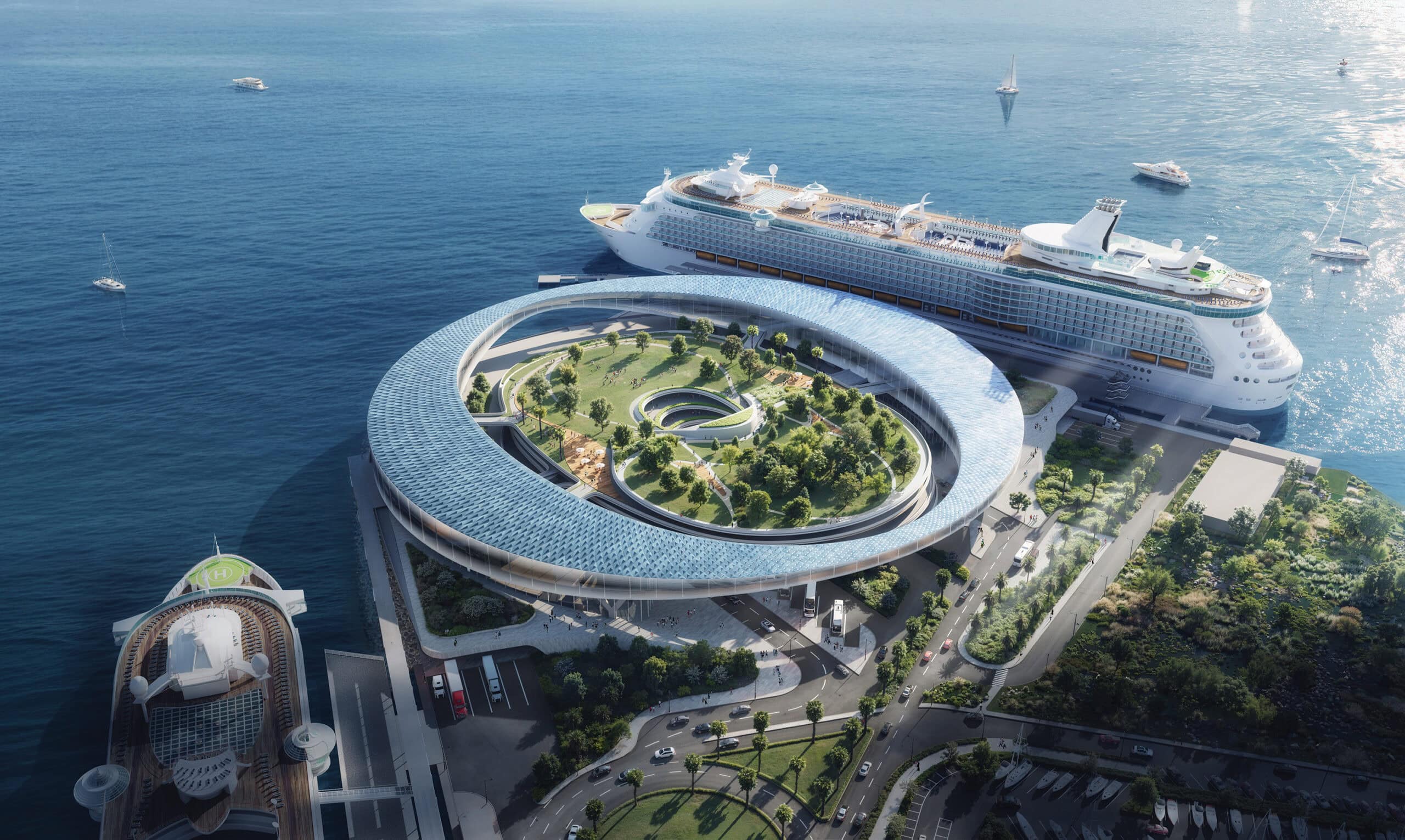
It’s estimated that every cruise ship visit to the Port of Los Angeles drops an average of $1.3 million into the local economy within a five-mile radius.
In 2025, POLA saw 241 cruise calls with a record 1.6 million passengers injecting over $303 million into the local economy. San Pedro is working hard to capture an even greater share.
America’s Port has always been a critical connection between the US and the rest of the world. A working waterfront that supports families, builds industries, and firmly powers Southern California’s economy. We’re used to containers stacked like Lego bricks and massive container ships moving in and out of San Pedro Bay, carrying 40 percent of the goods that keep our country running.
But now, new attention and focus are being directed to the end of the port’s 7,500 acres along our shoreline.
The Port of LA has selected Pacific Cruise Terminals to renovate our existing cruise terminal at Berths 92 and 93 and build an additional facility at Berth 46, aka, the Outer Harbor. PCT is a partnership between Carrix, North America’s leading cruise terminal operator, and JLC, which is led by LA’s own Magic Johnson. Together, they are moving forward with plans for a new, modernized cruise ship terminal designed to elevate the passenger experience while reinforcing our identity as a global gateway. And whether you’re a born-and-raised San Pedran or a transplant who just bought their first home here, this moment matters.
The Los Angeles World Cruise Center has long been one of the West Coast’s primary cruise hubs for Princess, Norwegian, Royal Caribbean, and Celebrity Cruises. But the cruise industry has evolved. Ships are larger. Travelers expect more. Ports compete for routes and itineraries. If San Pedro wants to stay in that conversation as an industry leader, we have to grow with it.
The proposed upgrades include modernized terminals, improved traffic flow, expanded passenger amenities, and infrastructure designed to handle next-generation cruise vessels. In practical terms, that means smoother embarkation days, less congestion, and a far more welcoming first impression for the millions of visitors who pass through our harbor each year.
And make no mistake, first impressions matter.
Cruise passengers don’t just board ships. They eat in our restaurants. They book hotel rooms. They shop in our stores. They will soon wander through West Harbor. They visit the Battleship USS Iowa Museum. They post photos of our coastline and tell friends about the place they discovered at the edge of Los Angeles.
A modern cruise terminal strengthens that ecosystem.
More sailings mean more foot traffic. More foot traffic means more opportunity for small businesses. More opportunity translates into jobs in hospitality, transportation, maintenance, and event programming.
For a community that has long balanced heavy industry with neighborhood charm, this is the kind of growth that promotes our “live, work, play” mission.
San Pedro is in the middle of one of the most significant waterfront transformations in its history. From new dining concepts to expanded public spaces, the harbor is slowly becoming more accessible, more experiential, and more connected to the community.
The cruise terminal project fits squarely into that broader picture. It’s not just about moving passengers. It’s about positioning San Pedro as a destination.
Growth can make people nervous, and that’s understandable. San Pedro isn’t trying to become something it’s not. We are not a polished resort town. We are a working harbor with grit, history, and soul.
The challenge and the opportunity require thoughtful development and infrastructure that serves both visitors and residents. Projects that enhance quality of life rather than overwhelm it. That’s why considerations for the final design include waterside observation decks that can be used for watching sailing competitions, as well as exploring flexible spaces that may allow for gatherings and convention-type activities when ships aren’t currently at berth. This announcement may encourage additional investment in hotels, both downtown and along the waterfront.
The cruise terminal expansion, if executed well, can strike that balance. Cleaner technology, smarter traffic design, and community engagement will be critical pieces of the puzzle.
Our parents and grandparents worked these docks. Generations have watched ships come and go from these bluffs. The harbor is part of our identity, not just our skyline.
The new cruise ship terminal isn’t just about tourism. It’s about momentum. It’s about San Pedro stepping confidently into its next era while honoring the one that built it.
Ships will continue to sail in and out of this port. The difference is that now, more of the world will step off those gangways and see what we’ve always known: San Pedro isn’t just a place you pass through. It’s a place worth spending time. spt

Lee Williams is a local real estate expert, community advocate, and harbor commissioner at the Port of LA. He believes in smart growth and investing in community, culture, art, and history. He can be reached at lee@lamove.com.





Share Your Comments