
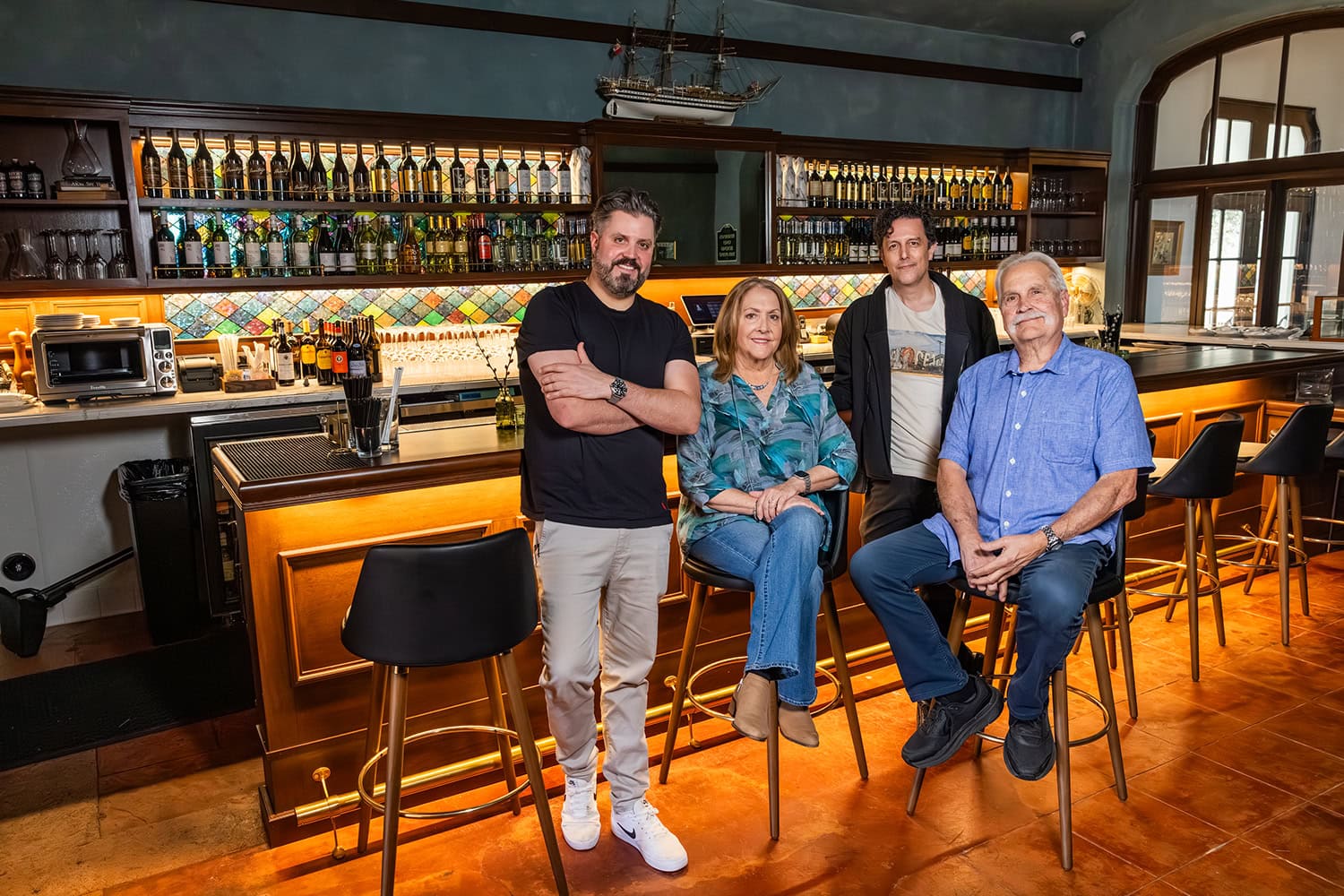
The marble tables arrived in San Pedro long before Dustin Trani did.
They came from the steam room downstairs, slabs of Carrara that had been part of this building since 1926, when it opened as the Army and Navy YMCA. Soldiers and sailors came here after their shifts to lift weights, to box and wrestle in the gymnasium, and to run laps on the sloped track that still hangs, shelf-like, above the basketball court.
Dustin’s great-grandfather Filippo knew this building. So did his grandfather Jim Sr. They worked out here, used the steam room, and walked these halls when the paint was fresh, San Pedro was younger, and the Vincent Thomas Bridge didn’t exist yet. Now Dustin stands in the same building, surrounded by those same marble slabs, fabricated into tables for a restaurant that carries a name his family hasn’t used in nearly 40 years: The Majestic.
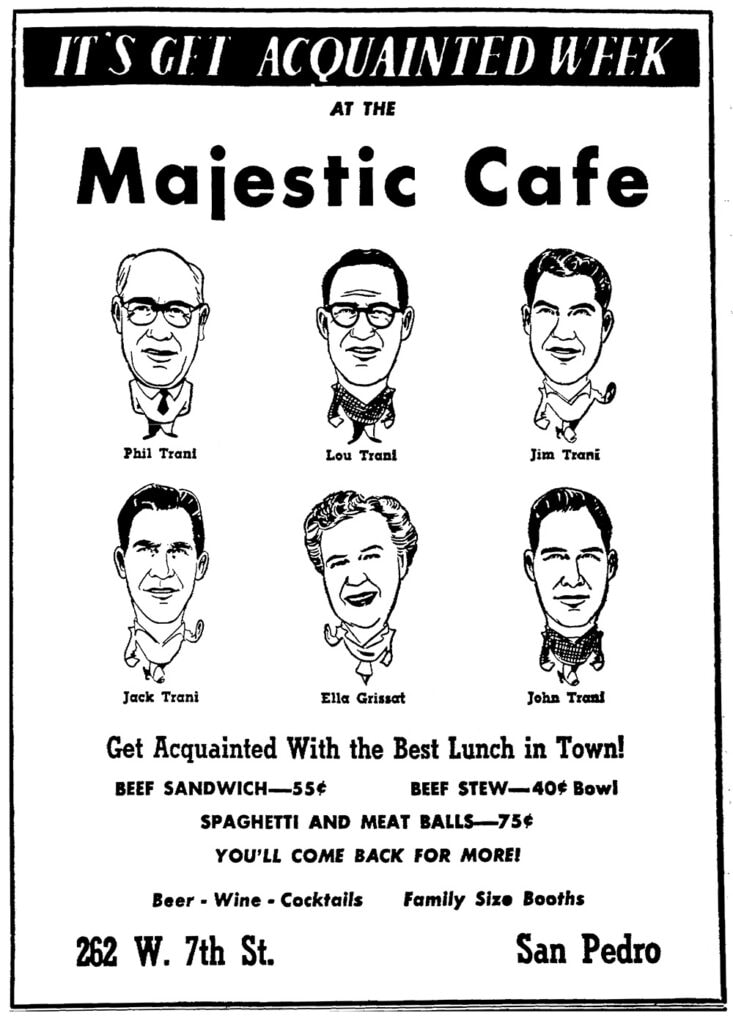
It’s early afternoon, a few hours before dinner service, and the dining room is empty except for the light coming through the tall windows that face the harbor. Dustin walks between tables, checking details—a table setting, the angle of a chair. He’s 41, fourth generation in a restaurant family that started in San Pedro in 1925, when Filippo Trani opened a pool hall a few blocks from here and served chili beans, beef stew, and wet beef sandwiches to men who’d just cashed their checks.
“The original Majestic was on Seventh Street,” Dustin says. “A dumpy little pool hall next to the check-cashing place. That’s what they started with.”
He pauses at one of the marble tables and runs his hand across the surface.
“These were in the steam room here. When they were renovating, the owner said, ‘What do we do with these?’ I said, ‘We’ll make them into tables.’”
A TOWN THAT’S ALWAYS WAITING
The history of The Majestic is also the history of waiting.
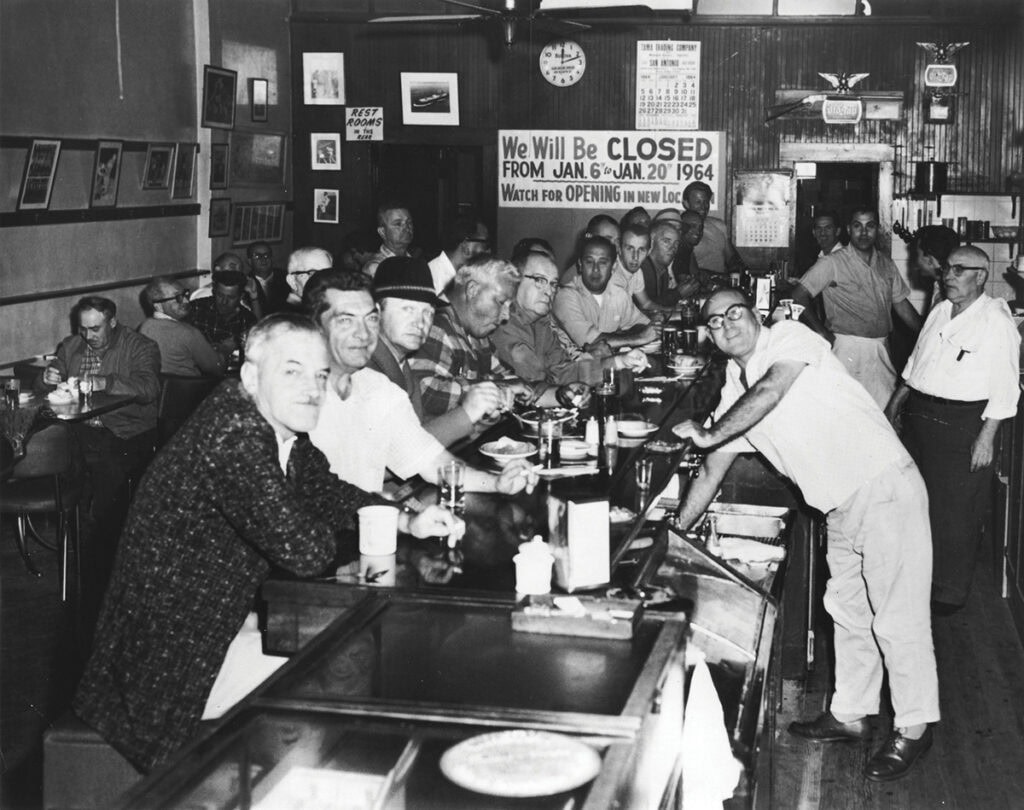
In 1925, Filippo Trani—an immigrant from Ischia who arrived via Ellis Island—opened his restaurant in Downtown San Pedro after a brief stint in Pennsylvania’s coal mines. He was part of a wave of Italians who settled here because the cliffs and the fishing reminded them of home. The pool hall wasn’t much, but it was his.
The name might have been painted on the door when he took over the place. Dustin isn’t sure. “Someone told me he called it The Majestic because it was ironic, like calling a dump a ‘palace.’ But I don’t know if that’s true.”
What’s true is that it worked. The restaurant grew. In 1964, they expanded. In 1974, the city approached Filippo with a proposal: move closer to the waterfront. The whole area was about to be redeveloped, they said. The new San Pedro waterfront was coming.
Fifty years later, it’s still coming.
“My dad remembers being told, ‘This is it, the waterfront is happening,’” Dustin says. “I remember being 21 in the early 2000s, looking at renderings of the [San Pedro] Public Market, thinking, ‘I’ll be 25 when this opens.’ I’m 41 now.”
All those years, while the town was busy waiting for its future, the building—known locally as the Harbor View House—was accumulating a history of its own. It was a Jay, Rogers, and Stevenson-designed Mediterranean Revival landmark that spent five decades as a state-run mental health facility, a long, quiet stretch of time before the Hillcrest Company arrived in 2018 to peel back the layers and find the 1926 bones underneath.
Dustin is sitting at a table near the stage (yes, there’s a stage; more on that in a moment), talking about how San Pedro isn’t a pass-through town, about how every decade, someone promises the waterfront is about to change, and every decade it doesn’t, until maybe now it finally is. West Harbor is taking shape.
The Majestic opened just before Christmas in a building overlooking West Harbor that required millions in restoration, with a vision that’s both reverent of the past and completely uninterested in being trapped by it.
INHERITANCE AND INDEPENDENCE
Dustin Trani became executive chef at J. Trani’s Ristorante when he was 18 years old.
It wasn’t nepotism; he earned the job. His grandfather Jim Sr. had been running the family kitchens since returning from World War II. His father, Jim Jr., loved the business—the architecture, the design, the building—but not the daily grind of the kitchen. When the opportunity came, Dustin took it.
“I’d been working there since I was 12,” he says. “Dishwasher, then pantry, then pizzas. At 18, I was already running the kitchen a few nights a week. When they said, ‘You want it?’ there was no doubt in my mind.”
He learned the basics from his grandfather and father: work ethic, attention to detail, and the difference between good enough and good. He learned that you don’t outsource, you make it yourself—the sausage, the bolognese, the breads. He learned that restaurants are built on consistency, and consistency is built on repetition, and repetition is only sustainable if you love it.
But there was something they couldn’t teach him.
“The biggest thing I had to learn on my own was that you don’t always have to do it yourself,” he says. “They gave me this incredible foundation—work hard, pay attention, do it right. But to be successful without killing yourself, you have to trust people. You have to teach them to do it as well as you, if not better.”
At 28, he got the chance to test that theory. An opportunity came to open a restaurant in Beverly Hills (Doma, in the Golden Triangle), and Dustin took it. Esquire took notice. Bravo came calling.
It also didn’t feel right.
“It didn’t feel like home,” he says. “I was going to move to LA, and I just couldn’t do it. I couldn’t leave San Pedro.”
He came back in 2016 and opened Trani’s Dockside Station in 2023, in the old immigration building (and former home to Canetti’s Seafood Grotto) at the corner of 22nd and Signal streets. And now this: The Majestic, in a building his ancestors knew, under a name that hasn’t existed in decades.
“When I saw this space,” he says, “I knew. This is The Majestic.”
TRADITION WITHOUT THE TRAP
The menu at The Majestic is an argument about memory, where dishes like linguini and clams nod to old-world originals, while the sea urchin with black ink pasta reflects Dustin’s time in Thailand and Michelin-starred kitchens.
“It’s about finding the balance,” he says. “Paying tribute to the past but not being trapped by it. You can still get the lasagna, the bolognese. But we’re also doing things nobody in my family would have done.”
His grandfather and father let him do this. After he came back from Thailand in 2007, inspired and restless, they gave him permission to change everything at J. Trani’s. New menu. New techniques. Asian influences. Square plates.
“If they’d said no,” Dustin says, “I probably wouldn’t be here. I’d have gone to work somewhere else.”
But they didn’t say no. They said: go.
His father, Jim Jr., remembers that decision. “All the old restaurants in this town–Olson’s, Papadakis, Louie’s—they all did the same thing every night, and they’re all gone,” he says. “The changes created a whole new clientele.”
It’s a small thing, that permission. But it’s also everything. Four generations in the restaurant business is rare. Four generations where each one is allowed to reinvent the work is rarer still.
“My grandfather was at the restaurant every morning until he was 85,” Dustin says. “Cleaning stoves, making soups. My dad’s 73, still making the bolognese, still making the sausage. That’s the work ethic. That’s what they taught me.”
He pauses.
“But they also taught me that it has to be mine.”
Dustin’s grandfather Jim Sr. died in 2013. Dustin never knew Filippo, who died five years before Dustin was born.
“I know my grandfather was proud of all his grandkids,” Dustin says, “but he wasn’t a big ‘attaboy’ guy. It was more like ‘You do the work, you prove yourself, you earn respect.’”
Dustin’s mother, Viki, agrees. “Knowing Jim Sr., he would just nod his head,” she says. “He would have tears in his eyes, and I think he would have been extremely happy.”
MORE THAN A DINING ROOM
The Majestic isn’t just a restaurant. It’s also a venue.
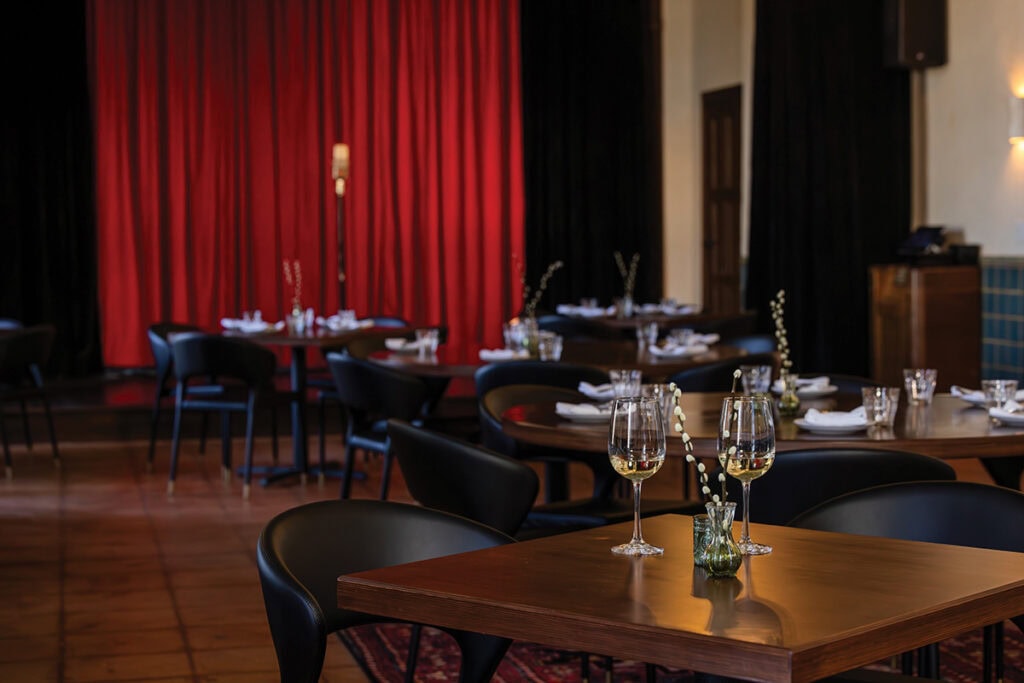
The dining room has a stage and a state-of-the-art sound system designed for live performance. The vision is unannounced acts—a comedian one night, a guitarist the next, another day a string quartet. Dustin and his business partner, KamranV, want The Majestic to become the kind of place where you never quite know what you’re going to get, where the surprise is part of the draw.
The curation philosophy draws from the building’s history. “When Bob Hope and Lucille Ball were entertaining the troops here, it may have been a comedian and a juggler or a musician,” KamranV says. “That variety spirit is how we decide what happens here.”
The bet is that food and performance together create something neither could alone: a reason to drive to the edge of Los Angeles, to a harbor town that’s always been a little out of the way, a little overlooked. The bet is that San Pedro is ready.
“San Pedro isn’t a pass-through town,” Dustin says. “It’s a destination. That’s been the problem, but it’s also the opportunity. If we give people a reason to come, they’ll come.”
NOT A REVIVAL—A REWRITING
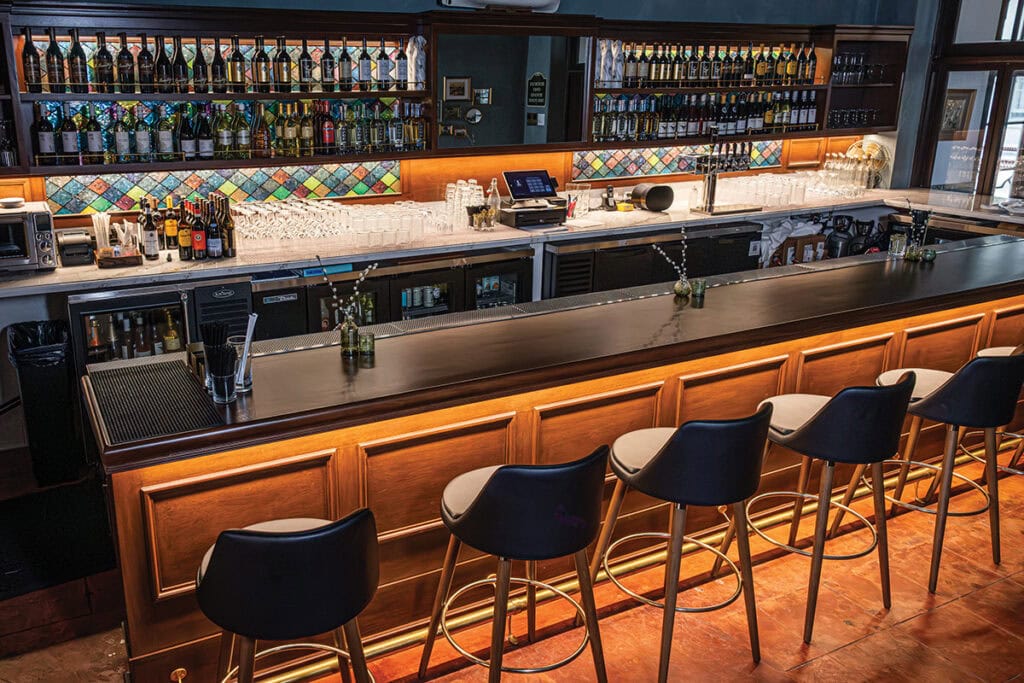
It’s a winter afternoon in The Majestic, and the light changes quickly. Dustin walks through the empty dining room, pointing out the building’s many original features. Those marble tables catch the late afternoon light. The harbor—the cranes, the ships, and the bridge that’s under construction, now always under construction—is visible through the windows.
The original Majestic served its last dinner in the late 1980s. When the relocated restaurant on Sixth Street closed (the space later housed the Green Onion), the name disappeared. The family moved on. Filippo was gone. Jim Jr. was running J. Trani’s. The pool hall became memory, then mythology, then a name that younger generations didn’t recognize.
And now it’s back, in a building Filippo and Jim Sr. knew, in a town that’s been waiting 50 years for its waterfront to arrive.
Across the courtyard, the restored gymnasium gleams with its polished floors and that original sloped running track around the upper perimeter. Downstairs, in the old boiler room, they’re building a speakeasy with a 30-foot library bar, vinyl records, and a password you’ll need to know.
But The Majestic is not a museum to a lost San Pedro. It’s a revision. A rewrite. The same name painted on a new door, the same family in a new kitchen, the same harbor outside, completely changed—all of it part of a new story taking shape.
The past, Dustin knows, isn’t something to be preserved under glass. It’s raw material. Steam-room marble you can eat off, and recipes you can argue with. In a town that’s been told for generations that its future is “coming soon,” The Majestic makes a quieter, more confident claim: The future is already here, built out of what survived. spt
The Majestic is located at 921 S. Beacon St. For more info, visit themajestic.la.

Aaron McKenzie is a director, photographer, and producer who has called San Pedro home since 2014. Whether he's exploring the town’s local history, its arts scene, economics, or maritime industries, Aaron’s writings for San Pedro Today are just his selfish excuse to learn about his fellow San Pedrans and this cool place we call home. Follow his adventures on Instagram at @aaronwmckenzie.




Share Your Comments