
Fran Siegel is a renowned San Pedro-based artist you may not have heard of unless you ride the Metro D extension or took her classes at Cal State Long Beach.
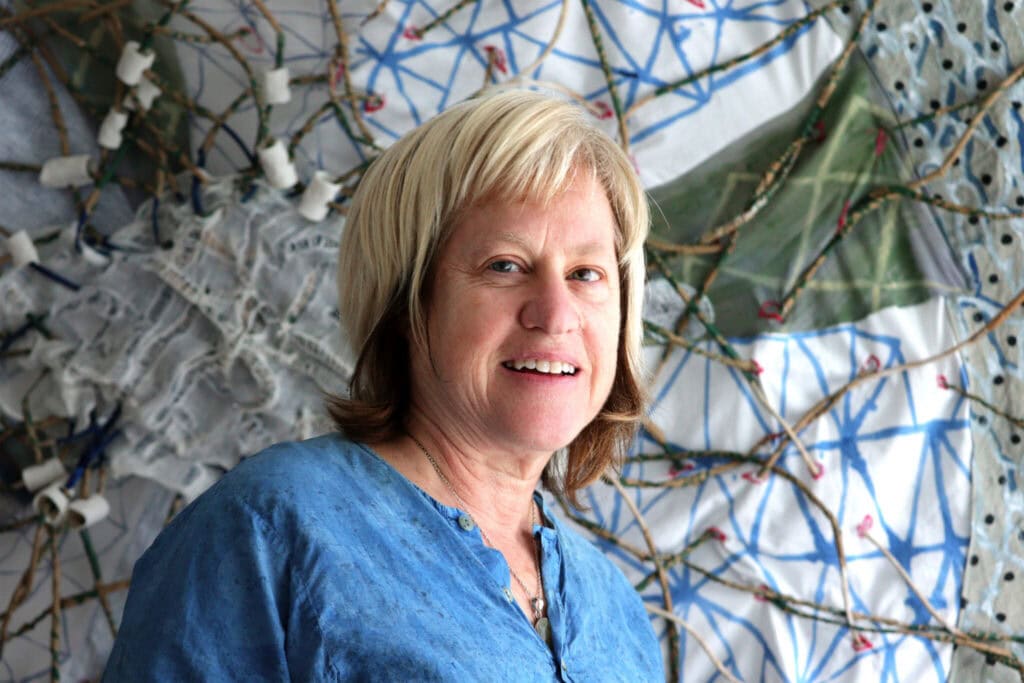
We first encountered each other during the pandemic, when she agreed to appear on a Zoom Armchair ArtWalk Tour.
Fran grew up on Long Island, earned her MFA at Yale in the late 1980s, and lived in Manhattan for 15 years before relocating to San Pedro in 2002.
Her drawings and installations are rooted in a deep curiosity about place, moving gracefully across landscapes, cultures, and materials. In her collaged tapestries, she stitches together many viewpoints, patterns, moments, and surfaces. Siegel’s work has found a home in public collections, including the Los Angeles County Museum of Art (LACMA), the LA Museum of Contemporary Art, the Art, Design & Architecture Museum at UCSB, and the Long Beach Museum of Art, among others.
She has received two Fulbright awards to conduct research in Brazil and Lisbon, Portugal, and her works have been featured in the Getty’s Pacific Standard Time exhibitions. I asked her about her work and inspiration:
Give us a brief history of the Metro project and how you won the commission?
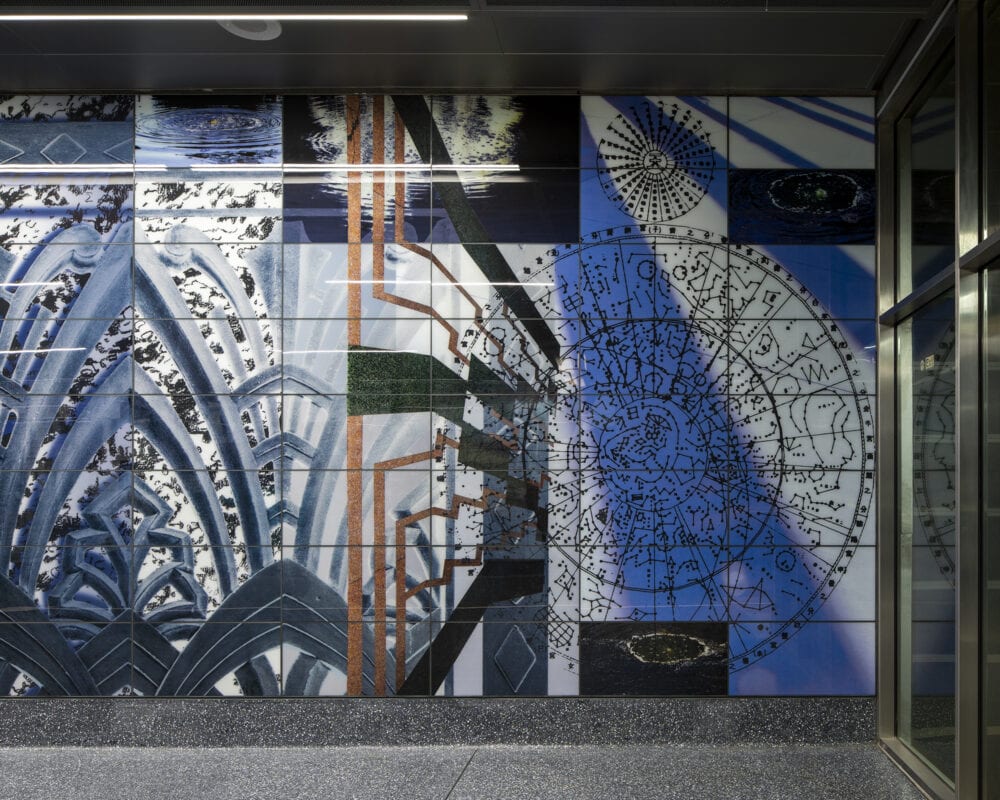
Fran Siegel: About 10 years ago, I was first contacted by Metro and invited to submit images of my work into a selection pool for upcoming stations. From that pool of over 1,000 artists, 27 were selected to submit proposals for the three Wilshire stations. In 2017, nine artists were awarded commissions for the La Cienega, Fairfax, and La Brea Metro stations.
My project became two glass-tiled murals for the La Brea concourse. Walking up and down Wilshire Boulevard to get a sense of the area, I was most interested in the fact that the grid of the city changes at Hoover from the Spanish colonial grid downtown to the east-west axis of Wilshire. This fascinated me as the path of the sun rises at one end of Wilshire and sets at the other. I started drawing, photographing, and combining images from these walks, which eventually evolved into the composition for Re: Orientation, the final work.
What is your advice for young artists?
Siegel: Be curious about the world. I think it is also very important for young artists to interact with other artists’ work and to go see as many exhibitions as they can to deeply engage in relevant dialogues. Sometimes I have noticed artists are less interested in the work of others yet hope for people to see their work. Be aware of who is curating what on a global scale.
Being an artist is a lifelong commitment to living outside the mainstream to survive. Our culture views art as a luxury and not an essential part of our humanity. For me, art is not a vocation about making and selling pretty pictures but learning and sharing. The work is just a byproduct of this. I feel it is important to step outside of your comfort zone and continuously challenge yourself.
What inspires you?
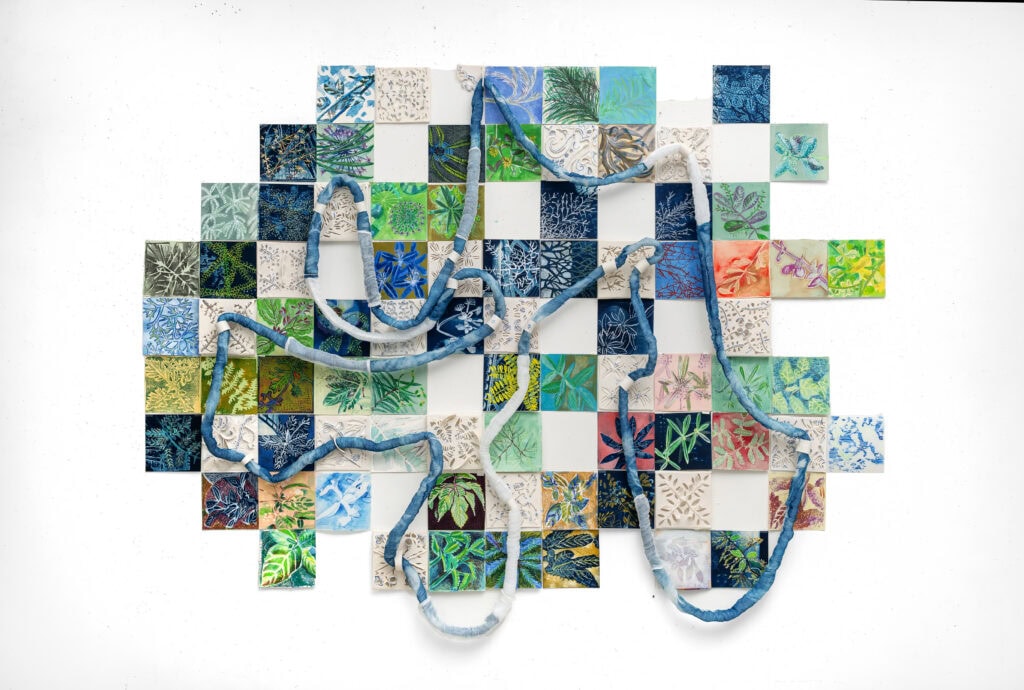
Siegel: Travel is my most important source of inspiration. I often begin projects on residency fellowships, which serve as catalysts for initial stages of research. My main interests relate to cultural histories passed from one location to another through trade or population movement.
For this reason, I am fascinated by plants that adapt from one climate to another (passing through geopolitical borders). And porcelain, which was historically an imperial power symbol and has been translated and transported from various cultures to others with modifications along the way.
What other projects do you have coming up?
Siegel: I just had a solo exhibition entitled Arrábida at Wilding Cran Gallery in Los Angeles. This body of work came from my Fulbright research in Portugal last year. I focused on intersections between local ecology and botanical motifs from azulejo tiles (a form of Iberian painted tin-glazed ceramic, insulating tilework) on the facades of buildings throughout Lisbon.
With the help of botanists and the gardens, I created an extensive index pairing designed patterns with natural plants. This work will be expanded further, and in 2027 I will have a solo exhibition in a very special project space at the Natural Science Museum in Lisbon.
To see more of Fran Siegel’s astonishing work, visit her website: fransiegel.com. spt

Linda Grimes is the executive director of the San Pedro Waterfront Arts District and can be reached at 55lindagrimes@gmail.com.






Share Your Comments