
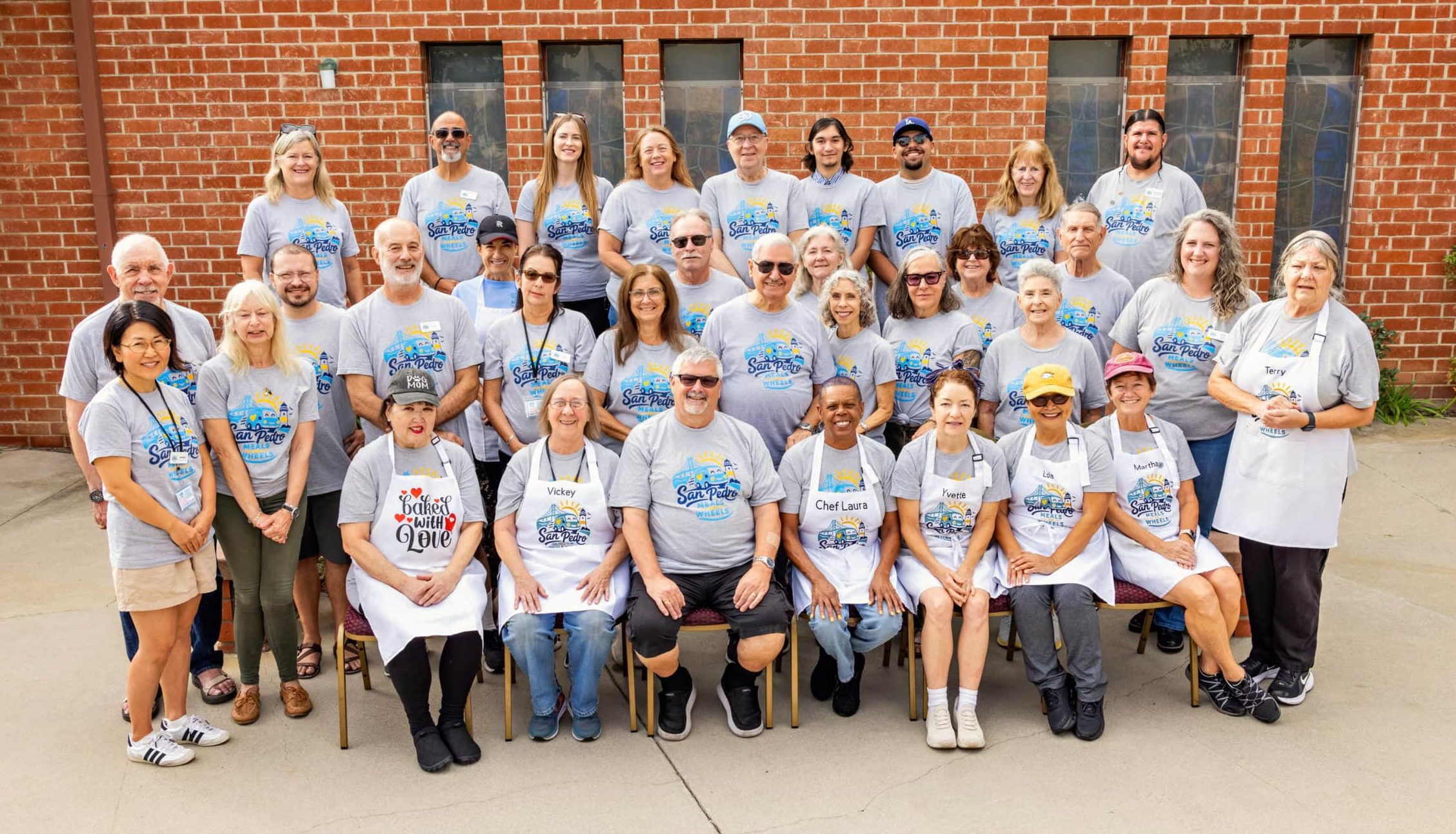
By 10:30 on a weekday morning, the kitchen at San Pedro’s First Presbyterian Church has already put in a full shift.
Chef Laura Clark has been there since 7, working the day’s entrée at her station in front of the oven. The kitchen volunteers arrived at 8:30 to chop donated carrots, roll meatballs by hand, and pack every hot dinner and sack lunch. Now the delivery volunteers are heading to their cars. Eight routes fan out across town, and the first doors get a knock by 11.

“They show up like it’s their job,” says Laura Avila, the board president, who is also serving as interim executive director while Mercedes Hernandez is on maternity leave.
That has been the formula since 1972, when five women from the church founded San Pedro Meals on Wheels. Today, it serves about 75 clients across San Pedro and Wilmington and, after years of serving only Rancho Palos Verdes, now covers the entire Palos Verdes Peninsula.
FROM THE FREEZER TO SCRATCH
Some 20 years ago, Mike Caccavalla answered a newspaper ad that read “interviewing for a cook,” with nothing but a phone number. Nobody called him back, so he kept calling for nearly a month. “It became a challenge,” he says. When he finally got the interview and walked into the church (“it didn’t fall down”), he got the job.
What he found was a beautiful kitchen used mostly to reheat frozen entrées. “I looked at the kitchen and said, ‘Why aren’t we cooking?’” So they started cooking from scratch, without added salt or preservatives, and he sent clients their first menu. Today, more and more of the vegetables are fresh, thanks to Community’s Child in Torrance and local growers like Green Girl Farms.
The food is diner-style, the comfort cooking clients grew up on: chicken tamales, fajitas, barbecue pork and beans. When store-bought meatballs came in too salty, the kitchen went back to making them by hand. Fish can be tricky sometimes. “It’s weird in this town,” Caccavalla laughs.
For $9.50 a day, clients get a hot dinner in a microwave-safe container and a sack lunch with a sandwich, salad, fruit and dessert. Most eat the dinner at midday and save the lunch for the evening. “They eat the heavier meal first, like in Europe,” he says.
Caccavalla retired from the kitchen in January but still comes in, now as a volunteer who won’t take a paycheck. “It’s two people now doing the job I used to do,” he says.

MORE THAN A MEAL
Some clients have just lost a spouse and have kids who live out of town. Some lost their driver’s license and then, little by little, the ability to cook. Others are recovering from surgery and need help for only a few weeks. Many clients pay full price, and some are donors. What they’re missing is someone close by. For many, the delivery volunteer is the only person they’ll see all day.
That makes the routes personal. Most delivery teams ride in pairs, often married couples or old friends, on the same route each week. When a regular calls in sick, clients will call to make sure their driver is ok. “I use the word client because I do the billing,” Caccavalla says. “They call them friends.”
He remembers a woman who asked whether her mother could get meals for a month or two. Her mother was 95, terminally ill and living up the hill “by the golf ball,” outside the service area at the time. The route volunteers agreed to make the climb. She stayed with the program for years, kept a standing Tuesday hair-and-nails appointment, and lived to 105. A group of volunteers attended her funeral.

CLOSING THE GAP
The program costs about $250,000 a year to run. Volunteers drive their own cars and pay for their own gas, and $9.50 still doesn’t cover the real cost of a meal. Grants, an annual appeal, loyal donors, and a lot of improvising make up the difference. “If we get a huge donation of cucumbers and tomatoes,” Avila says, “well, it looks like we’re having cucumber tomato salad.”
The community pitches in. The Garden Church hosts a fundraiser the Saturday before the Super Bowl, and The Wigwam donates its room for the program’s major annual fundraiser. Caccavalla once found a sealed bag of carrots at the church door with a note apologizing that it was all the giver could afford. That bag fed 60 people. “You might have saved us $5, $6,” he says. “But it’s $5 or $6 that we have.”
Avila estimates that one in five calls comes from someone who can’t afford the service. So this fall, the board reopened the Granted Program, which subsidized meals during COVID, when the caseload tripled. Anyone under 200 percent of the federal poverty level qualifies automatically, and others can qualify based on medical costs, housing costs, or isolation. Approved clients are guaranteed six months of meals. The board seeded the fund with $40,000 and hopes to sustain it at $80,000.
Caccavalla knows what happens when that money runs out. Years ago, when the fund ran dry, he and longtime board member Susan McKenna had to call clients and tell them their meals were ending. They kept the people who needed it most and found a way to make the numbers work, but he hasn’t forgotten that week. “Trust me,” he says, “Susan and I cried more than most of the clients.”
For Avila, the work comes down to the people around her. “You will not find more passionate volunteers anywhere than here,” she says. “They want to make sure no one falls through the cracks.”
WHAT COMES NEXT
The goal is at least 120 regular clients, and the kitchen and the 110-plus volunteers can already handle that many. Next year the program plans quarterly community lunches, complete with mahjong lessons, plus a friendly-visiting program for clients who can’t leave home.
Most of all, the people who run it want San Pedro to know it exists. “We’re here, we’re needed, so we have to grow,” Caccavalla says.
After two decades in that kitchen, he didn’t think anything there could surprise him. Then, not long ago, he complimented Mindee, an office assistant, on how warmly she greets the volunteers each morning, and she answered with a line he’d never heard.
“Mike,” she told him, “our kitchen volunteers are the meals, and these drivers are our wheels.” spt
To sign up for meals, volunteer or donate, including the $10-a-month Monthly Meal Maker program that feeds clients who can’t afford the service, call San Pedro Meals on Wheels at (310) 832-7335 or visit sanpedromealsonwheels.org.




Members only
Sign in to your member account to join the conversation.
Sign In Subscribe