
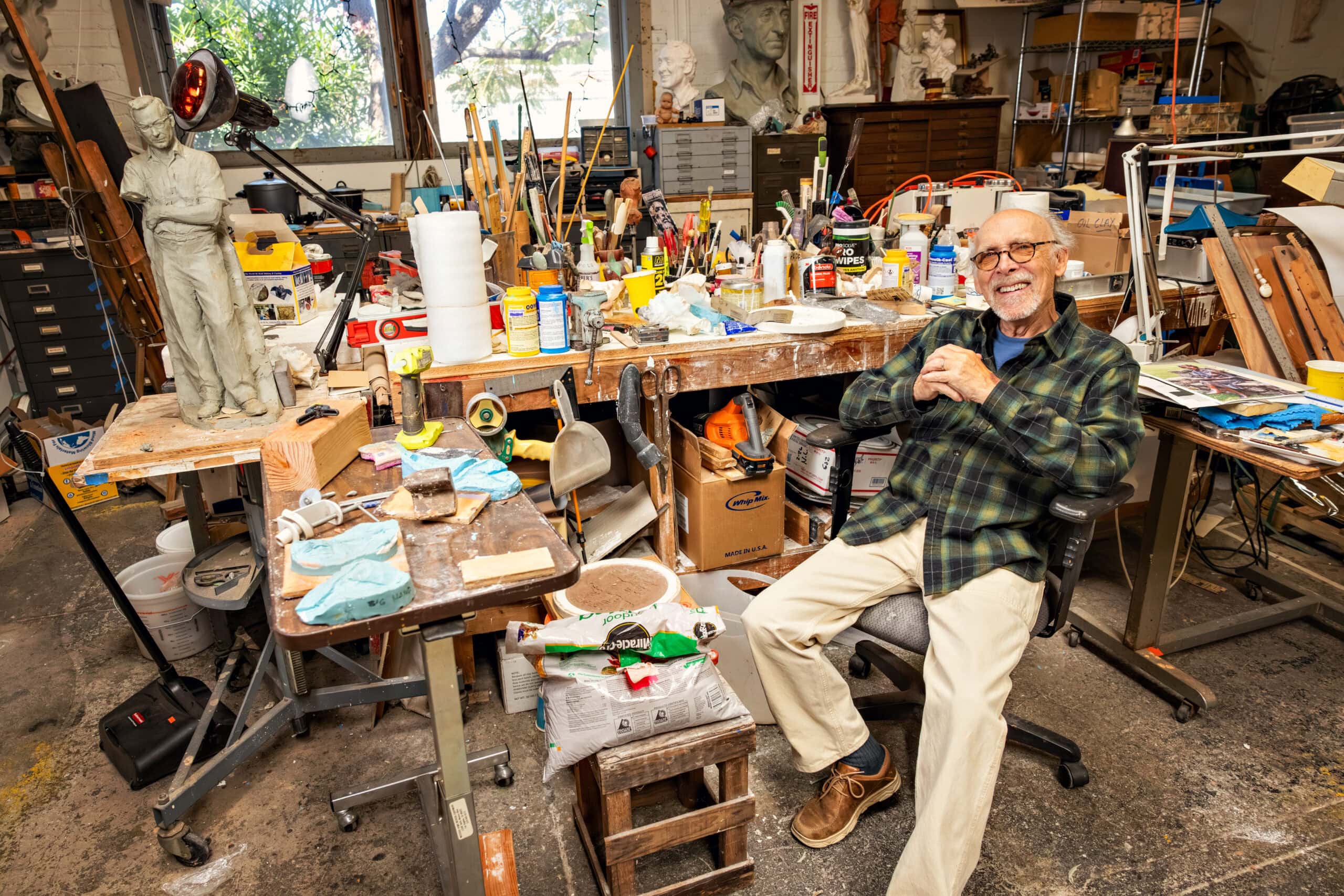
The first thing you notice about Eugene Daub’s studio is that there is no empty space.
Not a shelf, not a windowsill, not a corner of the floor that hasn’t been claimed by something: a small maquette of his Thomas Jefferson, a study head from the Joe Hill piece, the mockup figures from his Corps of Discovery group in Kansas City. In one corner sits the clay bust of Amelia Earhart, the one that didn’t win him the Capitol commission.
The studio occupies an old warehouse on the edge of San Pedro’s port district, and it has the feel of a place that has been continuously inhabited by someone who can’t stop making things—who can’t stop, period—who tried to retire and failed.
Daub, 83, has been a sculptor for roughly five decades. In that time, he has completed more than 40 major public monuments, and his work is held in the collections of the British Museum, the Smithsonian, and the Helsinki Art Museum. Most conspicuous among his achievements is a statue of Rosa Parks in the National Statuary Hall of the United States Capitol. But his work hasn’t stayed confined to the world’s great institutions. A few miles from where we’re sitting stands his Harry Bridges monument on the waterfront. A Joe Hill plaque marks Fifth Street. A bronze Phineas Banning watches over the Banning’s Landing Community Center in Wilmington.
OBSESSED WITH SCULPTURE
Daub was born in Pottstown, Pennsylvania, in 1942. His father died young, and Daub spent part of his childhood in an orphanage before finally leaving home for good at 15, a biographical detail that tends to reframe everything that follows.
A War Orphans Benefit grant paid his way through hairdressing college, a faster way out of minimum-wage work than anything else on offer. He turned out to have a knack for it: the 1960s hairstyles were big and sculptural, and styling them was, in its own way, his first sculpture job.
He moonlighted at mortuaries, too, preparing the deceased for open-casket viewings, to pay his way through graphic design school in Pittsburgh. From there, he climbed through entry-level design jobs until he co-founded his own ad agency in Pittsburgh. By his mid-30s, he was doing well enough. He was also, he says, completely consumed by a feeling he couldn’t explain.

“I just became obsessed with sculpture,” says Daub. “I don’t know where it came from. I’d never sculpted anything. I didn’t have any education. I didn’t know how to do it.”
He left the agency and moved his family to Gainesville, Florida, where he took a job at the University of Florida for three dollars an hour. With four children, he couldn’t keep that job for long. He returned to advertising temporarily, certain he had miscalculated something. Then his brother called from Philadelphia with a tip: the Franklin Mint was looking for sculptors.
Daub flew up, completed three sample pieces, and was hired. What happened next surprised him. The Franklin Mint specialized in commemorative art and American history: medals and coins depicting Revolutionary War heroes, scientists, politicians, and Renaissance painters. Every piece required research. Every figure had to be historically accurate down to the buttons on a waistcoat, because the collectors, Daub learned, came at these things with magnifying glasses.
“I spent as much time in the library as I did making sculpture,” he says, “and the love of history just never left me.”
This is, in retrospect, the hinge on which his entire career turns. The Franklin Mint job was, as Daub puts it, the eye of a needle, an almost impossible point of entry into sculpture for someone with no background in it. The job didn’t just lead him to sculpture; it inculcated him in it, enabled him to earn a living from it, and introduced him to a whole world of other sculptors he otherwise would never have met. He had left high school in the tenth grade. The Franklin Mint’s research library became, as he puts it, his university.
THE LESS OBVIOUS APPROACH
The question of what research offers a sculptor that intuition can’t is one Daub thinks about seriously. A photograph can give you a likeness, he explains. It cannot give you a person.

For his Rosa Parks statue, which now stands in the United States Capitol, he needed to understand not only what Rosa Parks looked like but also what she meant. And what she meant had, over the decades since 1955, grown into something that resists easy representation.
“You could do a seated Rosa on a bus,” he says. “That’s what she’s known for. And most of the proposed designs probably did just that—her sitting in a bus seat.” For Daub, the obvious approach is nearly always the wrong one. “You want to make sitting about something bigger than just that bus seat.”
The solution he arrived at was a figure emerging from stone, immovable, as if she had always been there and always would be. It is, he says, about psychological presence. “It could be in their body language, could be in their gaze. There are any number of things. You hope you’ve captured some kind of psychological context that people will connect with.”
This is the animating tension in his work: the distance between a historical figure and the myth that figure becomes. Daub points out that Harvey Milk was photographed laughing in nearly every picture ever taken of him. You start there. You start with what made the person real, and then you try to build outward to what made them matter.
Daub arrived in California at 50, initially landing in Berkeley (“everybody was doing interesting things, and nothing was too unusual,” he says, and you can still hear the excitement in his voice) before moving to Alameda, where his career finally caught fire.
In 1995, his Corps of Discovery sculpture in Kansas City—a full-scale bronze group depicting Lewis and Clark, York, and Sacagawea—became what he calls his biggest break. The religious commissions followed. By the late 1990s, he was a sculptor with a national practice and a life that had pulled him decisively west.
PORTRAITS, MEDALS, AND MONUMENTS
San Pedro entered the picture through love. Daub met Anne Olsen, a designer at Mattel, on a blind date arranged by mutual friends. He was living in Sonoma County at the time, while she was in Los Angeles. It wasn’t a difficult decision. He sold the house and moved south. The couple married within six months and, in 2001, bought the warehouse in San Pedro, drawn by the space and light the building offered and, he admits without embarrassment, its price.

The neighborhood itself didn’t immediately enchant him. “We weren’t crazy about San Pedro at the time,” he says. “It felt a little rough.” What changed wasn’t the neighborhood so much as the community of artists he found there. Daub is the first to acknowledge that figurative sculpture isn’t the current fashion. “I’m kind of a dinosaur,” he says without apology. “Not many people do figurative art anymore.” What he discovered in San Pedro was that it didn’t seem to matter. His neighbors—painters, photographers, sculptors, writers—accepted him on his own terms. “They don’t treat me like an old classical relic stuck in the last century,” he says, smiling. “Even though a few probably thought it.”

This year, Daub has published Portraits, Medals, and Monuments, a 177-page retrospective spanning five decades of his career, featuring more than 200 photographs and a biography by Wolfgang Mabry. In his words, it is a record, something his children can point to when they try to explain what he has been doing all these years in that warehouse. “My kids will say, ‘Yeah, dad did something down in San Diego somewhere, or I think he’s got something in Alabama,’” he says. “And now here’s this book. It’s all there.”
The book exists because a group of San Pedro friends, led by Adolfo Nodal, decided it should. Daub still sounds a little stunned by it. “He was my angel,” he says. “He inspired me to do the book, helped me, and gathered a team.” For a man with five decades of work scattered across the country, having friends assemble it into something he could hold felt less like a reckoning than a gift.
What it gave Daub, in addition, was something more practical: control over how the work would finally be seen. “It just felt really good to have it all documented so well,” he says. People often photograph sculpture poorly, he explains—bad lighting, awkward angles, work you end up ashamed of. A book let him choose. For a man who left school in the tenth grade and built his education from library stacks at the Franklin Mint, there’s a tidy logic to where it landed. “Books have always saved me,” he says.
Obsession like Daub’s rarely comes free, however, and he doesn’t pretend otherwise. When his kids were growing up, he tried to bring them into his world rather than disappear into it, taking them along on jobs, letting them get dirty in the studio, and making things out of clay. One studio even had a conveyor belt the kids would ride like a carnival ride. But long stretches still passed with their father gone, working.
“You get busy,” he says. “This project comes in, another project comes in. Before you know it, your whole life is blocked out.” As much as it is a catalog of his successes, the book is also a reminder of the trade-offs that underlie artistic ambition.
That life is still very much in motion, and the studio holds it all at once, the joy and the sacrifice. On the walls: decades of history made physical, figures drawn from books and archives and rendered in clay and plaster. On the worktable: new projects. A monument to Lori Cannon, an AIDS activist who nursed and fed the dying during the epidemic’s earliest, most brutal years. A figure of Romayne Martin, remembered locally as a founder of the Malaga Cove Library.
He tried to retire a year ago, but work kept coming in. He couldn’t say no. “I just love to make sculpture,” he says. “I love faces and figures. Even if they didn’t pay me, I’d just be doing this anyway.” spt
For more info on Eugene Daub and to purchase Portraits, Medals, and Monuments, visit eugenedaub.com.
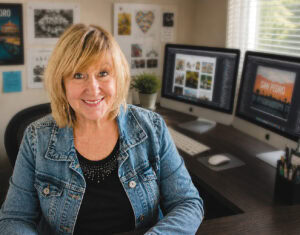
Aaron McKenzie is a director, photographer, and producer who has called San Pedro home since 2014. Whether he's exploring the town’s local history, its arts scene, economics, or maritime industries, Aaron’s writings for San Pedro Today are just his selfish excuse to learn about his fellow San Pedrans and this cool place we call home. Follow his adventures on Instagram at @aaronwmckenzie.


Share Your Comments