
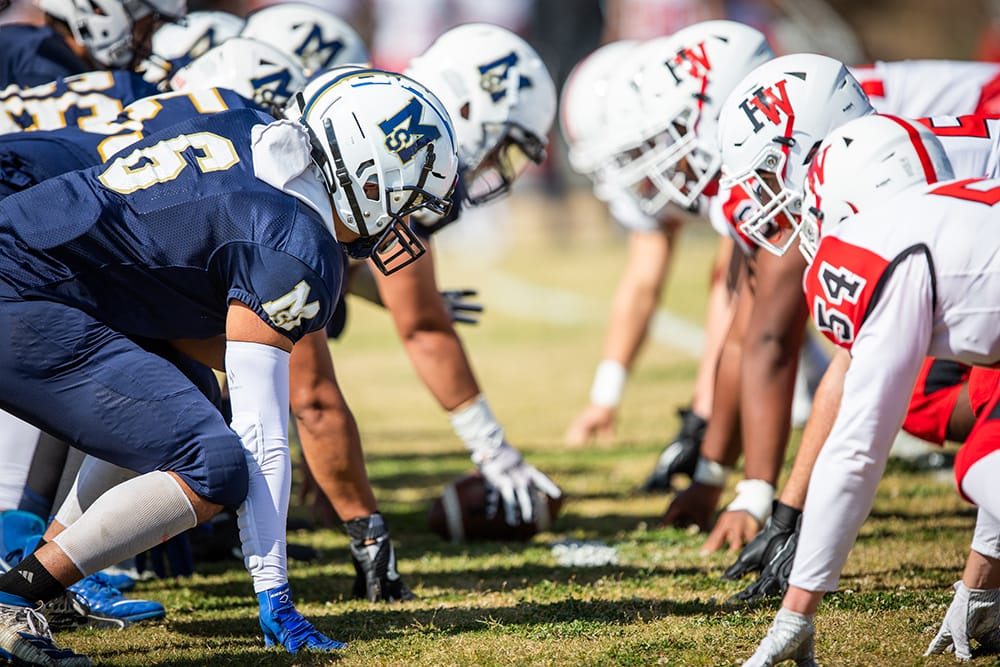
A new school year brings a fresh season for San Pedro’s high school athletes.
Whether it’s football, volleyball, soccer, cross country, or another sport, three qualities distinguish good athletes from great ones: speed, agility, and staying injury-free. At Physical Therapy San Pedro, we help athletes develop all three. Here’s what every student-athlete should know.
SPEED IS A SKILL
Most athletes believe speed is innate, but the truth is speed can be developed. Fast athletes run efficiently, and it all begins with mechanics. Your arm drive sets the pace for your legs, stability in the core and hips generates power in your stride, and the posterior chain—glutes, hamstrings, and calves—serves as your engine. Drills like wall drives, resistance sprints, and ladder work improve technique and boost explosiveness. Remember: You can’t have fast feet without fast arms and a strong core.
AGILITY = CONTROL + INJURY PREVENTION
Agility isn’t just about being quick; it’s about how well you can stop, cut, and change direction under pressure. When athletes skip agility training, their risk of injury skyrockets. Safe and powerful agility comes from learning proper deceleration mechanics, practicing lateral movement to protect hips and knees, and running reactive drills with cones, lights, or partner cues to sharpen decision-making. If your body doesn’t know how to land or absorb force, it will eventually break down. Agility training builds control—and that control prevents injuries.
STRENGTH: THE FOUNDATION OF EVERY SPORT
No matter what sport you play, strength is your base. Without it, speed and agility fall apart. Foundational lifts and sport-specific exercises build power while reducing injury risk. Movements like Bulgarian split squats for single-leg stability, trap bar deadlifts for full-body power, and med ball rotational throws for core explosiveness create a solid training foundation. Strength training should always be combined with mobility and plyometrics, because strength without flexibility can quickly become a liability.
TRAINING THE BRAIN
Athletic performance isn’t just physical—it’s also neurological. The best athletes don’t only move fast; they think quickly. Incorporating neuro-based training enhances reaction time, coordination, and body awareness. Exercises—such as ladder drills combined with reaction balls, shadowing a partner’s movements, or responding to sound and light cues—challenge both the brain and the body. Train the mind to move fast, and train the body to move smart.
INJURY PREVENTION BUILT INTO TRAINING
Injury prevention isn’t an extra step—it’s the foundation of performance training. Every athlete should include dynamic warmups and cooldowns, hip mobility and core stability work, landing mechanics, safe deceleration practice, and recovery strategies like sleep, hydration, and proper fueling.
If you’re a high school athlete gearing up for the season, keep this in mind: Speed can be trained, not gifted; agility is control, not just quickness; strength is the foundation of performance; and injury prevention should be built into every workout. Train with purpose, and you’ll not only perform better—you’ll stay in the game longer. spt








Share Your Comments