

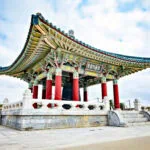
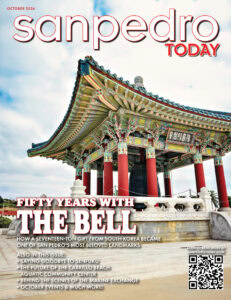
In 1976, the Republic of Korea cast a seventeen-ton bronze bell and sent it across the Pacific as a gift to the United States, a gesture marking the nation’s bicentennial and the friendship between the two countries.
It was a feat that hadn’t been attempted at that scale in more than a thousand years. The bell was modeled after South Korea’s Divine Bell of King Seongdeok, cast in 771 AD and still counted among the largest bells ever made.
Getting it here was its own undertaking. When the bell arrived at the Port of Los Angeles, it took two weeks to unload 28 cargo containers of materials. Korean stonemasons and carpenters worked fourteen-hour days to build the belfry, the platform, and the steps.
The bell had already sounded once, on the Fourth of July in Busan—rung in its homeland because it couldn’t reach San Pedro in time for the bicentennial itself. It wasn’t until October 3, 1976, some three months later, that the bell was formally dedicated and struck for the first time on American soil.
Ernest Lee was just a boy in Seoul at the time. He was thirteen when he immigrated to the U.S. a few years later. Only after he’d arrived, a recent transplant still finding his footing, did his parents bring him to San Pedro to see the bell. He turned a corner in an unassuming neighborhood and came upon an ocean view and a red-and-gold pavilion with writing he could actually read. He remembers the surprise of that, the pride of it.
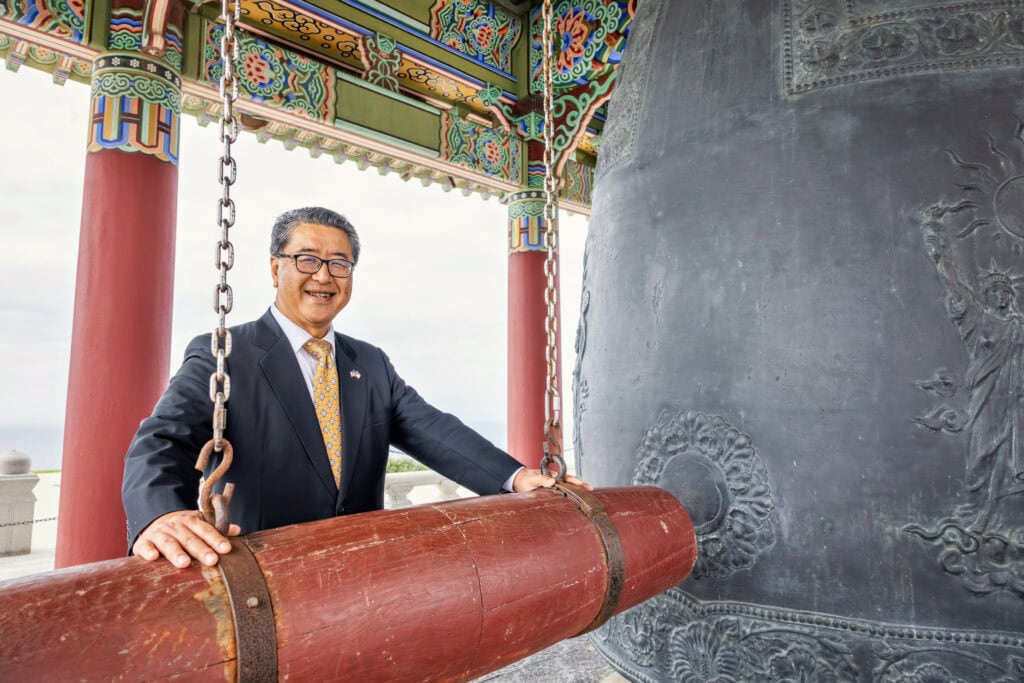
He didn’t think about the bell again for years. He grew up and became an American citizen. Then one day, as a grown man with children of his own, he brought his son to see it and found it in poor shape: the metal linkage was corroded, rebar was exposed, and no one could tell him whose job it was to fix it. It moved him more than he expected. “I felt a kinship to make sure that nothing bad would happen to it,” he told me.
That visit turned Lee into a caretaker, almost by accident. The city owned the land but lacked both the budget and the specialized skills required for a bronze bell and a hand-painted pavilion. Into that gap, Lee and a handful of others simply stepped. He is unpaid and disinclined to be the center of attention. He calls himself “a finger pointing at the moon,” his way of saying he’d rather people look at the bell than at him. Today he’s president of the Korean Friendship Bell Foundation, which was reorganized last year from the committee he helped start in 2006.
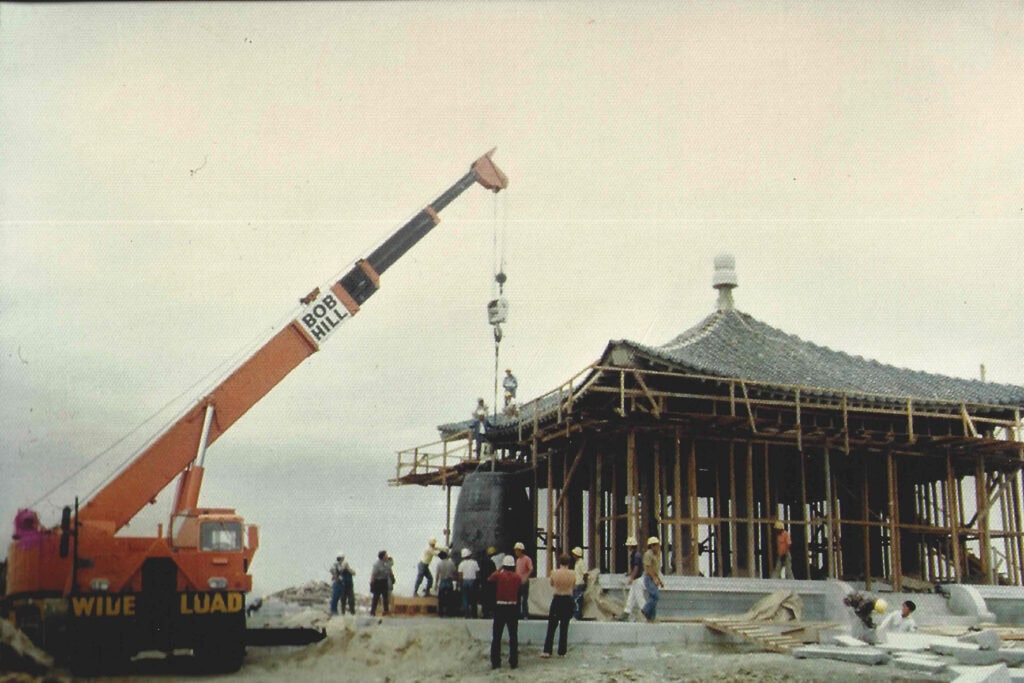
That the bell even lives in San Pedro at all is something of a historical accident. It nearly ended up on a mountaintop in Griffith Park instead, and, as Lee tells it, the deciding factor was the old name of the land on which it now resides: Fort MacArthur. The delegation in charge of choosing a site arrived assuming the honor was for General Douglas MacArthur, hero of the Incheon landing that turned the Korean War. What they learned was that the fort had actually been named for his father, Lt. Gen. Arthur MacArthur Jr., a general in his own right a generation earlier.
Rather than a letdown, the discovery seems to have sealed the deal: a Korean culture that takes ancestor reverence seriously found real meaning in a father-son lineage, with the elder MacArthur, in a sense, helping produce the son who later helped save their country. What’s more, if the search for a site had taken place a year earlier or a year later, the hilltop above Point Fermin would likely not have been available. “So many things,” Lee said, “just kind of fell into place, as if someone else had a hand in it.”
Unlike a church bell, the Korean Friendship Bell has no clapper. A suspended wooden log strikes the bronze from the outside, and the bell’s sculpted form, along with an acoustic reflector beneath it, helps produce its long, layered resonance. At ceremonial ringings, it is struck thirty-three times, a sequence Lee describes as moving outward in all directions before returning to the center. To him, the ringing is less a signal than a continuing prayer. In recent years, visitors have sometimes been invited to place a hand against the bell as it sounds, feeling the vibration travel through the bronze. “The human body itself is resonant,” Lee says.

Keeping the bell’s structure honest has required real detective work. The pavilion’s painted decoration, called dancheong, requires a small group of Korean artisans who can keep it authentic even as small details have quietly shifted over the decades: a tiger that once flanked a dragon in the artwork was eventually deemed a historical error and repainted as a second dragon.
A major restoration in 2013 required tracking down Chai Dong-hey, the last living apprentice of the bell’s original master caster, Kim Chul-oh, who by then was too old to travel. Kim has called the bell “his child that he sent away for adoption,” says Lee, and had spent decades wondering how it was doing.
Officially, the bell is rung five times a year, each date chosen for its meaning to one country or the other: January 13 for Korean American Day, July 4 for American Independence Day, August 15 for the Republic of Korea’s National Liberation Day, September 17 for Constitution Week, and December 31 on New Year’s Eve. Beyond those five occasions, it’s also rung on the first Saturday of every month in a maintenance ringing open to the public, giving visitors a standing chance to hear it year-round.
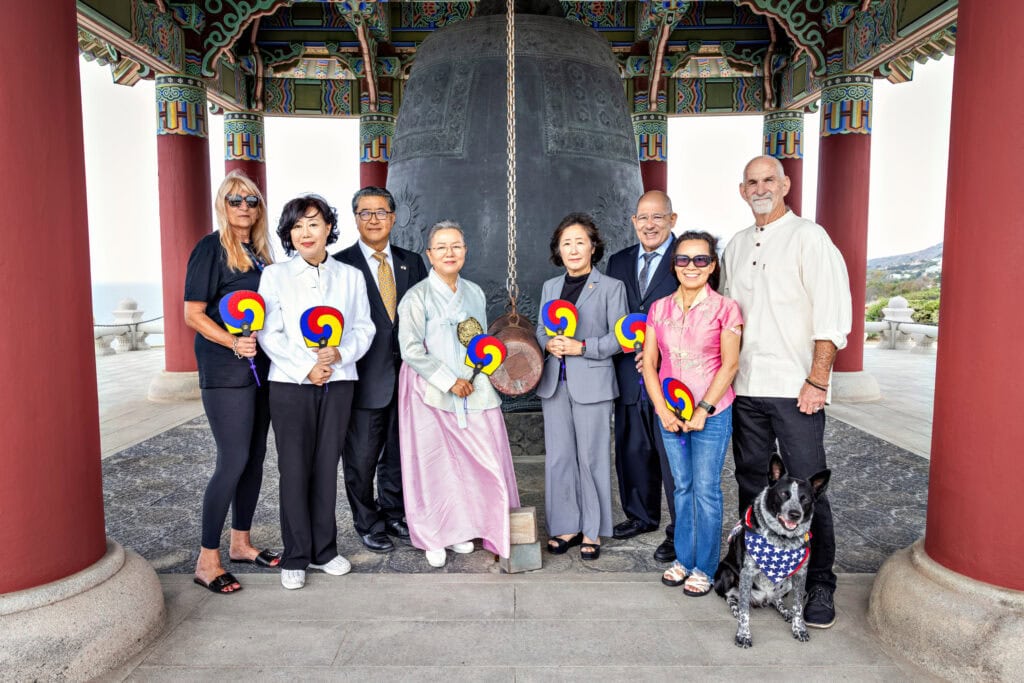
This October, though, marks fifty years since the bell’s dedication, a milestone Lee insists on calling a jubilee rather than a birthday, and one his team has been quietly marking since last December with a rotating series of small ceremonies rather than a single blowout event. The bell will be rung on-site on the anniversary itself, October 3rd. The larger public draw comes two weeks later, on October 17, with a 5K/10K run-walk paired with a K-pop concert. That event outgrew the park and has been moved to West Harbor, with a trolley shuttling visitors back up to the bell for a slate of anniversary activities.
The moment Lee comes back to most isn’t a ceremony, though; it’s a sentence. In his first year on the committee, John Olguin—for decades the closest thing San Pedro had to a town patriarch—pulled him aside after an early ringing. “You’re young enough that I can tell you,” Olguin said. “No matter what happens, you don’t go away. Promise me you will not leave the bell.” Lee said okay. Twenty years later, he’s still here. spt

Aaron McKenzie is a director, photographer, and producer who has called San Pedro home since 2014. Whether he's exploring the town’s local history, its arts scene, economics, or maritime industries, Aaron’s writings for San Pedro Today are just his selfish excuse to learn about his fellow San Pedrans and this cool place we call home. Follow his adventures on Instagram at @aaronwmckenzie.





Share Your Comments